

There’s a big difference between two sentences that sound almost the same.
I chipped a tooth.
My teeth are chipping.
The first is an event. Somebody bit a popcorn kernel, caught an elbow, opened a bottle they shouldn’t have. One tooth, one moment, and the answer is a repair.
The second is a pattern, and a pattern has a cause. If pieces are coming off more than one tooth, or off the same tooth repeatedly, or off teeth that have never been touched, then nothing has hit your mouth. Something has changed about the teeth themselves, and repairing the chips without finding out what just schedules the next one.
Almost everyone who searches this is in the second group. The plural is the whole clue.
Why do my teeth keep chipping? Because something is thinning or weakening the enamel faster than it should, usually acid, clenching, or both. Every tooth exposed to it reaches its breaking point at about the same time, which is why it seems to start suddenly. Repair the chips without finding the cause and they keep coming.
Enamel doesn’t chip because it’s weak
Enamel is the hardest substance your body makes. It’s also brittle, the way glass is brittle, and it depends entirely on what’s underneath it.
Think of a tile bonded to a floor. The tile is hard, and while the bed under it is solid the tile is fine. Undermine the bed and the tile cracks under a load it carried for years. Enamel behaves the same way. It’s supported by the softer dentin beneath it, and once that support thins or the enamel itself is undermined, the edge starts breaking off in pieces.
So chipping is almost never about the force. It’s about what the tooth had left to resist the force with. The bite you have now is the bite you had five years ago. Something in between changed.
Before a tooth chips, it goes see-through
Almost nobody is told to look for this, and it’s the stage where the fix is still cheap.
Hold your front teeth up to a light and look at the biting edges. If the last millimeter or two looks grayish, glassy, or slightly transparent compared with the rest of the tooth, that isn’t a stain and it isn’t the light.
That’s enamel thin enough to see through.
Enamel is naturally translucent and dentin isn’t. A healthy tooth reads as solid because there’s dentin behind the enamel all the way up. When the edge wears down past the point where dentin supports it, what’s left is a thin shell of enamel with nothing but air behind it, and light passes straight through.
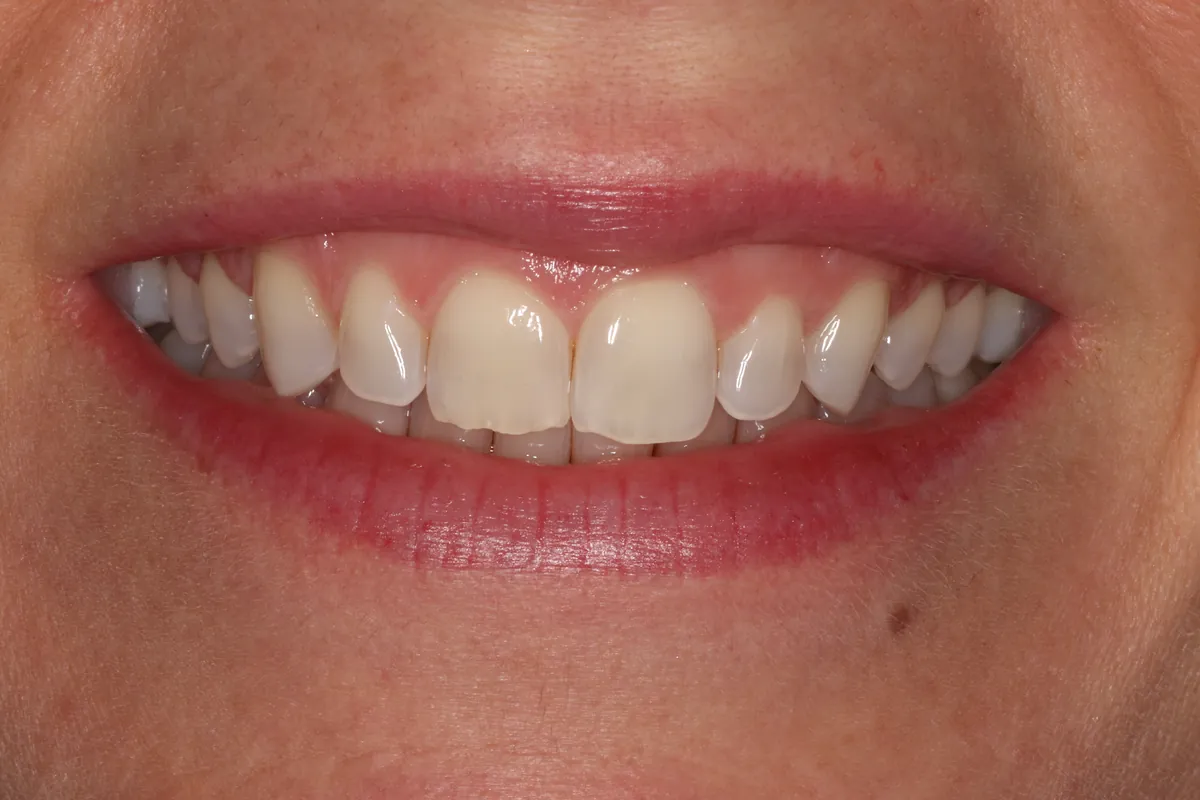
This is that stage, and notice how subtle it is. Compare the last millimeter of the two upper front teeth against the solid part above it: the edge reads slightly translucent rather than fully opaque. It’s easy to miss and easy to blame on the lighting, which is why it usually gets ignored until something breaks.
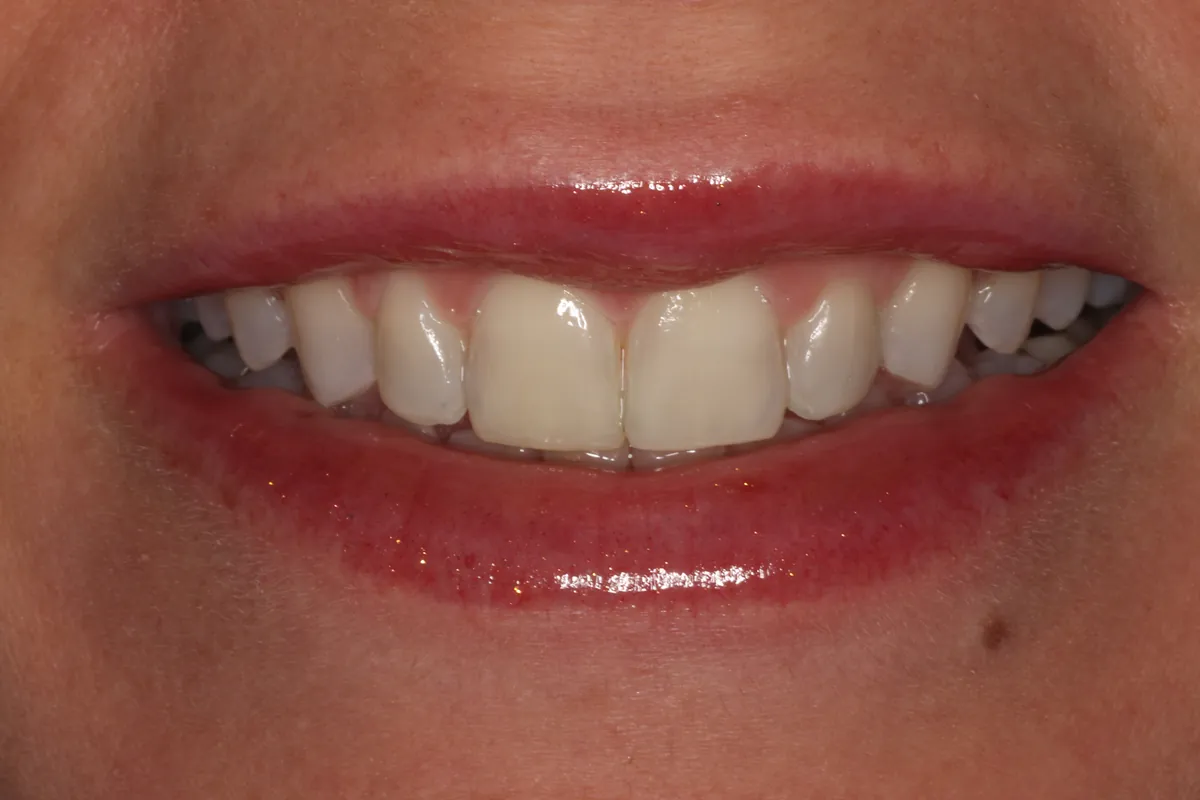
The same teeth afterward. Aligners moved them into position first and composite then rebuilt the edges, so not every difference here is the bonding. What matters for this page is the edges: back to full length, reading as solid tooth again, and no tooth structure removed to do it. Her full case is in the gallery.
Translucent edges and chipped edges are the same problem photographed at two different times. The see-through stage comes first, sometimes by years. The chipping starts when that unsupported shell finally gives way, and there’s a photograph of that further down this page.
People often notice the translucency and assume it’s cosmetic, or that their teeth are staining oddly. Then a corner breaks off and it feels like bad luck. It wasn’t bad luck. It was the next step.
Where they chip tells you a lot
Location is the most useful clue, because the three common sites have three different causes.
The biting edges of the front teeth
Small pieces breaking off the bottom edge of the upper or lower front teeth, often leaving a jagged or uneven line across several teeth.
This is the classic acid-plus-force combination. Acid softens the enamel, and then normal chewing and any clenching take material off far faster than they otherwise would. It’s the pattern we see most, and usually the person has no idea acid is involved at all.
Right at the gum line
A notch or a shelf where the tooth meets the gum, sometimes sharp enough to catch a fingernail, often on several teeth on the same side.
Enamel is at its thinnest here, so this area gives way first under almost any insult. Aggressive brushing with a stiff brush contributes, acid contributes, and there’s an argument that flexing of the tooth under a heavy bite contributes as well. That last one is debated, and we won’t call it settled. What isn’t debated is that these notches mean the surface is losing material, and that they get deeper if nothing changes.
Quick answer: Why are my teeth sensitive at the gum line?
The full article: Why Is There a Notch in My Tooth at the Gum Line?
The corners and cusps of the back teeth
A chunk breaking off a molar or premolar, frequently one that already carries a large filling.
This one is a different kind of problem, and it’s the one to take most seriously. A back tooth that loses a cusp is usually a tooth that was already cracked, or a tooth where so much structure has been replaced with filling material that the remaining walls couldn’t hold. The restorative cycle ends here more often than anywhere else.
A cracked back tooth can be lost, and where the crack runs decides it. A cusp that breaks off cleanly above the gum is usually restorable, often with a crown. A crack that travels down the root, or that extends below the gum and the bone around it, frequently isn’t, and that tooth comes out. The hard part is that you often can’t tell which one you have from the outside, and a crack that’s restorable today can become the other kind by continuing to flex under a bite.
That’s why we don’t tell people to watch a cracked back tooth. Watching is how a tooth that needed a crown becomes a tooth that needs replacing.
We had one recently that made the point better than any explanation does. The crack gave no symptoms at all. No pain, no sensitivity to cold, nothing the patient could have reported to anyone. It had already run the full length of the root, and the tooth had to come out.
That’s the uncomfortable truth about cracks. A tooth that hurts gets attention. A tooth that doesn’t hurt gets left alone, and whether a crack can be saved is decided by where it runs, not by whether it’s talking to you.
Quick answer: My dentist found a crack around a filling. It doesn’t hurt, so why is it a big deal?
Why it feels like it happened all at once
Almost everyone describes this as sudden. Nothing was wrong, and then in the space of a few months three things chipped.
The wear wasn’t sudden. The breaking point was.
Enamel thins gradually and silently, and nothing happens until the edge reaches the point where it can no longer support itself. Then it fails, and so do all the other edges that were thinning at the same rate. Several teeth crossing the same line within months of each other looks like a sudden event, but it’s the opposite. It means this has been going on for a long time, evenly, across your whole mouth.
The uniformity is the tell. An injury damages one tooth. A process damages the teeth that were exposed to it, which is usually a matching set.
If this started during pregnancy
This gets its own section because it’s common, it has a specific cause, and people are often embarrassed about it.
Morning sickness means stomach acid reaching the teeth, sometimes many times a day for weeks. Stomach acid is far stronger than anything you can drink, and repeated exposure softens and removes enamel quickly. Reflux is also more common in pregnancy for simple mechanical reasons. And dental visits often get postponed during and after a pregnancy, so a year can pass before anyone looks.
What to do: rinse with water afterward to clear the acid. There’s no need to rush to brush, and no need to wait an hour either. Brush on your usual schedule with a soft brush. A remineralizing product at night helps. And come in sooner rather than later. This phase ends, and the goal is to limit what it costs you before it does.
What’s actually behind it
The causes are the same handful that drive all tooth wear, and usually more than one is at work:
- Acid, from what you drink or from reflux you may not know you have. This is the one most often missed and the one that makes everything else worse.
- Clenching and grinding, including the daytime kind that no night guard reaches.
- A bite that concentrates force onto a few teeth instead of spreading it.
- Old dentistry, where large fillings have replaced enough structure that the remaining tooth can’t carry the load.
- Abrasion, from a stiff brush, heavy pressure, or an abrasive whitening paste.
The full story, including where the acid comes from and why so much of the damage happens overnight, is in why your teeth are wearing down. If your chipping is on the front edges, read that one next. If clenching is the likely driver, the clenching side is here.
What the next stage looks like
K.G. didn’t come to us about her front teeth. She came in for a back tooth that was giving her trouble. Once that was under control, a full exam found what had been happening to her front teeth in the meantime.
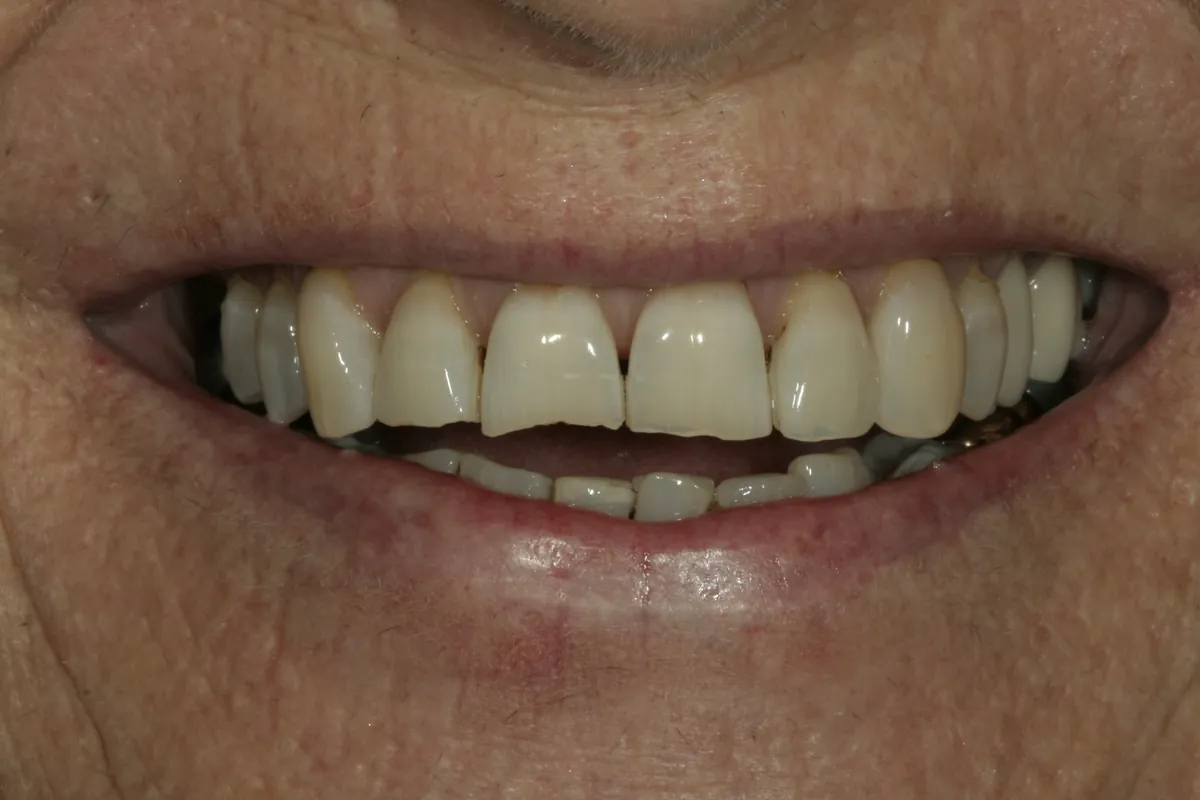
Before. The edges of the upper front teeth have broken back unevenly, which is the jagged line across several teeth described further up this page. The lower front edges have gone the same way. This is the stage after the see-through one.
We talked through ceramic veneers against composite bonding, and she chose bonding to rebuild the shape and length of the front four.
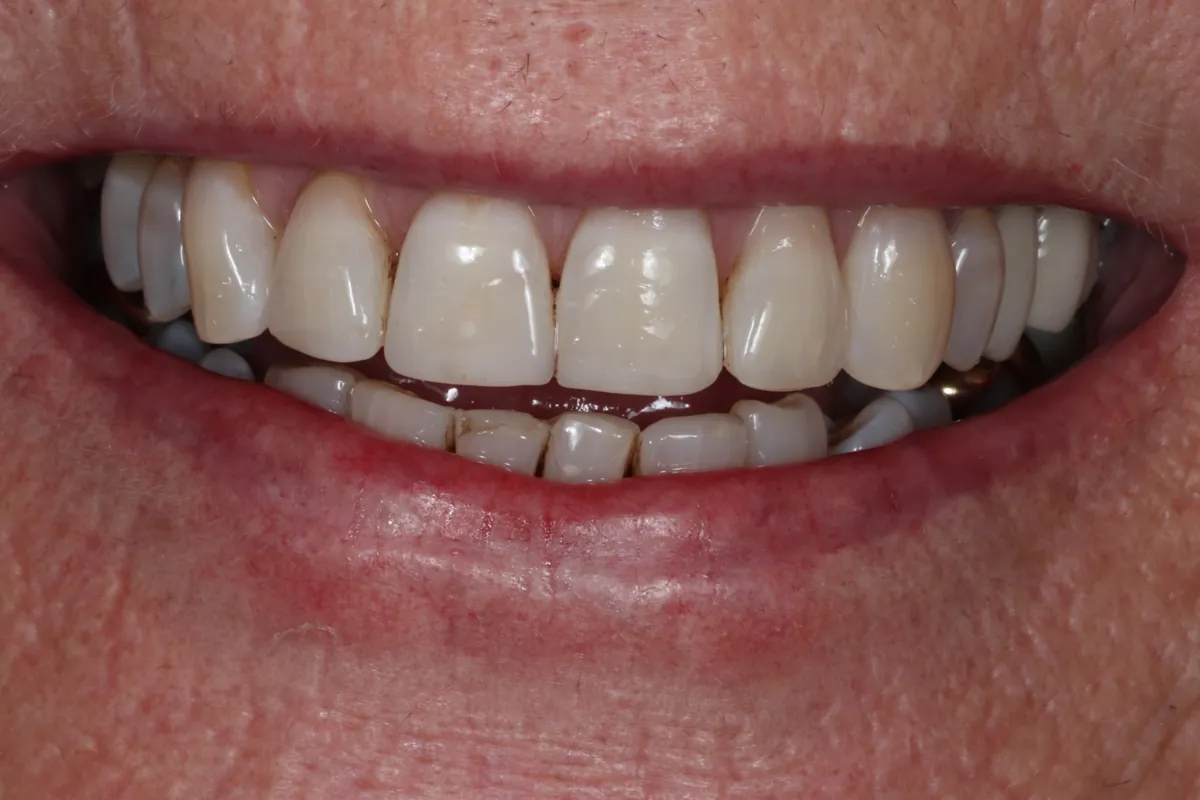
After. Shape and length rebuilt with composite, and no tooth structure removed to do it. Where enough sound tooth remains, that’s the conservative end of the options.
Notice that none of this is what brought her in. Chipping that happens slowly enough tends not to feel like a problem, right up until somebody puts a photograph in front of you.
What we would actually do
Work out which of those causes is at work, because repairing chips without knowing is how you end up doing this twice.
That means looking at where the chips are, what the wear pattern looks like on the surfaces you can’t see, whether the bite is loading a few teeth harder than the rest, and whether there’s acid in the picture from a source you haven’t connected to your teeth. Photographs and a 3D scan give us something to compare against later, which is how we find out whether what we changed actually worked.
Then repair, once the cause is under control. Often that’s bonding, which adds material back without removing any. Sometimes it’s ceramic, where too much structure is gone for bonding to hold. Which one depends on how much tooth is left and how your bite closes, and we decide that after looking, not before.
Doing the repairs first and the investigation never is the most common version of this we see, and it’s why people arrive having had the same front teeth bonded three times. The bonding was fine. It was placed into a mouth that was still dissolving it.
L.B.’s case is the clearest example on this site. Years of acidic drinks as a teenager, enamel gone from the biting edges. We traced the cause together first, he changed what he was drinking, and only then did we rebuild it.
When not to wait
Most chips aren’t urgent. These are:
- It hurts, or it’s sharply sensitive to cold or air. That suggests the chip has gone through enamel into dentin, and dentin isn’t built to be exposed.
- A back tooth has lost a corner or a cusp. That frequently means a crack, and depending on where the crack runs the tooth may be restorable with a crown or may not be savable at all. Left alone, cracks travel in the wrong direction.
- The edge is sharp enough to cut your tongue or lip. Easily smoothed, no reason to live with it.
- It’s a front tooth and it bothers you. That counts. Bonding a front edge is usually quick and doesn’t require removing anything.
Notice what isn’t on that list: a cracked back tooth that feels perfectly fine. That one still needs looking at, for the reason above.
Worth bringing up
If more than one tooth has chipped, or the edges of your front teeth have started to look thin or see-through, schedule an exam, not just a repair appointment. The question isn’t how to fix the chip. It’s what’s taking the enamel, and whether it’s still doing it.
Call 702-734-0776 or tell us what’s going on.
Enamel does not regenerate, so material already lost has to be replaced rather than recovered. The contribution of tooth flexure to notching at the gum line is debated in the literature and is presented here as one proposed mechanism among several. General education, and not a substitute for an exam.