

A tooth only has to last as long as you do.
That’s a strange sentence to read and a really useful way to think. It reframes every dental decision you’ll ever make, and almost nobody puts it to a patient, because the appointment is usually about the tooth in front of us today rather than the next forty years of them.
So here’s the question worth asking at your next visit, whatever you came in for: on their current trajectory, will these teeth see me out?
Teeth age, and they don’t all age at the same speed
Everybody accepts this about skin, joints and eyes. Teeth get treated as though they were fixed objects that either break or don’t.
They aren’t. Enamel thins. Edges chip and shorten. Restorations fatigue and are replaced by larger ones. Gums recede and expose root surface, which is softer than enamel and wears faster. Bone levels change. All of that happens on a clock, and the clock runs at wildly different speeds in different mouths.
Two people the same age can have dentitions three decades apart. One is 55 with teeth that will comfortably do another forty years. The other is 55 with teeth that won’t make it to seventy without significant help. Their birthdays tell you nothing about which is which.
What separates them isn’t age. It’s the rate.
What aging quickly actually looks like
These are the findings that suggest a dentition is running fast rather than normal:
- Wear that’s ahead of the years. Shortening front teeth, cupped-out hollows in the back teeth, edges going translucent. Acid, grinding and abrasion each leave a different signature, and the cause determines whether it keeps going.
- A restorative cycle that’s accelerating. More on this below, because it’s the most predictable of them.
- Cracks, particularly in teeth already carrying large restorations or heavy bite forces.
- Recession, which exposes root surface that has no enamel on it at all.
- Teeth already lost and never replaced, after which the neighbors drift and tip and the load redistributes onto teeth that weren’t designed to carry it.
- A bite doing damage. Force has to go somewhere, and the teeth taking most of it age fastest.
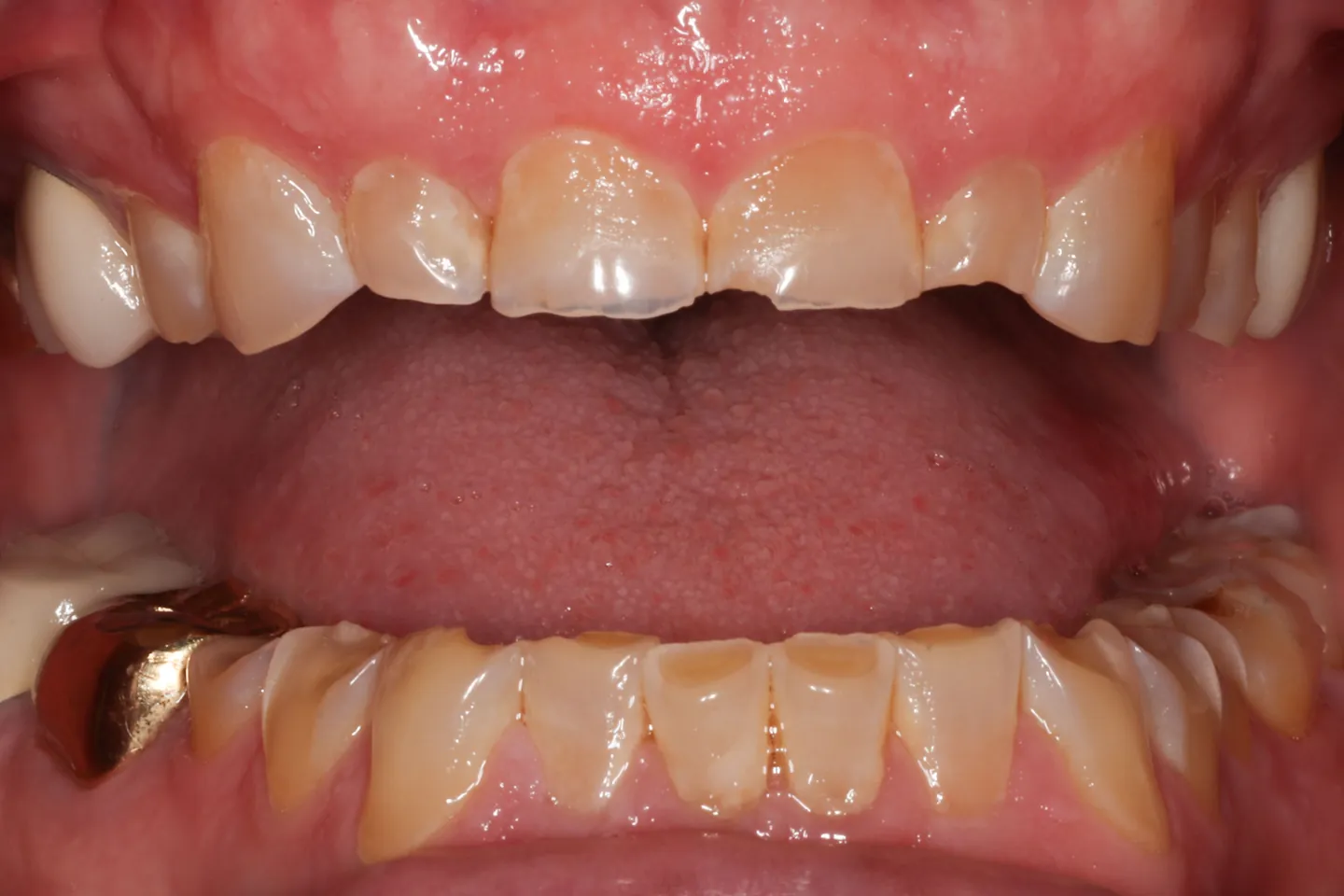
Look at the left side of this mouth. The crowned teeth and the gold restoration still stand at their original height. The natural teeth beside them, exposed to the same acid and the same forces for the same number of years, have worn shorter and yellower as the enamel thinned and the dentin underneath began to show.
The restorative cycle
This is the one worth understanding properly, because it’s the most reliable way a tooth ages faster than its owner.
A small filling is placed. Years later it needs replacing, and removing the old material inevitably takes a little sound tooth with it, so the new one is slightly larger. That happens again. Eventually there isn’t enough tooth left to hold a filling, so it becomes a crown. A crowned tooth can still need a root canal. A root-treated, crowned tooth can still fracture, and at that point it comes out.
Nothing in that sequence is anybody’s fault, and every individual step is the right treatment at the time. The problem is the direction. Every stage removes structure, and structure doesn’t come back.
A tooth entering that cycle at thirty has a lot of time to work through it. A tooth entering it at seventy may never reach the end. Same cycle, completely different consequence, and the only variable is how much life the tooth needs to have left.
The catch: nobody can answer this
We won’t pretend otherwise. There’s no test that tells you how long a given tooth will last. Too much of it is genetics, habits, luck, and what happens to your health over the next few decades.
Anyone offering you a confident prediction about the next thirty years of your mouth is guessing with a straight face.
But unanswerable in the abstract isn’t the same as unknowable in practice, and the difference is where this becomes useful.
You can’t predict the rate. You can measure it.
Here’s the part that changes the conversation.
We take a 3D scan of every patient. Photographs too. On the day, those are used for whatever you came in for. But they’re also a baseline, and a baseline is the only thing that turns an unanswerable question into a measurable one.
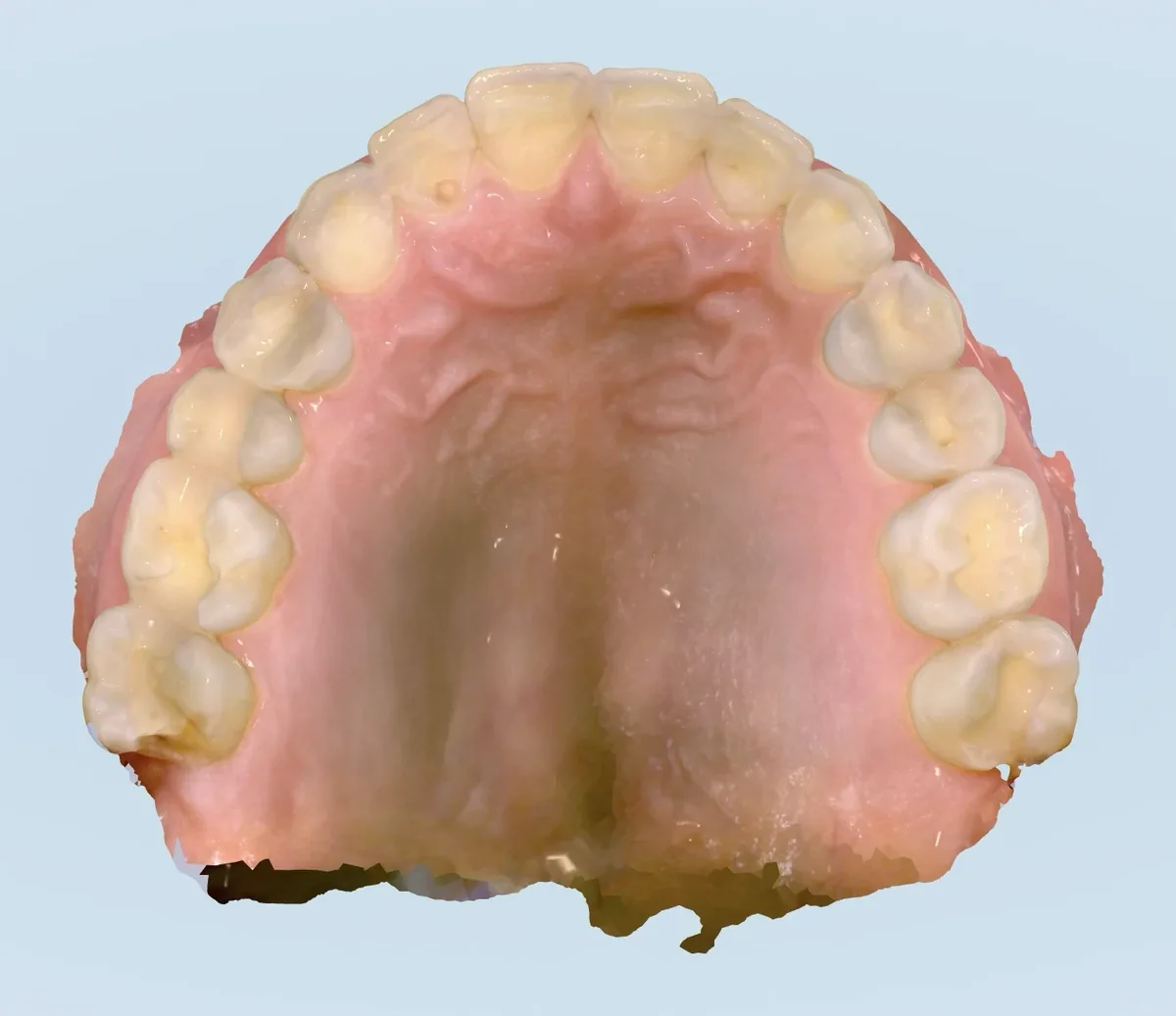
A digital scan records the whole arch at once. The value is not what it shows today. It is that the same scan in five years can be laid directly against it.
Scan you today and scan you in five years, and the wear is no longer a matter of opinion. It’s a comparison. We can see which teeth moved, how far, and how fast. That’s a trajectory rather than a guess, and it’s the closest anyone can get to answering whether your teeth are going to see you out.
The most valuable thing about a scan isn’t what it shows today. It’s that in five years it will tell you the rate.
Which means the best time to start asking this question is well before there’s a problem, and the cost of starting is a scan you were having anyway.
It might be all of them, or it might be four
When people hear that teeth might need restoring to last, they picture the whole mouth rebuilt. Sometimes that’s the answer. Often it isn’t.
Wear is rarely uniform. Often it’s the upper front teeth carrying it, because that’s where an edge-to-edge bite or acid does its work. Sometimes it’s the uppers and lowers together at the front, and everything behind them is fine. Sometimes it really is the whole arch.
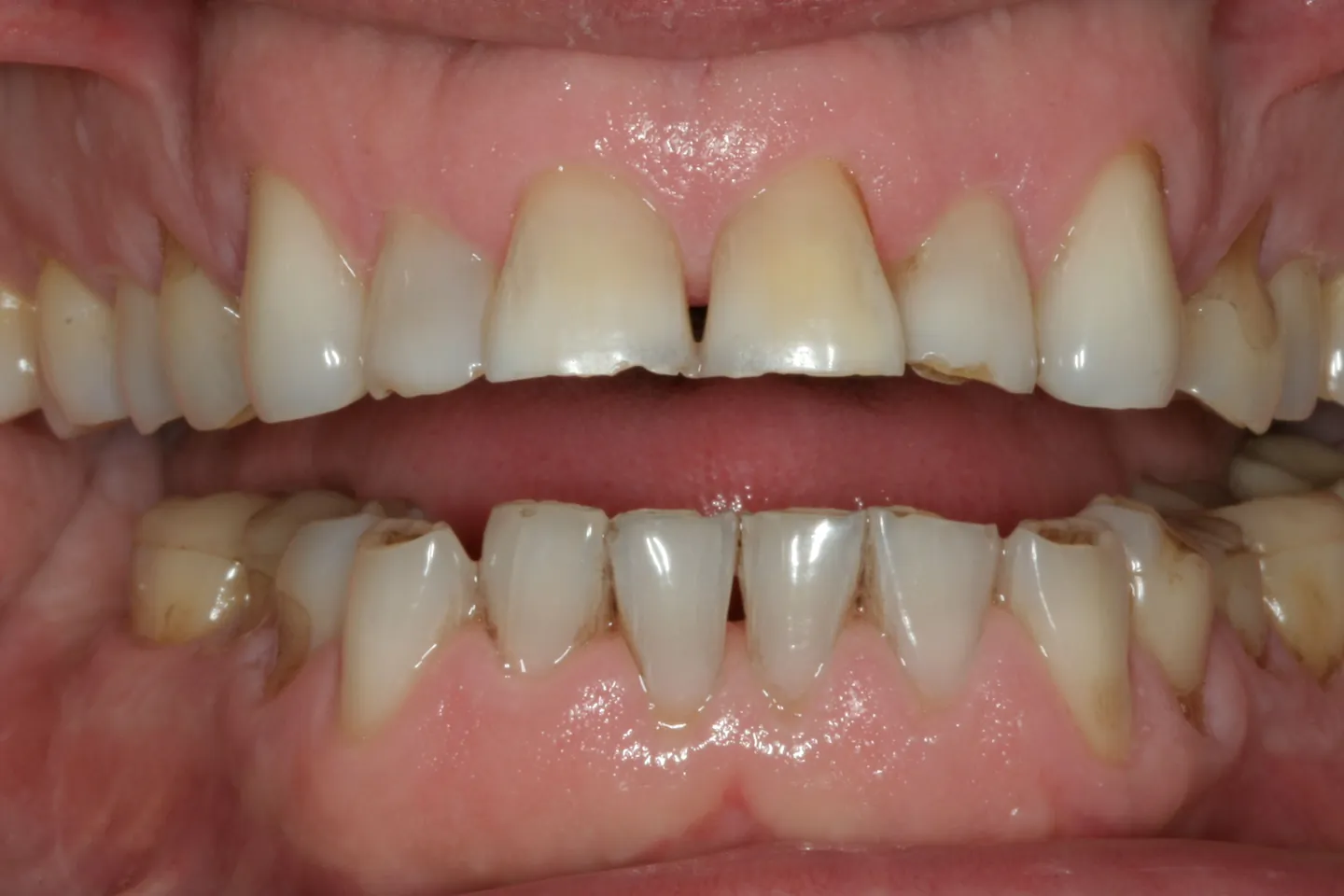
A different patient, and a different pattern. Worn, uneven incisal edges across the front teeth of both arches.
The scope question matters enormously, because it’s the difference between a contained piece of work and a full mouth rehabilitation. Assuming the largest version is as unhelpful as assuming nothing is happening at all.
What’s actually possible, and how well it holds up
If the answer turns out to be that some teeth need help to go the distance, the modern version of that work is far more conservative than most people expect, and the evidence behind it is good.
A 2025 systematic review and meta-analysis looked at minimally invasive full-mouth rehabilitation in patients with moderate to severe tooth wear, pooling ten studies with at least three years of follow-up. The estimated annual failure rates were 0.64% for direct composite, 0.13% for resin nanoceramics and 0.04% for ceramics.
Fan J, Wang B, Wang L, Xu B, Wang L, Wang C, Fu B. Clinical performance of minimally invasive full-mouth rehabilitation using different materials and techniques for patients with moderate to severe tooth wear: a systematic review and meta-analysis. Clin Oral Investig. 2025;29(2):96.
Read that the right way round. Minimally invasive means adding material back rather than cutting teeth down to stumps and crowning everything. It’s closer to rebuilding what was lost than to replacing what’s left, and it fails at well under one percent per year.
That matters for the trajectory question, because it means intervening earlier isn’t just cheaper. It’s less destructive, because there’s more tooth left to build on.
What you can change, and what you can’t
Some of the rate is fixed. Genetics, the enamel you were born with, and damage already done aren’t negotiable.
A surprising amount of the rest is:
- Acid exposure, from what you drink and how long you take over it, or from reflux you may not know you have.
- Clenching and grinding, including the daytime version that no night guard reaches.
- How the bite distributes force, which is sometimes treatable and sometimes the whole explanation.
- Gum health, which determines how much support the teeth keep.
- Whether missing teeth get replaced, and therefore whether the remaining ones get overloaded.
Change the rate and you change the answer to the whole question. That’s the actual point of asking it early.
For most people the answer is yes
We want to be clear about this, because an article like this could easily read as a case for treatment nobody needs.
Most people’s teeth will outlast them, and asking the question produces the answer nothing needs doing. That’s a real and common result, not a failure of the exercise. Being told your trajectory is fine is worth something, and it’s what we tell most people.
The value is in the minority for whom the answer is different, and in finding that out while the fix is still small.
Worth a conversation
Bring the question with you. Ask what your wear looks like for your age, whether anything is heading somewhere, and what it would take to change the direction. If the answer is that everything is fine, that’s a good answer and it costs nothing to hear.
Call 702-734-0776 or tell us what’s going on.