

Your teeth look shorter than they used to. Or they’re getting yellower no matter how much you whiten. Or cold water has started to hurt.
Those are the three ways this shows up, and they get blamed on the same two things: grinding at night, or simply getting older. Often it’s neither.
Three ways a tooth wears down
Enamel is the hardest substance your body makes, and it’s the only one that never grows back. Once it’s gone, it’s gone. It disappears by three separate routes, and most patients we see have some mix of all three.
- Erosion is chemical. Acid dissolves mineral straight off the surface. No bacteria involved, no cavity required.
- Attrition is tooth against tooth. Grinding and clenching, and not only while you sleep.
- Abrasion is something else against tooth. Aggressive brushing, a stiff brush, an abrasive whitening paste.
Erosion is the one that gets missed, and it’s also the one that makes the other two worse. Enamel softened by acid wears far faster under a grinding habit or a hard toothbrush than sound enamel would. Treat the grinding and ignore the acid and you’ve solved a third of the problem.
Not sure which kind you have? Here’s a one-page printable guide, with a drawing of each kind of wear, what to look for, and what helps.
Grinding isn’t just a nighttime problem
Almost everyone arrives assuming attrition happens while they’re asleep. Awake clenching and sleep grinding are treated as two separate conditions, and clenching during the day, at a desk or in traffic or in the middle of a difficult week, is at least as common as anything that happens overnight.
That distinction has a practical consequence. A night guard protects you for eight hours and does nothing at all for the other sixteen. If someone has been wearing a guard faithfully and the teeth are still shortening, daytime clenching is usually the reason, and no appliance is going to fix it. That part is about awareness and habit, and sometimes about what’s going on in the rest of your life.
If you have a night guard and the wear is still progressing, that’s information, not failure. It usually means the cause is daytime clenching, acid, or both, and none of those are what the guard was built for. There are also reasons we don’t recommend a guard for everybody, which are worth knowing before you get one.
A guard also isn’t an answer to acid. A well-fitting one can shield the surfaces it covers during a high-risk stretch such as sleep, but a poorly fitting guard can hold acid against the teeth rather than keeping it off them. If reflux is in the picture, the reflux is what needs treating. The appliance isn’t a substitute for that.
Acid arrives from two directions
This is the distinction that actually matters, because the two look different on the tooth and they need completely different conversations.
From outside: what you drink
A useful rule of thumb is that enamel starts losing mineral somewhere below pH 5.5, and exposed root surfaces and dentin earlier, around 6.2 to 6.5. For erosion there’s no single fixed line: how much a drink dissolves also depends on how much calcium and phosphate it carries and how strongly it holds on to its acidity. But most soft drinks sit so far below either number that the fine print doesn’t change the answer.
| Drink | Measured pH |
|---|---|
| Coca-Cola Classic | 2.37 |
| Diet Coke | 3.10 |
| Mountain Dew | 3.22 |
| Club soda, plain | 5.24 |
| Enamel starts dissolving (approximate) | 5.50 |
| Water | 7.00 |
Values from a survey of 379 US beverages published in the Journal of the American Dental Association, 2016. Individual products vary by batch and region. The 5.5 line is approximate: for erosion, the real tipping point shifts with each drink’s calcium and phosphate content and with your own saliva (Lussi A, Carvalho TS. Monogr Oral Sci. 2014;25:1-15).
Two things surprise people here. The first is that diet versions aren’t a solution: Diet Coke at 3.10 is more acidic than regular Mountain Dew in the same study. Switching to diet is a sugar decision, not an acid decision. The second is that flavored sparkling water usually contains citric acid and lands back around pH 3.5, while plain club soda sits near 5.2.
Wine, citrus, sports drinks and kombucha all belong on the same list. If drinks are the likely culprit in your case, the full beverage list and what actually helps are here, including why sipping one can slowly is far worse than drinking it quickly.
From inside: stomach acid
Stomach acid is far stronger than anything you can buy in a can, and it reaches the teeth in more situations than most people realize: acid reflux and GERD, some medications, pregnancy sickness, and repeated vomiting for any reason.
This route is more common than most patients expect. A systematic review of the published evidence found that among adults who presented with tooth erosion, a median of 32.5% had gastroesophageal reflux disease. Roughly one in three.
Pace F, Pallotta S, Tonini M, Vakil N, Bianchi Porro G. Systematic review: gastro-oesophageal reflux disease and dental lesions. Aliment Pharmacol Ther. 2008;27(12):1179-1186, as reported in Ranjitkar S, Kaidonis JA, Smales RJ. Gastroesophageal reflux disease and tooth erosion. Int J Dent. 2012;2012:479850.
Acid from inside leaves a different pattern than acid from a glass. It concentrates on the tongue side of the upper front teeth, which is precisely where you can’t see it and we can. Those surfaces go smooth and glassy, the edges turn translucent, and existing fillings can start to stand proud of the tooth around them because the tooth has dissolved and the filling hasn’t.
Silent reflux: the part that catches people off guard
A great many people with reflux never get heartburn at all. No burning, no obvious symptom, nothing that would send them to a doctor. It’s common enough to have its own name: silent reflux.
How common depends on who’s being studied, and the range is wide. Among patients whose reflux damage had been confirmed by endoscopy, a Swedish population study found 36.8% had no symptoms whatsoever, and studies across Asian populations report a range from 11.6% to 45.3%. Wherever the true figure sits, every one of those studies found a substantial share of people who had no idea.
Lu CL. Silent gastroesophageal reflux disease. J Neurogastroenterol Motil. 2012;18(3):236-238. Figures are for patients with endoscopically confirmed erosive esophagitis, not for everyone who refluxes.
That’s why we look for the wear pattern during an exam rather than waiting for a patient to report symptoms. For a silent refluxer, the teeth are often the first evidence anybody sees, and a dentist is often the first person to see it.
Why the damage happens at night, and why snoring is a clue
Reflux does most of its dental damage while you’re asleep, because four things stack up at once.
- Saliva nearly stops. Flow falls to almost zero during sleep, so the buffering, clearing and rebuilding described below are all switched off for seven or eight hours.
- Lying flat helps acid travel. Gravity is no longer keeping stomach contents where they belong.
- Obstructed breathing makes reflux more likely. Snoring and obstructive sleep apnea are strongly associated with nighttime reflux. Each obstructed breath generates negative pressure inside the chest, which can help draw stomach contents up past the valve that normally holds them down.
- Mouth breathing dries out whatever saliva is left. An open mouth all night removes the last of the defense.
So the patient who snores, sleeps with their mouth open, and wakes with a dry mouth or a sour taste has all four running together. That combination is worth taking seriously, and it’s a pattern we look for when wear doesn’t match what someone is eating or drinking.
To be accurate about the evidence: the association between obstructive sleep apnea and reflux is well documented, but which one drives the other is still argued, and plenty of people snore without either. What isn’t in doubt is that acid reaching the teeth overnight meets almost no defense.
This is also where the dental side stops being only about teeth. If breathing is part of the picture, mouth breathing is worth reading, and myofunctional therapy with Dr. Lee-Mirzayan addresses that side directly. Snoring and suspected apnea belong with a physician for diagnosis, and we’ll say so rather than treat around it. What a dentist can and can’t do there is set out in full.
On eating disorders, briefly and without a lecture
Repeated vomiting erodes teeth badly and quickly, and dentists are often the first people to see it, sometimes years before anyone else knows. We want to be straightforward about that rather than dance around it.
If this is part of your life, you’re not going to get a lecture in this office. What you’ll get is the practical half: we can protect what’s there, treat the sensitivity, and rebuild what’s been lost when you’re ready. Rinsing with water afterward helps clear the acid. A remineralizing product at night helps. So does anything that keeps saliva flowing.
None of that is a substitute for care from a physician, and we’d encourage that conversation. But your teeth don’t have to wait for the rest of it to be sorted out.
Saliva is the entire defense
A healthy mouth absorbs an acid hit and repairs itself within the hour. That repair is saliva doing four jobs at once:
- Buffering. Bicarbonate neutralizes acid and pulls pH back toward neutral.
- Clearing. Flow physically washes acid off the teeth and out of the grooves.
- Rebuilding. Calcium and phosphate held in saliva redeposit into softened enamel.
- Defending. Antibodies and antibacterial proteins keep acid-making bacteria in check.
With normal flow, pH bottoms out within a few minutes of a drink and climbs back above the enamel threshold in roughly 20 to 40 minutes. A short attack, then repair. With reduced flow there’s less buffering and slower clearance, so the mouth starts lower, drops further, and can still be under the line an hour later. Same drink, completely different outcome.
That’s why dry mouth is the multiplier on everything above. If it’s what’s driving the wear, no change to the drink will be enough on its own.
What it looks like
Early on, before anything is obvious:
- Edges of the front teeth turning translucent, almost gray at the tips
- Teeth looking yellower as thinning enamel lets the darker dentin below show through
- Cupped-out hollows in the biting surfaces of the back teeth
- Sensitivity to cold and to sweet, arriving before anything looks obviously wrong
- Fillings that seem to sit slightly high, because the tooth around them has gone
Quick answer: Why are my teeth sensitive at the gum line?
If they’ve started breaking: Why do my teeth keep chipping?
Left to run, it ends up looking like this.
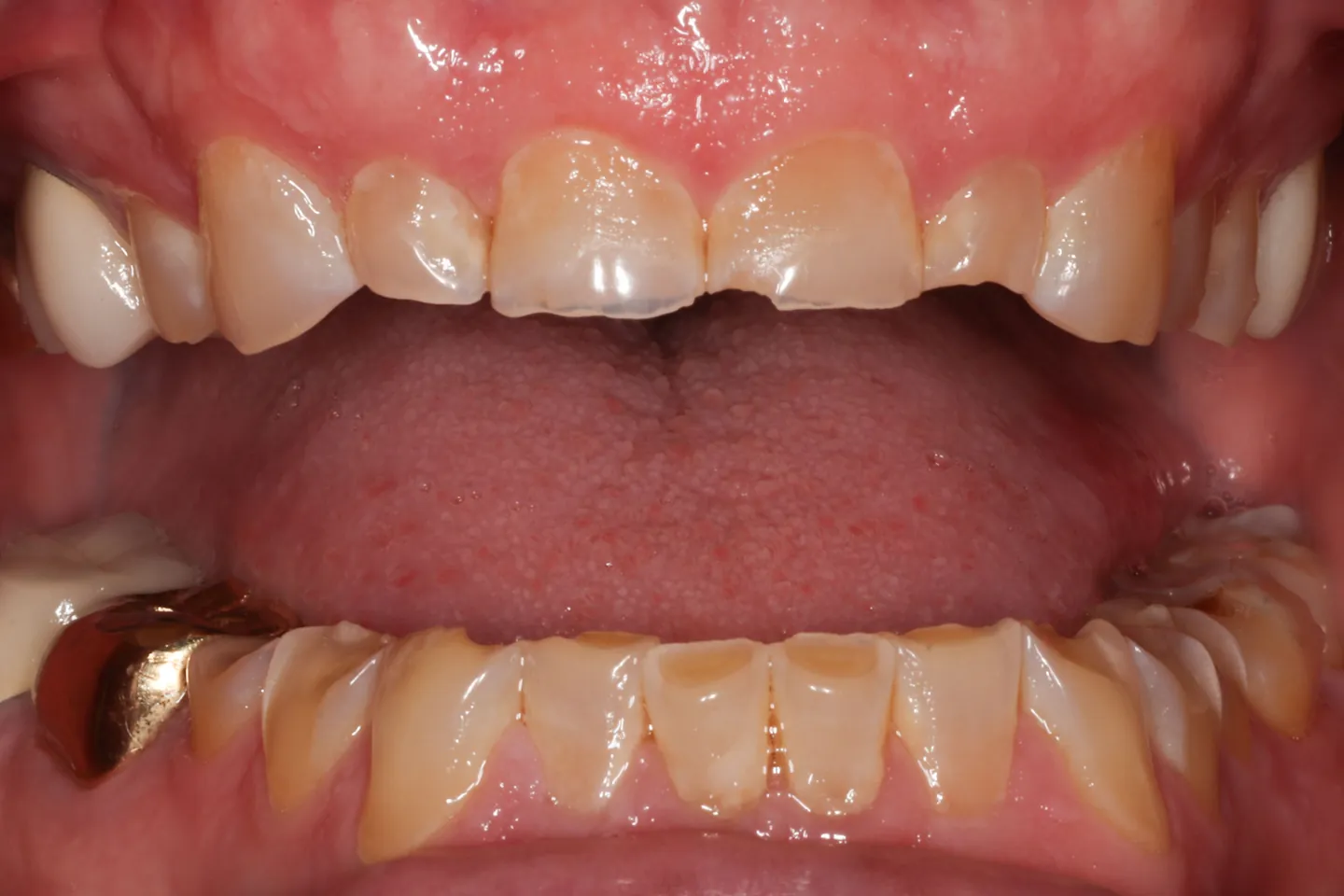
Advanced wear, and that last point made in one photograph. On the left, the crowned teeth and the gold restoration still stand at their original height. The natural teeth beside them, in the same mouth, exposed to the same acid and the same forces for the same number of years, have worn shorter and yellower as the dentin underneath began to show. Restorative material does not dissolve. Enamel does, which is why old dental work ends up standing proud of the tooth around it.
What this looks like in practice
L.B. drank a lot of carbonated, sugary drinks as a teenager. By the time we met him, the enamel was gone from his biting edges.
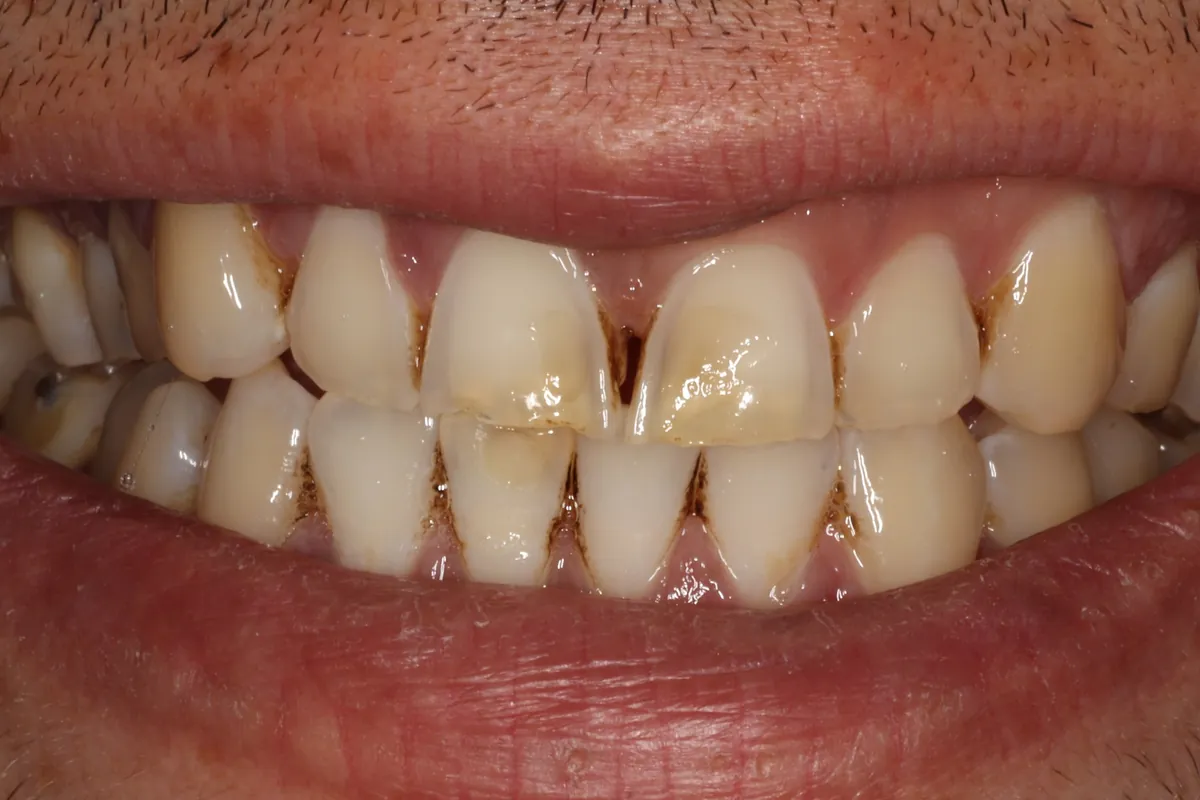
Before. The wear here is not from grinding. It is acid, and the pattern gives it away.
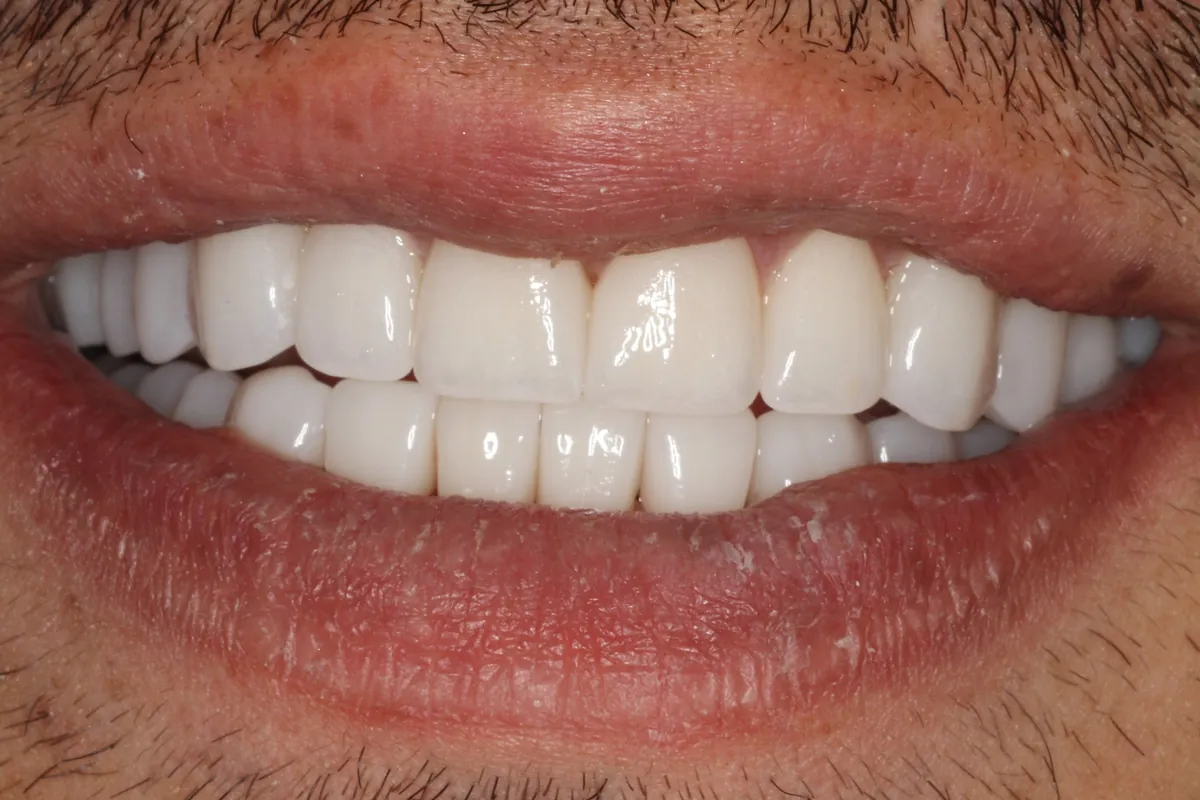
After. We traced the cause together first, he changed what he was drinking, and then we rebuilt it.
The order there is the point. Restoring a worn tooth without finding out what wore it down means doing the same work again in a few years, on a patient who now trusts you less.
P.M. came in for a different reason. Her teeth were turning gray, and every attempt at whitening seemed to leave them grayer. It was never staining. She’d lost enamel from the inside, and what looked like discoloration was the darker structure underneath showing through what enamel was left. The sensitivity she’d learned to live with was the same story. See her case in the gallery.
What can actually be done
In roughly this order, because the sequence matters more than any single item:
- Find the source. Diet, reflux, dry mouth, medication, breathing, clenching. Usually more than one.
- Change the timing, not just the amount. Damage tracks how long and how often acid sits on your teeth, not ounces consumed. One can with a meal is a single attack followed by recovery. The same can sipped across two hours at a desk is eight attacks with no recovery window in between. Don’t swish or hold acidic drinks in your mouth.
- No need to rush to the sink. You may have heard that you should wait 30 to 60 minutes after something acidic before you brush. Larger studies haven’t found that the timing makes much difference, and we don’t think you need to jump up and brush after a soda. A sip of water helps clear the acid. Then brush on your usual schedule, with a soft brush and a low-abrasion toothpaste.
- Put mineral back. A fluoride or nano-hydroxyapatite product at night. We run both tracks here, so if you’d rather avoid fluoride, the hydroxyapatite protocol is a real option and not a consolation prize.
- Deal with the night side. Reflux management with your physician, and the breathing side with us if that’s part of it.
- Deal with the day side too. If you’re clenching while you work, a guard worn at night won’t reach it. Noticing when your teeth are together is where that one starts.
- Restore what’s been lost, once the cause is under control. Sometimes bonding. Sometimes ceramic. It depends on how much structure is left and how the bite closes.
On brushing after acid: O’Toole S, et al. Timing of dietary acid intake and erosive tooth wear: a case-control study. J Dent. 2017;56:99-104. Bartlett DW, et al. Prevalence of tooth wear on buccal and lingual surfaces and possible risk factors in young European adults. J Dent. 2013;41(11):1007-1013.
Wear is one of the few dental problems where doing nothing has a guaranteed direction. It doesn’t stabilize on its own, and every millimeter lost makes the eventual fix larger.
Worth getting looked at
If your teeth are getting shorter, more sensitive or yellower and nobody has explained why, that’s a question with an answer. A real exam can tell erosion from grinding from abrasion, because they leave different marks, and the treatment is different for each.
Call us at 702-734-0776 or tell us what’s going on and we’ll take a proper look.