

The short answer
Usually because the gum has pulled back and exposed the root of the tooth. Unlike the part above the gum, the root has no enamel on it. It’s made of softer material full of microscopic tubules that lead to the nerve. When the mouth is acidic, from drinks, food, reflux or a dry mouth, the acid cleans those tubules out and leaves them open, so cold travels almost straight to the nerve. That’s the sting. It’s common and it’s treatable, and it’s worth finding out why it happened, because whatever caused it is usually still going on.
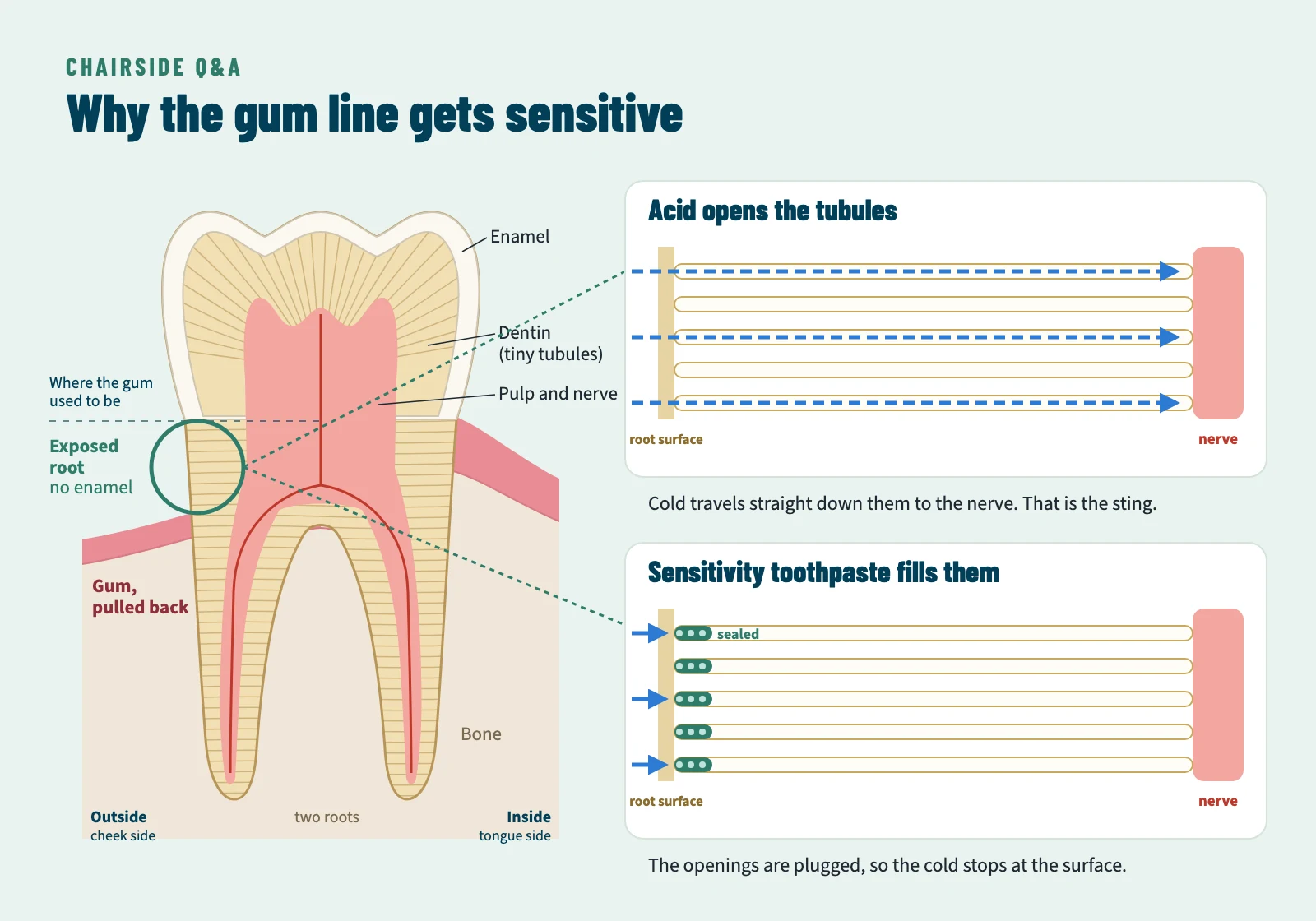
Open tubules first, lost tooth later
Early on, nothing is actually missing. Acid at the surface cleans out the openings of the tubules, and the root can look completely normal while cold goes straight through it. This is the stage where a sensitivity toothpaste does its best work, because all it has to do is fill tiny holes.
If the acid keeps coming, the surface itself starts to go. Root surface softens at a milder acid level than enamel does, so it gives way sooner, and a stiff brush, heavy pressure or an abrasive toothpaste scrubs the softened layer off. Over time that can become a notch where the tooth meets the gum. Once tooth structure is gone, toothpaste can calm the sensitivity but it can’t put the tooth back, and a notch can often be covered with tooth-colored bonding.
Exposed roots can decay, too
Recession doesn’t only cause sensitivity. The exposed root has no enamel protecting it and gives way to acid sooner than enamel does, so decay can start there as well, right at the gum line where it’s easy to miss.
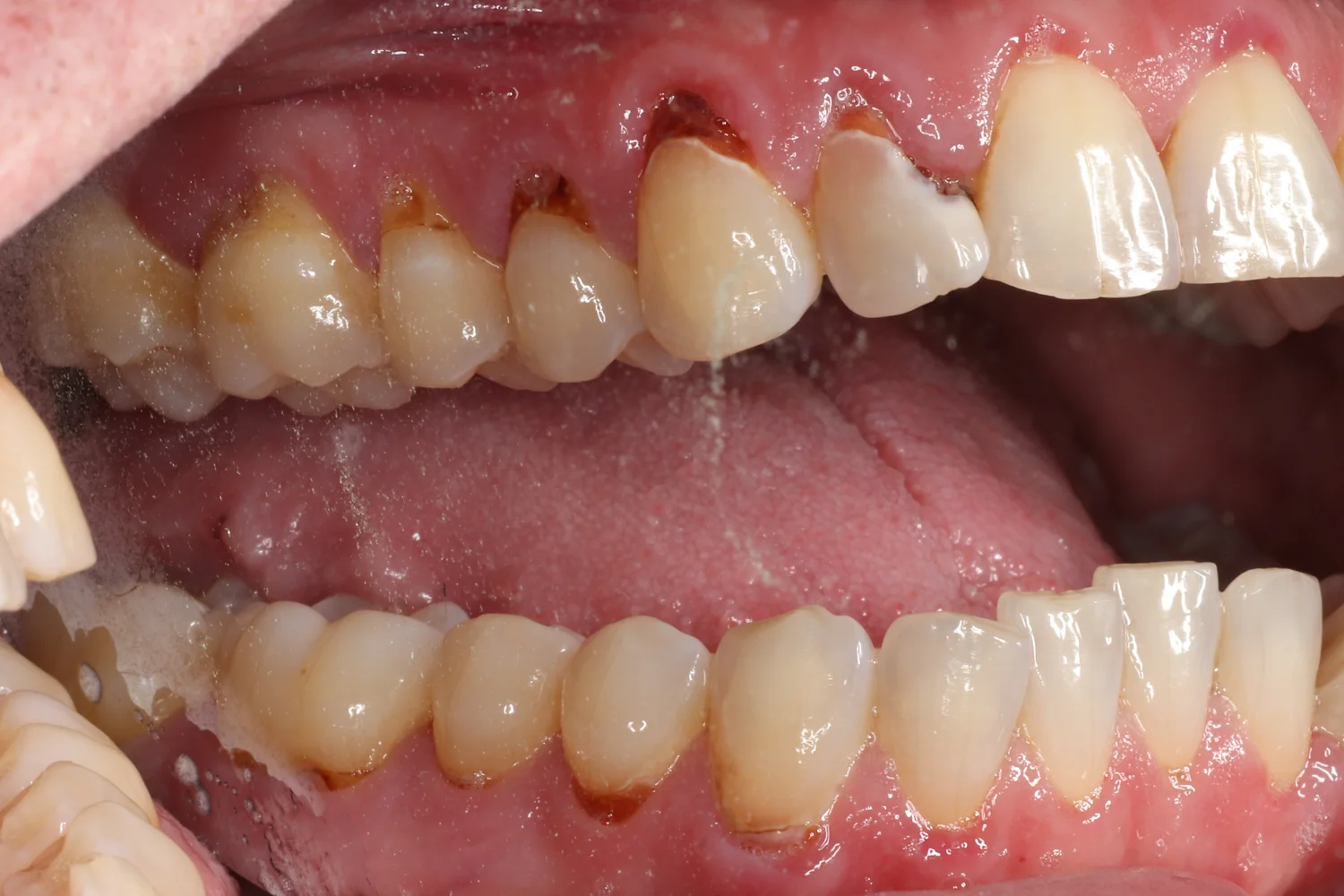
That’s one more reason to have recession looked at, even when the sensitivity is something you can live with.
What’s behind it
- Recession. As the gum pulls back, root surface is exposed. Gum disease can be part of that, and so can years of hard brushing.
- Acid, or a low pH in the mouth. Soda, sports drinks, lemon water, acid reflux and a dry mouth all lower the pH. That’s what opens up the tubules in exposed root, and root surface gives way to acid sooner than enamel does.
- Brushing too hard, or with an abrasive toothpaste. A stiff brush, heavy pressure and a gritty paste all wear away root surface that acid has already softened. Whitening toothpastes are abrasive, so they can make this worse.
- A cavity or a worn filling edge at the gum line, which can feel the same. That’s one reason to have it checked rather than assume.
Sensitive, or something more?
Exposed root surface stings with cold and then settles quickly, and it’s usually spread across several teeth. Two things point somewhere else:
- It’s much worse on one side, or in one tooth. That can be the nerve inside a single tooth that’s inflamed, called pulpitis, rather than exposed roots.
- The ache lingers after the cold is gone. That can also mean the nerve is in trouble.
Either one is worth an exam rather than a new toothpaste.
What to try at home
- A toothpaste for sensitive teeth can help. The idea is to fill in those tiny open tubules. Use it every day, not just when it hurts.
- Be careful with “whitening” toothpastes for sensitive teeth. Whitening pastes are abrasive, so they work against the whole idea of filling those tiny holes.
- NOBS works well here as a trial. It’s a nano-hydroxyapatite toothpaste, and it’s what Dr. Sandquist uses himself.
- Cut back on sipping acidic drinks through the day, so the mouth spends less time acidic.
- Switch to a soft brush and ease up on the pressure.
- Brush with lukewarm water for now.
Like anything, every situation is different. What helps one person may do little for the next, so if home care isn’t making a difference, that’s the time to have us take a look.
What we can do
First we find the cause, because covering the spot without fixing what’s wearing it away doesn’t last. From there, if the teeth are very sensitive, we start with a fluoride varnish to see if that helps. A notch can often be covered with tooth-colored bonding. If gum disease is part of it, we treat that first.
The full story: Why Is There a Notch in My Tooth at the Gum Line?, Why Your Teeth Are Wearing Down and Why Are My Teeth Chipping?
Chairside Q&A from Douglas Sandquist, DDS, Sandquist Dentistry, Las Vegas. More quick answers.