

Receding gums are one of the most common things I see. The gum edge creeps down the tooth, a little more root shows, and a tooth starts to look longer or feels sensitive to cold. Most people assume it’s age, or that they brushed too hard. Sometimes that’s part of it. But the gums usually aren’t where the story starts.
There’s an old saying for getting older: “long in the tooth.” It comes from horses, whose teeth look longer as they age, which is how buyers judged a horse’s age. In people, teeth that start to look longer usually mean the gums have pulled back.
The short answer: the gum sits on bone, and it follows the bone. Where the root of a tooth sits close to the edge of its bone, the bone over it is thin, and thin bone can give way. When it does, the gum pulls back after it and exposes the root. Recession is very common, some of it stays the same for decades, and some of it changes quickly. That’s why I’d rather you see a periodontist for an evaluation early, while the options are widest.
The gum follows the bone
Under every area of recession, the bone has already pulled back. In a study that looked at the bone under receding gums, the edge of the bone sat well below the edge of the gum, on average 2.8 mm below it. The gum doesn’t recede on its own. It loses the bone that was holding it up.
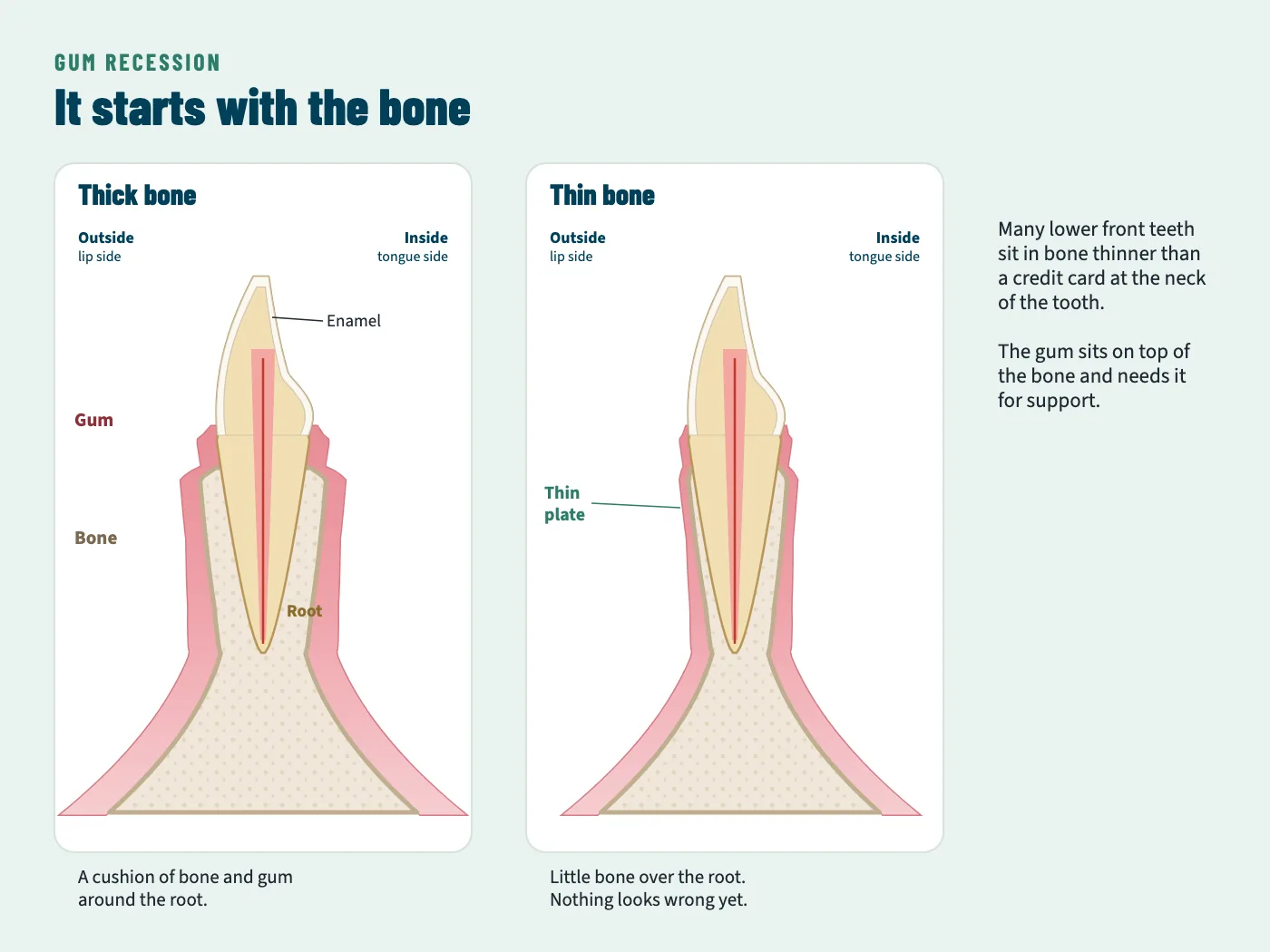
That’s why I look at the bone and where the root sits in it, not just at the gums.
Löst C. Depth of alveolar bone dehiscences in relation to gingival recessions. J Clin Periodontol. 1984;11(9):583-589.
Why some teeth sit in thin bone
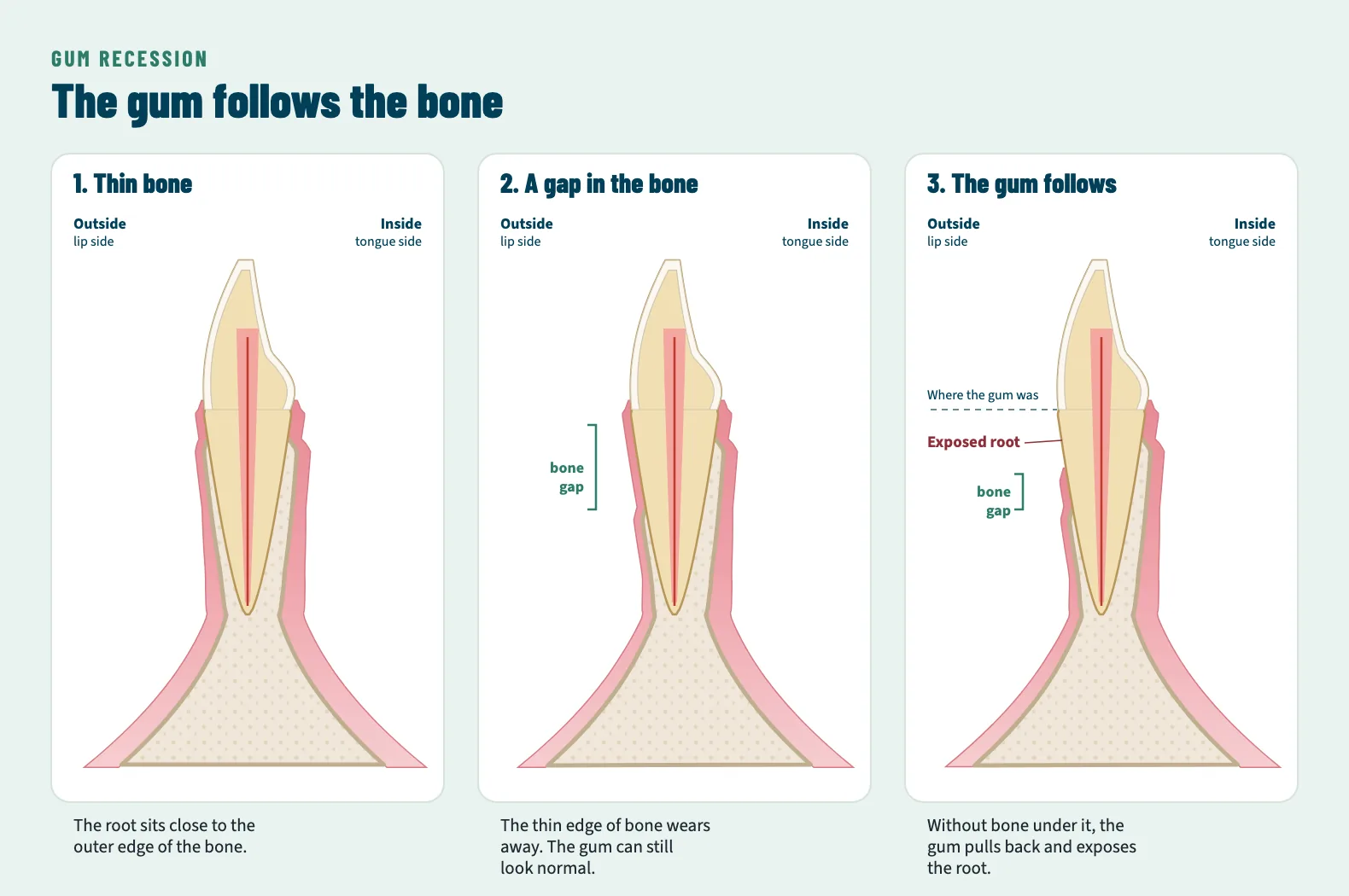
A tooth’s root sits in a shell of bone. On many teeth, especially the lower front teeth, that shell is very thin on the lip side, the tongue side, or both. In one study of lower front teeth, the bone at the neck of the tooth averaged well under a millimeter on both sides, thinner than a credit card.
A root ends up near the edge of its bone for several reasons. Some people are simply built that way. Crowding pushes some roots outward. Orthodontics can move a root toward the thin edge, especially when front teeth are tipped forward or an arch is expanded. Even a retainer wire that slowly changes shape can twist a root out over the years.
My view is that this is the biggest single reason recession starts: a root sitting too close to the bone’s edge. The research agrees that it matters. 3D scan studies find recession more often over teeth with thin or missing bone on the outside. But thin bone isn’t the whole story. Thin spots in the bone are common in people whose gums never recede, so something usually has to push it over the edge.
Nguyen TH, et al. Mandibular incisor alveolar housing and incisor-alveolar axis relationship in untreated skeletal Class III patients. PLoS One. 2026;21(9):e0358261. Evangelista K, et al. Dehiscence and fenestration in patients with Class I and Class II Division 1 malocclusion assessed with cone-beam computed tomography. Am J Orthod Dentofacial Orthop. 2010;138(2):133.e1-7.
What pushes it over the edge
Several things are known to add to the risk, especially when the bone is already thin:
- Plaque and inflammation along the gumline, and gum disease.
- Thin gums. Some people are born with thinner, more delicate gum tissue.
- Brushing too hard, especially with a stiff brush. The research hasn’t pinned down how much this adds, but it’s an easy risk to remove.
- A tight lip or cheek attachment that tugs on the gum.
- Smoking.
- Crown or filling edges placed under the gum.
- Tongue and lip piercings. In one study, half the people who had worn a long tongue barbell for two years or more had recession on the tongue side of their lower front teeth.
Campbell A, et al. Tongue piercing: impact of time and barbell stem length on lingual gingival recession and tooth chipping. J Periodontol. 2002;73(3):289-297.
What about the bite?
Here’s my own view, which the research hasn’t settled. When a root sits off its proper axis, the forces of biting don’t travel straight down it. I think the tooth flexes, and where the bone over it is already thin, that flexing can help wear the bone away. I see the bite as a problem mainly when the roots are off axis, not as a cause on its own.
The studies are mixed. Some find more recession on teeth that take extra force, or in people who grind. But they haven’t shown that force causes it, and the major periodontal guidelines say the evidence isn’t there. That’s why I don’t treat the bite specifically to fix recession. I look at where the root sits and how much bone covers it.
Jepsen S, et al. Periodontal manifestations of systemic diseases and developmental and acquired conditions: consensus report of workgroup 3 of the 2017 World Workshop. J Periodontol. 2018;89 Suppl 1:S237-S248.
Recession on the tongue side
Most recession is on the outside of the tooth, the lip or cheek side. But it happens on the inside too. In my practice I see it most behind the lower front teeth and on the inside of the upper molars, and often in people with a large tongue and a small upper jaw. My belief is that the tongue pressing against those teeth, where the bone is thin, plays a part. I’ll be honest that this hasn’t been studied directly. What has been measured is that the bone around lower front teeth is often thin on both sides, so the gum can pull back on either side.
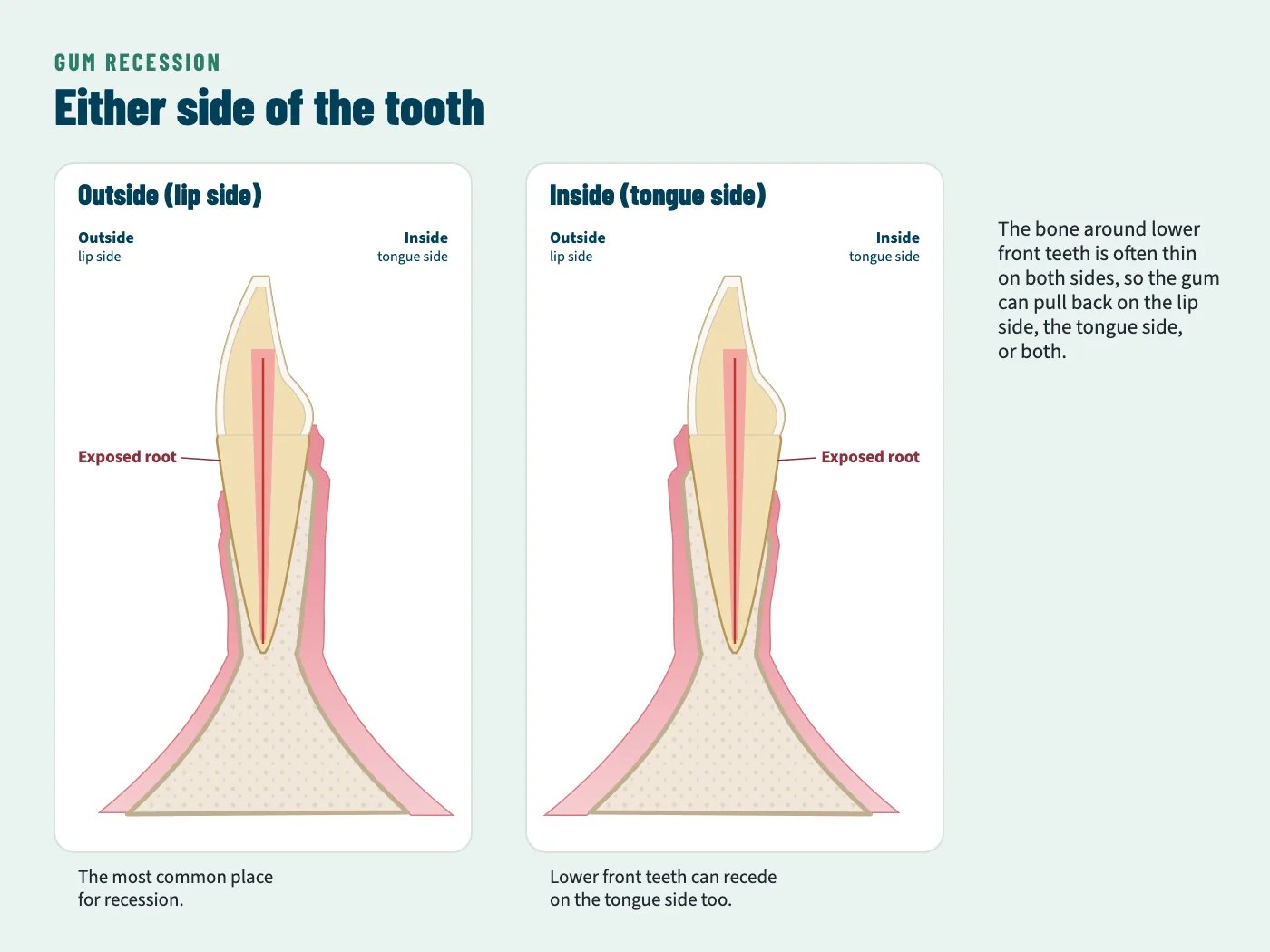
If tongue posture is part of the picture, it’s worth knowing that it can be retrained. How myofunctional therapy works.
Recession and notches at the gumline
Recession and the little notches that wear into teeth at the gumline often show up on the same teeth. Once the gum pulls back, the root is uncovered, and root has no enamel on it. It’s softer, so it wears and erodes more easily, and that’s usually where a notch starts. So recession tends to come first, and the notch follows. Why notches form at the gum line.
Pikdöken L, et al. Cervical wear and occlusal wear from a periodontal perspective. J Oral Rehabil. 2011;38(2):95-100.
Will it get worse?
This is the hard part. Some recession stays the same for years, even decades. Some becomes a problem almost overnight. In my experience that often happens when the bacteria in the mouth shift and decay starts on the exposed root, which is much softer than enamel. Why exposed roots get sensitive, and can decay.
The research shows that left alone, recession tends to creep. In studies that followed untreated recession for years, most spots got at least a little deeper. And it’s very common: in a large US survey, more than 9 out of 10 adults had at least one spot of recession.
Chambrone L, Tatakis DN. Long-term outcomes of untreated buccal gingival recessions: a systematic review and meta-analysis. J Periodontol. 2016;87(7):796-808. Romandini M, et al. Epidemiology of mid-buccal gingival recessions in NHANES according to the 2018 World Workshop Classification System. J Clin Periodontol. 2020;47(10):1180-1190.
What we do
- Measure it and keep track. We measure recession at your exams and compare it over time with photos and the 3D scan we take each year, so a change doesn’t sneak up on you.
- Brush gently. Use a soft brush, or an electric brush with light pressure. I don’t count on a pressure sensor to do this for you. Learn what light feels like.
- See a periodontist early. Because I can’t tell in advance whether your recession is the quiet kind or the fast kind, I’d rather you see a periodontist (a gum specialist) for an evaluation early, while the options are widest. An evaluation isn’t a commitment to surgery. You don’t have to do anything, but you’ll know what can be done and what needs to be done.
- Gum grafts, when they make sense. I refer all gum grafting to the periodontist I work with. A graft, usually with tissue from the roof of the mouth, is the most predictable way to cover a root and thicken the gum, and it often eases sensitivity too. How much root can be covered depends mostly on the bone and gum between the teeth. If that’s intact, full coverage is often possible. If it’s been lost, results are more limited.
- Sometimes the answer is moving the root. Because I see recession as mostly a question of where the root sits, I also look at whether orthodontics could bring a root back into better bone. What can be done about receding gums.
Where to start
If your gums are pulling back, a tooth looks longer than it used to, or the gumline has started to sting with cold, call 702-734-0776. We’ll measure it, look at where the roots sit, and tell you honestly whether it’s something to watch or something to have a periodontist look at now.
General education, and not a substitute for an exam.