

If your gums have pulled back, the first question is why. Why gums recede covers that: in most cases it starts with thin bone over the root, and the gum follows the bone. This article is about the next question: what can actually be done about it.
The short answer: not every spot of recession needs treatment, but it should be measured, because most untreated recession slowly gets deeper. When treatment makes sense, a gum graft done by a periodontist is the most predictable way to cover a root, and how much it can cover depends mostly on the bone and gum between the teeth. Sometimes the better first step is moving the root back into the bone.
Does it need treatment at all?
Not always. If there’s no sensitivity, no decay on the root, it isn’t getting worse and you’re happy with how it looks, measuring it and photographing it over time is a reasonable plan. But watching means actually measuring. In studies that followed untreated recession for years, about three out of four spots got at least a little deeper.
In one study that followed people for 18 to 35 years, about half of the untreated spots had gotten worse, while more than 8 in 10 of the grafted spots had improved. An exposed root is also softer than enamel and more prone to decay, so cleaning along the gumline matters more once a root is showing.
Because some recession stays the same for decades and some changes quickly, I’d rather you see a periodontist (a gum specialist) for an evaluation early. That isn’t signing up for surgery. It’s knowing what can be done, and what needs to be done, while the options are widest.
Chambrone L, Tatakis DN. Long-term outcomes of untreated buccal gingival recessions. J Periodontol. 2016;87(7):796-808. Agudio G, et al. Periodontal conditions of sites treated with gingival augmentation surgery compared with untreated contralateral homologous sites: an 18- to 35-year long-term study. J Periodontol. 2016;87(12):1371-1378.
What decides how much root can be covered
The single biggest factor is the bone and gum between the teeth. A graft can bring the gum back up only about as far as the support between the teeth allows.
- If the support between the teeth is intact, full coverage is often possible.
- If a little has been lost, full coverage is still common. In one study, teeth with 3 mm or less of attachment loss between them reached full coverage more than 80% of the time with a graft.
- If more has been lost, partial coverage is the realistic goal. In one long-term study, a small group of teeth like that reached full coverage only about 1 time in 5.
- Smoking clearly lowers how much coverage a graft gets.
Cairo F, et al. Coronally advanced flap with and without connective tissue graft for the treatment of single maxillary gingival recession with loss of inter-dental attachment. J Clin Periodontol. 2012;39(8):760-768. Pini Prato GP, et al. Long-term evaluation (20 years) of the outcomes of subepithelial connective tissue graft plus coronally advanced flap in the treatment of maxillary single recession-type defects. J Periodontol. 2018;89(11):1290-1299. Chambrone L, et al. The influence of tobacco smoking on the outcomes achieved by root coverage procedures. J Esthet Restor Dent. 2025;37(1):187-200.
The grafting options your periodontist may discuss
I refer all gum grafting to the periodontist we work with, so these are the options you’re likely to hear about there, in plain words:
- Gum slid up with your own tissue underneath. The gum next to the recession is loosened and moved up over the root, with a thin piece of tissue from the roof of your mouth tucked underneath. This is the most studied approach and the one the others are measured against. In studies that followed people for 5 to 20 years, full coverage held in about two-thirds to nearly 9 in 10 patients with the tissue, compared with one-third to 6 in 10 when the gum was moved without it.
- A tunnel approach. The same tissue graft, slid in through small openings at the gumline without cutting the gum between the teeth. It’s often used when several teeth are involved, or on the lower front teeth.
- A strip of gum from the palate sewn on. This mainly adds a band of firm gum where there’s very little, rather than covering the root. It’s often used before orthodontics, or under crown edges.
- Options without a second site. Donated skin, a collagen sheet, or a protein gel can be used instead of tissue from your palate. Recovery is usually easier. In most studies the coverage is a little less, or slips back more over the years, than with your own tissue. In one large trial, the collagen sheet meant recovery about two days sooner, but your own tissue gave about four times the odds of full coverage.
- The pinhole technique. The gum is loosened through a small opening in the lining of the lip and shifted down over the roots. Most of the long-term results come from the dentist who developed it. In one independent trial, its one-year results were similar to a graft from the palate.
Your periodontist can tell you which trade-off fits your mouth: more certainty with your own tissue, or an easier recovery with a substitute.
Chambrone L, et al. Root coverage procedures for treating localised and multiple recession-type defects. Cochrane Database Syst Rev. 2018;10(10):CD007161. Bertl K, et al. Root coverage stability: a systematic overview of controlled clinical trials with at least 5 years of follow-up. Clin Exp Dent Res. 2021;7(5):692-710. Tonetti MS, et al. Xenogenic collagen matrix or autologous connective tissue graft as adjunct to coronally advanced flaps for coverage of multiple adjacent gingival recession. J Clin Periodontol. 2018;45(1):78-88. Shibly O, et al. Compend Contin Educ Dent. 2025;46(1):35-41.
What it does for sensitivity
Covering a sensitive root often calms it. In pooled studies, about 7 in 10 people who were sensitive before stopped being sensitive after their root was covered. When surgery isn’t the plan, desensitizing toothpastes and in-office treatments can help too. Why the gum line gets sensitive.
Antezack A, et al. Effectiveness of surgical root coverage on dentin hypersensitivity: a systematic review and meta-analysis. J Clin Periodontol. 2022;49(8):840-851.
When there’s a notch, too
Recession often comes with a notch worn into the exposed root. A shallow notch usually needs only the gum procedure. A deeper one is sometimes filled partway with tooth-colored material first, so the gum has a smooth surface to cover. Why notches form at the gum line.
Moving the root back into the bone
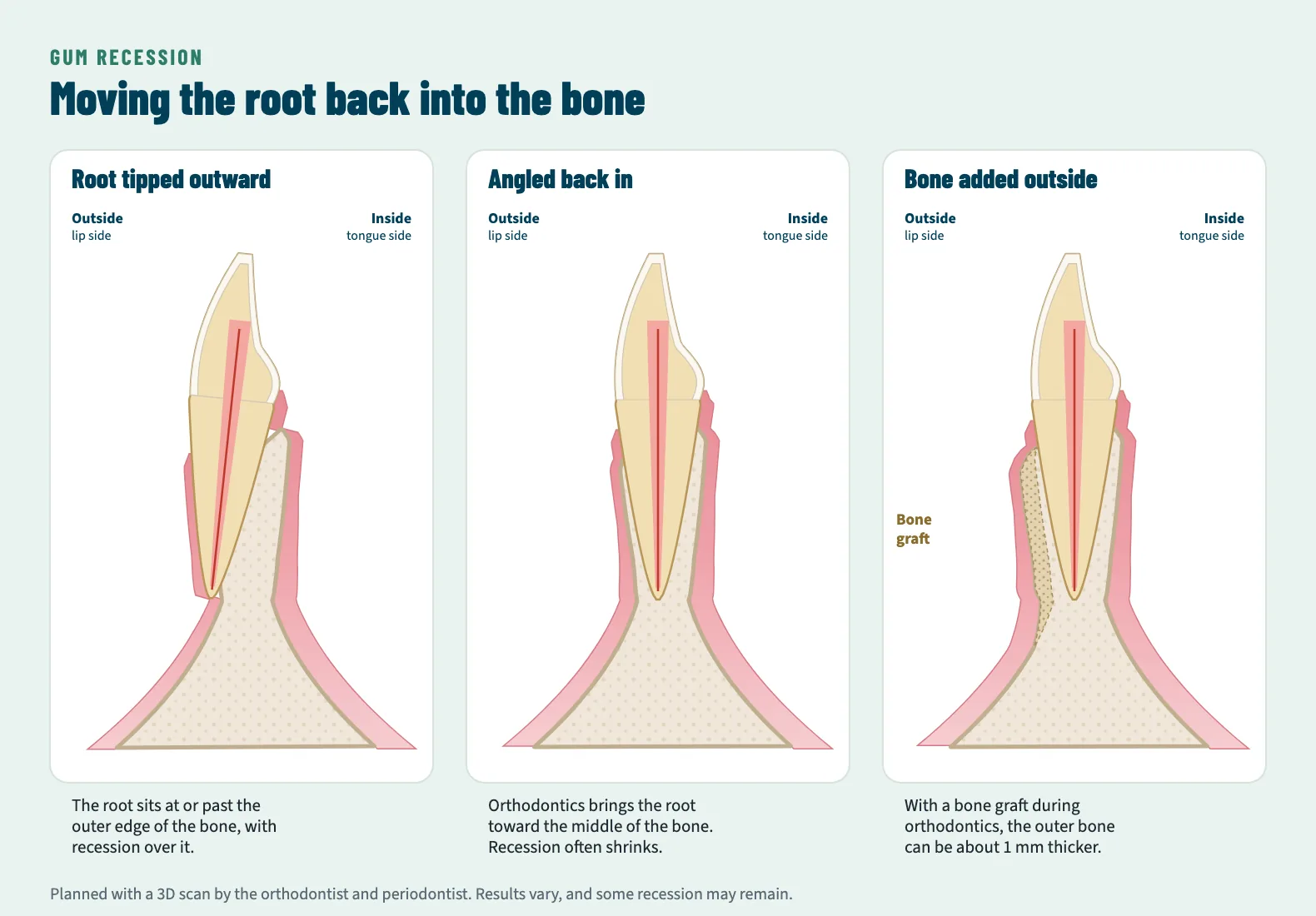
Because I see recession as mostly a question of where the root sits, this is the part I find most promising. A 3D scan shows the angle of the root in the bone. Sometimes changing that angle a little brings the tooth back into better bone.
- Small changes, in our office. Dr. Lee-Mirzayan can make small changes in root angle with Invisalign. In a small study, every tooth treated this way improved, by more than half on average, though some still needed a graft afterward. Aligners also tend to move roots less than planned, often around half, so we check progress with scans along the way. How Invisalign works here.
- Roots twisted by a retainer. A retainer wire that slowly changes shape can twist roots out of the bone over the years. In a study of people with that problem, bringing the roots back toward the middle of the bone with braces shrank the recession by close to half.
- Bigger cases with very thin bone. The orthodontist and periodontist we work with can add bone on the outside of the jaw during orthodontic treatment. It’s called surgically facilitated orthodontics. Studies suggest it leaves the outer bone about a millimeter thicker and can speed tooth movement a little. The research is early and mostly not randomized, and it is real surgery, so it’s for specific cases, planned together.
Einy S, et al. Optimizing axial inclination with clear aligner orthodontic treatment to address recession. Quintessence Int. 2025;56(3):218-225. Haouili N, et al. Has Invisalign improved? Am J Orthod Dentofacial Orthop. 2020;158(3):420-425. Schmid JQ, et al. The effect of lingual orthodontic appliances in the dimensional reduction of labial gingival recessions. Quintessence Int. 2025;56(4):306-317. Xu H, et al. Clin Oral Investig. 2026;30(10).
Who does what
- Here: I measure and track the recession, look at where the roots sit, and coordinate the plan around your teeth, bite and any fillings or crowns. Dr. Lee-Mirzayan handles small root-angle changes with Invisalign.
- The periodontist we work with: all gum grafting.
- The orthodontist and periodontist together: surgically facilitated orthodontics, when bone needs to be added.
Questions worth asking the periodontist
- Is my recession the kind to watch, or to treat now?
- How much of the root can realistically be covered on each tooth?
- Would you use tissue from my palate, or a substitute, and why?
- How long is recovery, and what can I eat?
- How long do results usually last in cases like mine?
- Should anything be done about the root position first?
Where to start
If your gums are pulling back, call 702-734-0776. We’ll measure it, look at where the roots sit, and tell you honestly whether it’s something to watch, something for Dr. Lee-Mirzayan, or something for the periodontist to look at now.
General education, and not a substitute for an exam.