

Often, no. That’s the first answer, and the more common one.
“Full mouth rehabilitation” sounds like a big undertaking, and sometimes it is. But the phrase gets used loosely, and plenty of people arrive assuming it applies to them when something far smaller would do. So the first job isn’t planning the rehabilitation. It’s working out whether you need one.
We’d rather tell you the problem is smaller than you feared than sell you a plan that matches the size of your anxiety.
What the phrase actually means
A full mouth rehabilitation is a plan that restores function, health and appearance across the whole mouth at once, treating the teeth, the gums and the bite as one system rather than fixing one problem at a time. It usually combines several things: crowns, veneers, implants, periodontal treatment, sometimes orthodontics.
The defining feature isn’t the number of teeth involved. It’s that the bite itself is part of what’s being rebuilt. If your bite is fine and you just need several teeth restored, that’s a lot of dentistry, but it isn’t this.
When you don’t need one
This deserves to come before the case photos.
A single cracked tooth, one failing crown, wear confined to a few teeth, or a bite problem isolated to one area can usually be treated on its own.
Looking daunting isn’t the same as being extensive. Part of what a first consultation is for is finding out whether what looks like a big problem is actually a contained one.
The reverse also happens: people arrive convinced they need a cleaning and a whitening, and the exam finds a bite that has been slowly collapsing for a decade. Neither assumption survives contact with an actual examination.
How a mouth ends up needing one
Almost always through one of these, and usually more than one at once:
- Wear. Acid erosion, grinding, or both, over years. If this is you, read the three ways teeth wear down, because the cause determines whether the rebuild will hold.
- Periodontal disease, which changes what the remaining teeth can be asked to do.
- Old dentistry reaching the end of its life, often several crowns and bridges placed years apart, none of them designed to work together.
- Teeth lost and never replaced, after which the rest drift, tip and over-erupt into the space.
- A bite that stopped working, sometimes after treatment that changed how the teeth met.
Notice that every one of those is a process rather than an event. That’s why the first question is always what caused it, not what to rebuild. Restoring a mouth without answering that means doing the same work again in a few years.
The sequence, and why it’s in this order
The order matters more than any individual procedure.
- Diagnose the cause. Exam, 3D scan, imaging, and a hard look at what has been driving the damage.
- Stabilize the disease. Gum health and decay first. Nothing worth building goes on an unstable foundation.
- Establish where the bite should be, before anything permanent is made. Where the jaw joints and muscles are involved, that usually means orthotic therapy first: let the overloaded muscles settle, then find where the joints actually want to rest, and confirm you’re comfortable there.
- Rebuild to that position. Crowns, veneers, implants and orthodontics, executed to a bite that has already been tested rather than one drawn up on a model.
Step three is the one that gets skipped, and it’s the one that decides whether the result lasts. A reversible appliance can tell you whether a proposed bite works before a single tooth is prepared. Nothing else can.
About raising the bite
When teeth have worn down, rebuilding them usually means opening the bite back up, which prosthodontists call increasing the vertical dimension. People worry about this, so here’s what the evidence says, including how thin it is.
The systematic review most often cited here searched the literature and retrieved 902 papers. Nine of them met its inclusion criteria. From those nine it concluded that a permanent increase in vertical dimension, where it’s indicated, is safe and predictable, and that the negative signs and symptoms it did find were self-limiting. It also said outright that no well-designed study existed on the question, and that controlled, randomized trials were needed to confirm its own finding.
A 2024 review reached the same practical conclusion and added the mechanism. The biological and functional environment around the bite has considerable adaptive capacity, which it argues has historically been underestimated, and muscle relaxation and changes in muscle length are the likely means of that adaptation rather than the bite drifting back to where it started.
Abduo J. Safety of increasing vertical dimension of occlusion: a systematic review. Quintessence Int. 2012;43(5):369-380. Yadfout A, El Aoud J, Merzouk N, Slaoui Hasnaoui J. Increasing Vertical Dimension of Occlusion (VDO): Review. Clin Cosmet Investig Dent. 2024;16:135-142. Nine included studies is a thin base for a clinical conclusion, and we would rather give you the number than the number of papers that were screened to reach it.
Two practical points come out of that literature. An increase of more than about 5 mm between the front teeth is seldom necessary, so be cautious about a plan that requires a great deal more. And the increase should be made across the whole arch rather than a few teeth, or the bite tends to settle back toward where it started.
Will rebuilding my bite fix my jaw pain?
Not on its own, and we want to be clear about that.
Reviews of vertical dimension changes find no direct causal or curative link with temporomandibular disorders. Raising a bite doesn’t generally cause TMD, and it doesn’t generally cure it either. A full mouth rehabilitation presented as a treatment for jaw pain is claiming more than the evidence supports.
What restorative work can legitimately do is make permanent a jaw position that has already been shown to work for you. That’s a different and much better supported claim, and it’s why the orthotic comes first. You’re not being asked to accept crowns on a theory about your bite. The full reasoning is here.
What this looks like in practice
P.M. came in asking about whitening. Her teeth had been turning gray for years, and every attempt to whiten them seemed to leave them grayer than before.
The exam found it wasn’t staining at all. She had lost enamel from the inside of her teeth, and what looked like discoloration was the darker structure underneath showing through what enamel was left. The sensitivity and the trouble eating she had learned to live with were part of the same story, which is why whitening kept failing. There was nothing on the surface to bleach.
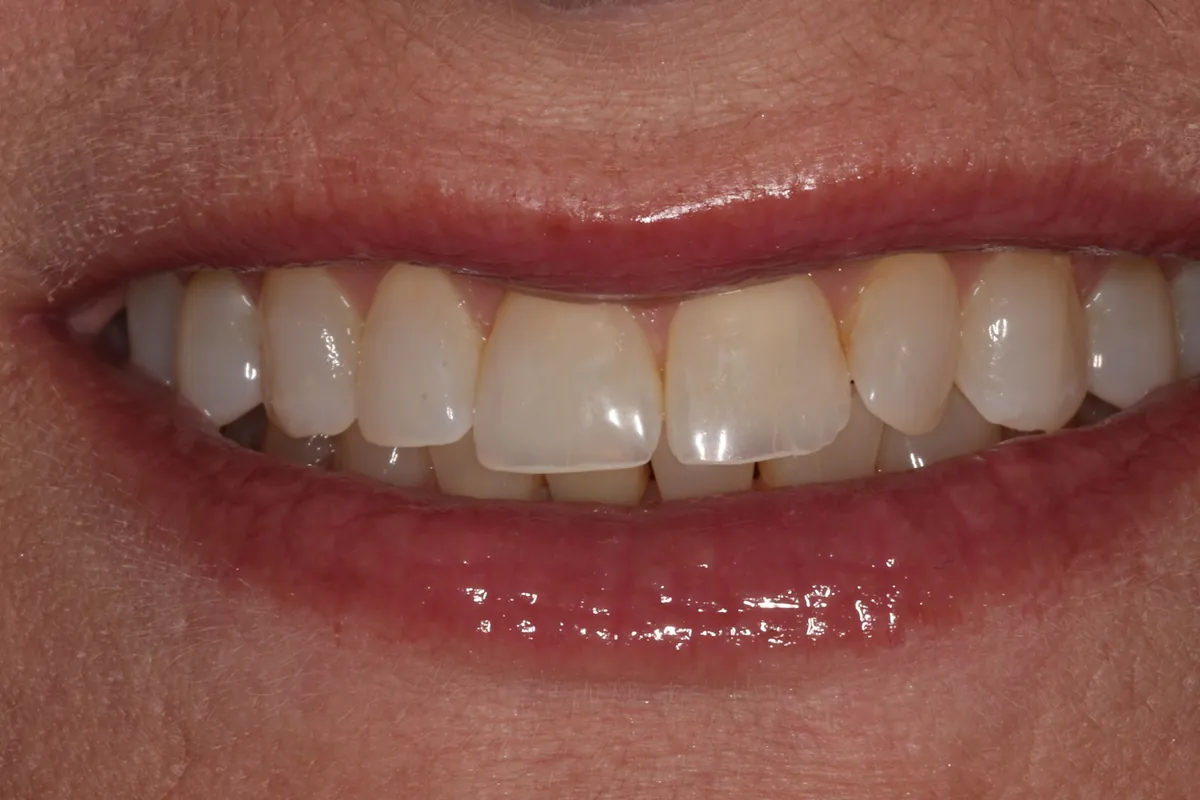
Before. Years of enamel loss had thinned and darkened the teeth. No amount of whitening was going to reach it.
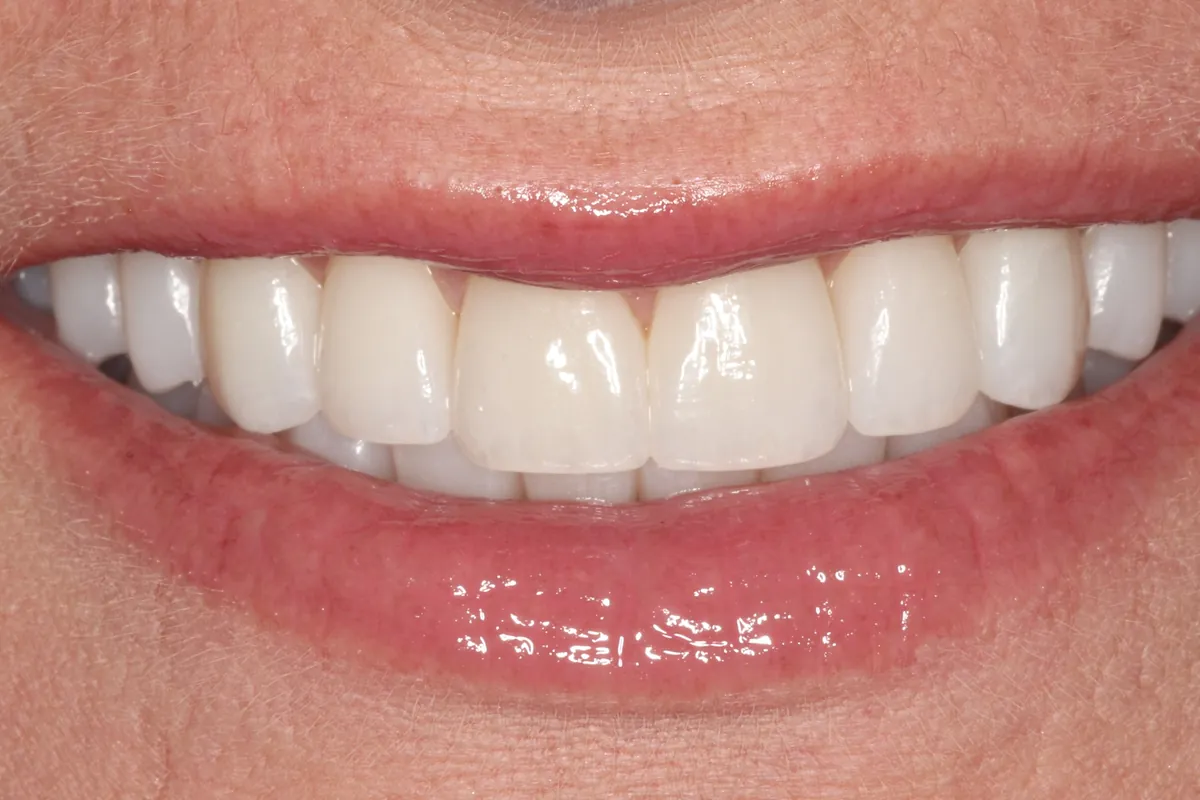
After. High-strength ceramic restorations rebuilt the lost enamel, restoring both function and an even, bright smile.
That’s what the phrase actually describes. Not a cosmetic upgrade, but rebuilding lost structure across the mouth so it works again. The brighter smile was a by-product of fixing the function, not the thing she came in for.
Another patient lived with a poor bite and periodontal disease for close to twenty years after old dental work changed how her teeth met, and had struggled to find a team willing to take on a problem that size. See how that was resolved → A third arrived after years of dental work, some of it successful and some not, mainly worried about who to trust. See B.R.’s case →
How long it takes
Every case is different, and before the workup is done, nobody can tell you yet. That isn’t evasion. The length of the build depends on what the diagnosis turns up.
The workup is its own phase and it isn’t a formality. Exam, 3D scan, imaging, and then a full diagnostic wax-up: a model of the finished result, built before a single tooth is touched, showing where every tooth is going to end up and how the bite will meet when it’s done. That’s the set of plans the whole build works from, and it’s what lets us tell you what you’re actually agreeing to rather than asking you to trust a description.
Once the plan is set, and if everything goes without a hiccup, the treatment itself usually runs to roughly four to eight appointments across two to three months.
That sentence has a hedge in it for a reason. When a case runs longer, it’s usually for one of four reasons. Gum disease that has to be treated and re-evaluated first. A tooth that turns out not to be restorable once it’s opened. A specialist who has to be scheduled into the sequence. Or an orthotic phase that needs more time before the bite has settled somewhere you’re comfortable.
None of those are complications exactly. They’re the reasons the diagnosis comes before the quote.
What determines the cost
We can’t publish a range for this, and we’d rather explain why than just decline.
A full mouth rehabilitation isn’t one procedure with a price attached. It’s a set of procedures, and which procedures are in the set is decided by what the workup finds. That list moves a long way:
- Teeth that need root canal treatment before they can carry a restoration at all.
- Teeth that can’t be saved, which changes that part of the plan from restoring to replacing.
- Joint problems that have to be settled before anything permanent is built to them.
- Periodontal disease, which has to be treated and re-evaluated before the foundation is sound enough to build on.
- Orthodontics, which can sometimes move teeth into a position that spares them from being restored at all.
The way we usually describe it is that it’s like buying a car. You know you need one. What nobody knows yet is which one. Sometimes the answer is a Honda or a Toyota. Sometimes the mouth in front of us needs a BMW.
Which one it turns out to be is settled by the diagnosis rather than by anyone’s preference. And notice that last item on the list, because it runs the opposite way to how a big treatment plan is supposed to behave: moving a tooth is sometimes cheaper than rebuilding it, so orthodontics can take work out of a case rather than adding it.
It doesn’t have to happen all at once
A full mouth rehabilitation is often described as though it were a single event with a single invoice. It usually isn’t, and the two to three months above assumes you’re doing it as one project.
Large cases can also be sequenced over years, stabilizing what’s urgent first and rebuilding in stages as budget allows. Several of the transformations in our gallery were done exactly that way. Your dental plan won’t carry a case of this size in one year regardless, since annual maximums have barely moved since the 1960s, so planning around the calendar rather than around the mouth is the wrong instinct anyway.
If you’ve been told your case is too complicated
That’s the sentence we hear most often from people who end up here, and it’s usually the point at which the search for the cause stopped.
Comprehensive restorative work on a worn or collapsed bite is the kind of case Dr. Sandquist has built his practice around, including the postgraduate education in the jaw and the bite that this work depends on. Where a case needs a periodontist, a surgeon or an orthodontist, we bring them in and coordinate it rather than referring you away and losing the thread.
Start with a real assessment and a straight answer about how much of this you actually need. Call 702-734-0776 or tell us what’s going on.