

Full mouth reconstruction, also called full mouth rehabilitation, means rebuilding the teeth, the gums and the bite as one plan instead of fixing one tooth at a time. It’s for mouths where enough has worn, broken, shifted or failed that patching individual teeth no longer works.
This is the work Dr. Sandquist has built the practice around. A lot of the patients who end up here were told somewhere else that their case was too complicated. Usually what that means is that nobody had worked out what caused it yet.
Worn, broken or failing teeth? Your first visit is where we find out how much of this you actually need.
A card is needed to schedule online. Appointments missed, or cancelled with less than 24 hours’ notice, are charged a $75 fee.
Who it’s for
A mouth almost always gets here through one of these, and usually more than one at once:
- Wear. Acid erosion, grinding, or both, over years, until the teeth are short, sensitive and chipping. The three ways teeth wear down.
- Gum disease that has changed what the remaining teeth can be asked to do.
- Old dentistry at the end of its life, often several crowns and bridges placed years apart, none of them designed to work together.
- Teeth lost and never replaced, after which the rest drift, tip and grow into the space.
- A bite that stopped working, sometimes after earlier treatment changed how the teeth meet.
- Work done elsewhere that didn’t hold up, including crowns and bridges done in another country that never fit.
Plenty of people who ask about this don’t need it. One cracked tooth, one failing crown or wear on a few teeth can usually be treated on its own. Part of what the first visit is for is finding out whether a problem that looks big is actually contained. Do I actually need full mouth rehabilitation?
Reconstruction, rehabilitation or smile makeover?
Full mouth reconstruction and full mouth rehabilitation are two names for the same thing. What makes it a reconstruction isn’t the number of teeth. It’s that the bite itself is part of what’s being rebuilt.
A smile makeover is usually about how the front teeth look: color, shape, length and spacing. Many of our makeovers are smaller than people expect, and some turn out to be reconstructions once we find the wear or bite problem underneath. More on cosmetic dentistry and smile makeovers.
How we do it, and why the order matters
- Find the cause. A comprehensive exam, photos, a 3D scan, and a hard look at what has been doing the damage. Because the bite is being rebuilt, that includes a full diagnosis of the jaw joints: at minimum a 3D X-ray (CBCT) of the joints, and sometimes an MRI, which shows the disc and soft tissue that X-rays can’t. Rebuilding a mouth without answering what caused it means doing the same work again in a few years.
- Stabilize the disease. Gum disease and decay come first. Nothing worth building goes on an unstable foundation.
- Settle where the bite should be, before anything permanent is made. When the jaw joints and muscles are involved, that usually means an orthotic first, so the muscles can settle and we can confirm you’re comfortable in the new position.
- Plan the finished result on a model. A full diagnostic wax-up shows where every tooth will end up and how the bite will meet, before a single tooth is touched. It’s what lets you see what you’re agreeing to.
- Rebuild to that plan. Crowns, veneers, bonding, implants and orthodontics, in whatever combination your mouth needs, made to a bite that has already been tested.
Step three is the one that gets skipped, and it’s the one that decides whether the result lasts.
Well-made temporaries are part of that testing. You live with the new shape and chewing surface for a while, and anything that needs changing gets changed before the final restorations are made. Our crowns are made by a skilled lab rather than milled in the office, which lets the material be matched to each tooth and the bite. Why we made that change.
Who does what
Dr. Sandquist plans the case and does the restorative work: the crowns, veneers, bonding and bridges, and the teeth that go on implants. When a case needs a periodontist, an oral surgeon or an orthodontist, we bring them in and coordinate the sequence, rather than sending you away and losing the thread.
We don’t place implants. A surgeon places them, and we plan each one together, starting from where the finished tooth needs to sit. How implant planning works here, and what that looks like for a full arch.
Cases from our office
Every photo is one of our own patients. Drag the slider on each photo to compare before and after.
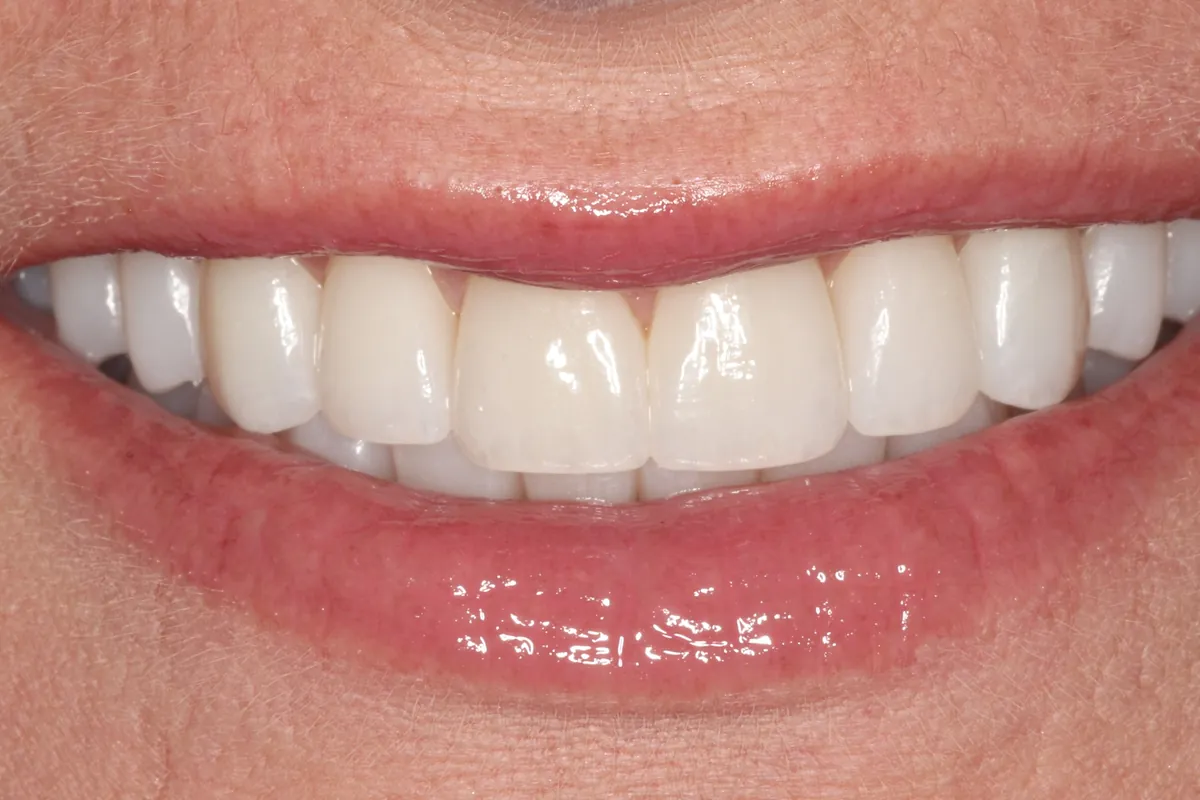
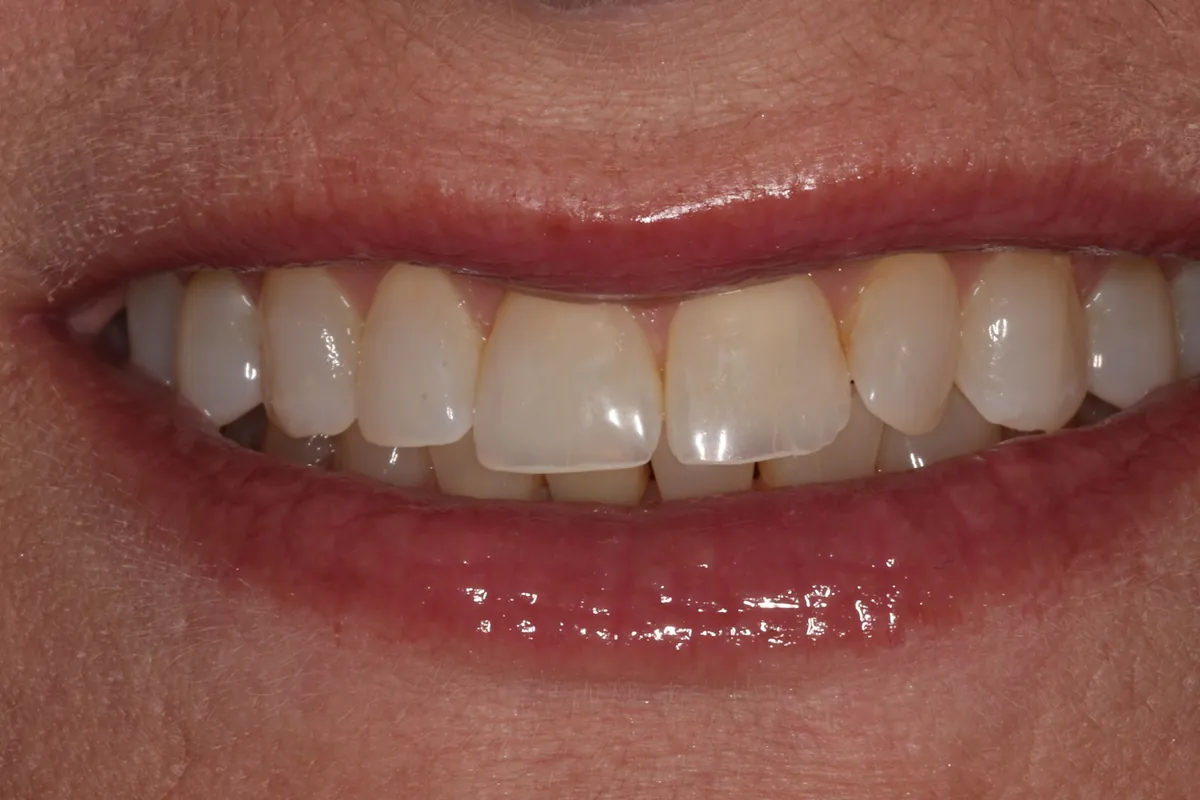
P.M.’s Story
The ask: Her teeth were turning gray, and every time she tried whitening them, they just came out grayer.
What we found: It wasn’t staining at all: she’d lost enamel from the inside of her teeth, which had started causing sensitivity and trouble eating.
The plan: High-strength ceramic restorations rebuilt the lost enamel, restoring both function and a bright, even smile.
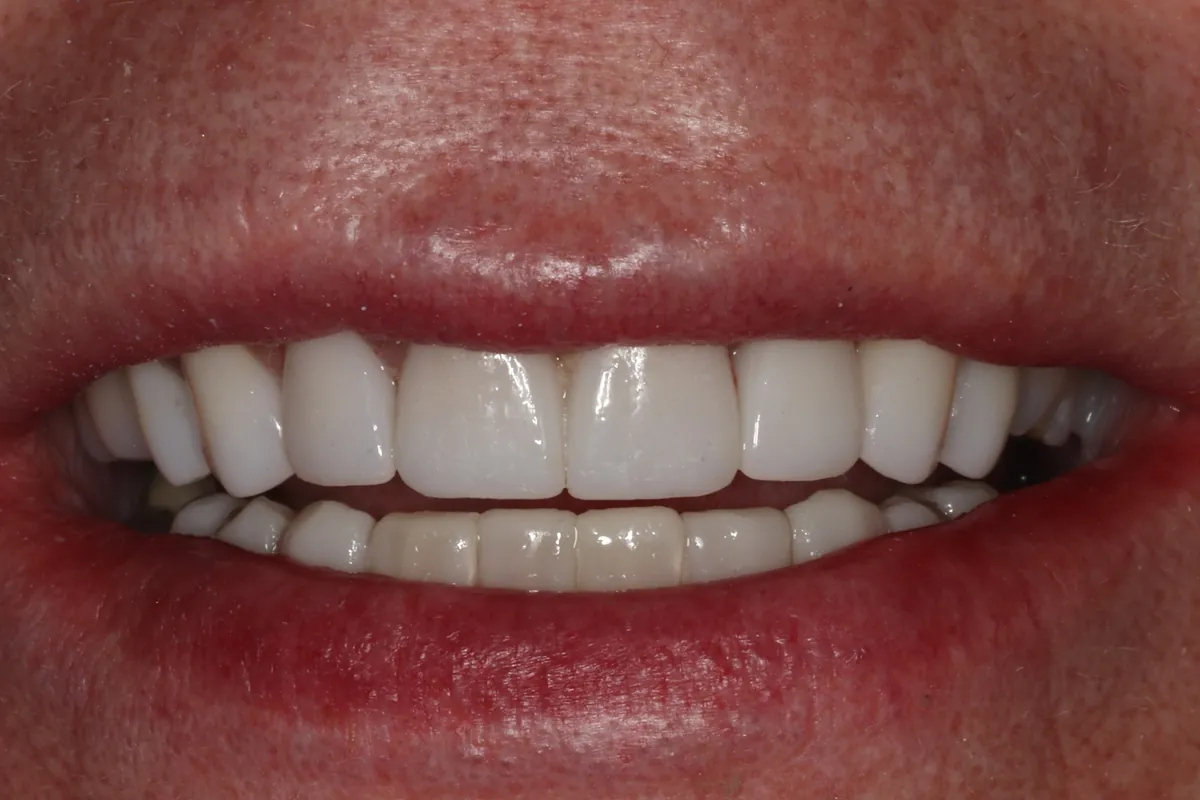
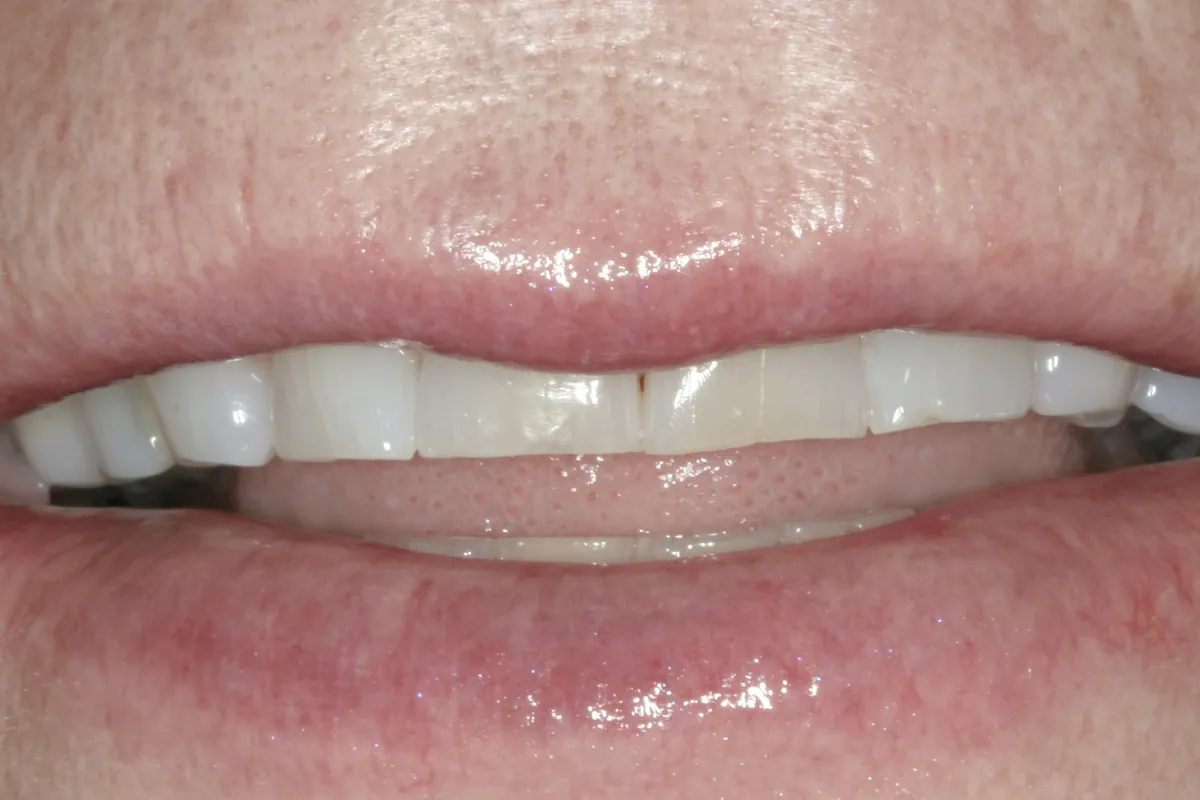
D.P.’s Story
The ask: She was concerned her teeth were wearing away, and didn’t show any teeth at all when she smiled.
The plan: A comprehensive exam found she’d lost several millimeters of tooth structure from wear. Ceramic restorations on top and composite bonding on the bottom restored her smile and function for the long run.


J.D.’s Challenge, Solved
The ask: J.D. had lived with a poor bite and periodontal disease for close to twenty years, ever since a significant bite change from old dental work, and she’d struggled to find a team she trusted to take on a challenge that size.
The plan: After a comprehensive exam, we worked through her options together with periodontist Dr. Ryan Gifford and lab technician Justin McElroy, and J.D. chose dental implants to support her new smile, pain-free, and back to singing with her sisters.
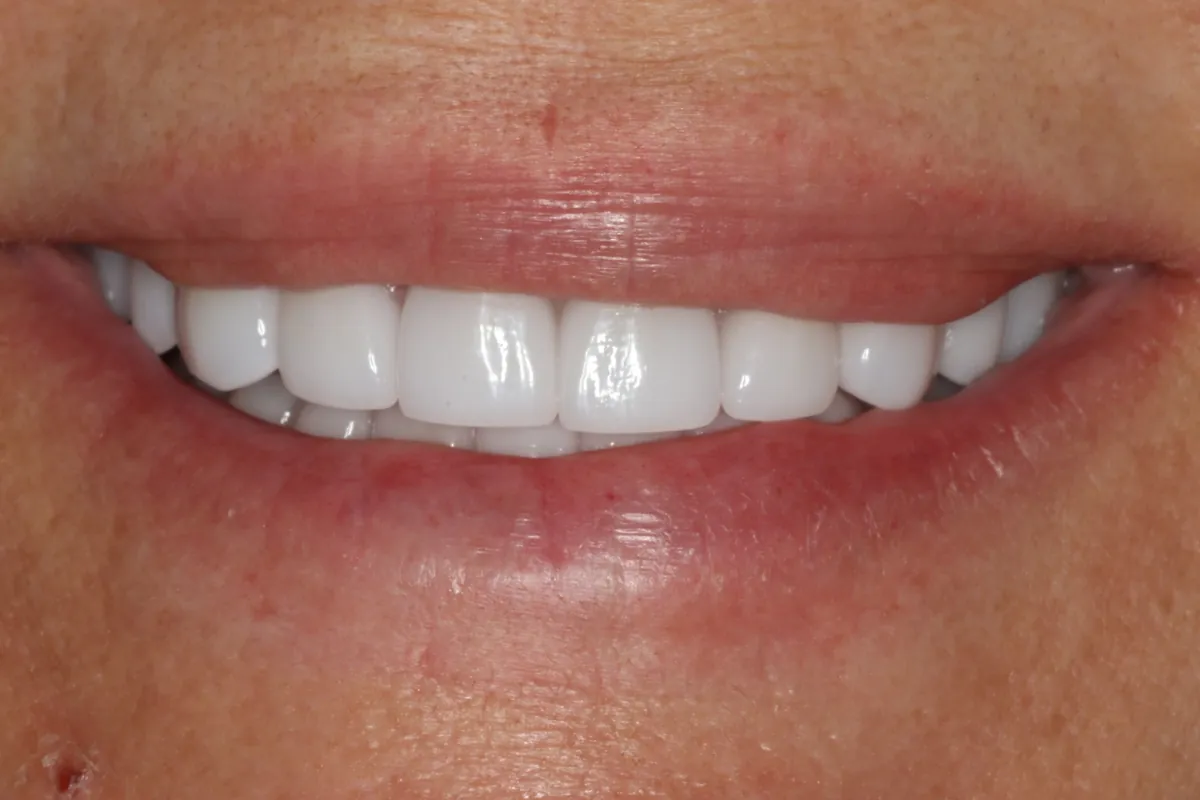
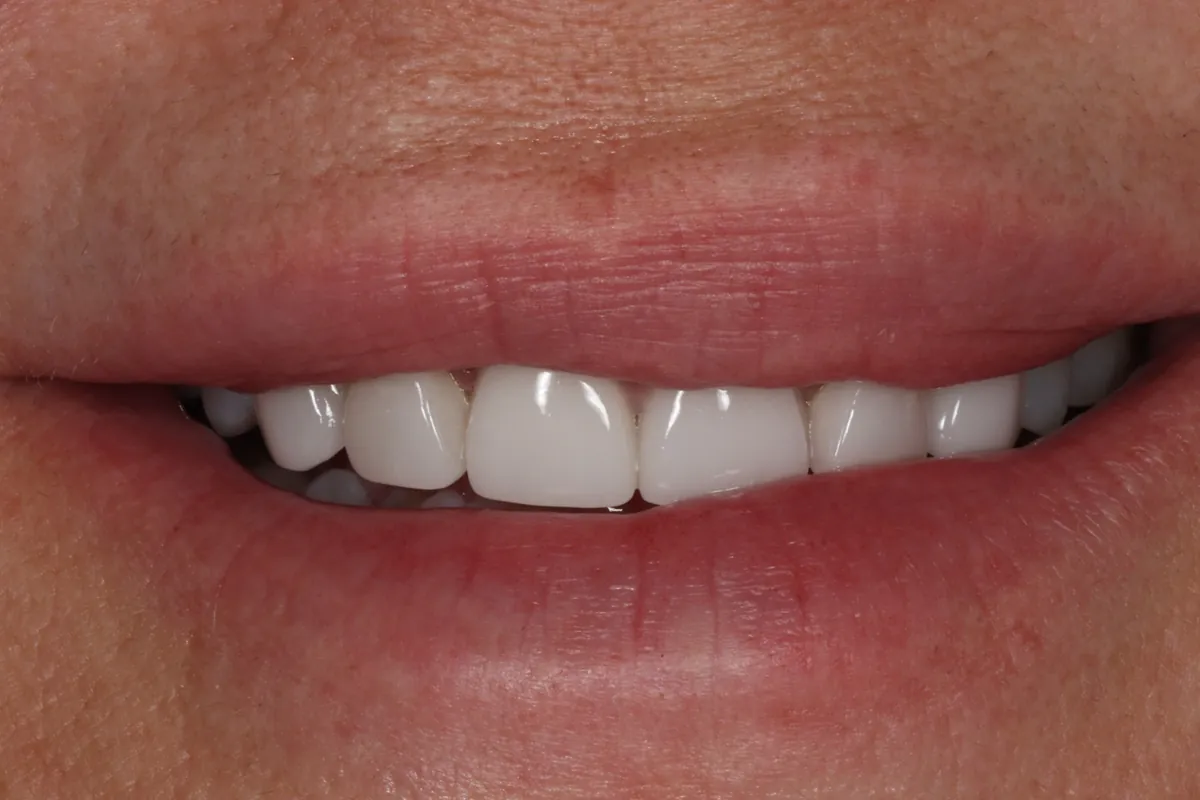
T.F.’s Story
The ask: Old, uneven veneers were wearing down her lower teeth, and four previous extractions had left her upper arch too narrow.
The plan: Arch expansion with an orthodontist, followed by restorative work, rebuilt both her function and her smile.
More rebuilt smiles: B.R., who was afraid of who to trust after years of dental work, S.V., whose crowns from another country never fit, and T.K., whose plan was phased over several years. See the full Smile Gallery →
How long it takes
The workup is its own phase: the exam, the 3D imaging of the joints (and an MRI when it’s needed) and the wax-up. Once the plan is set, and if nothing unexpected turns up, the treatment itself usually runs to roughly four to eight appointments across two to three months.
Cases run longer when gum disease has to be treated and re-checked first, when a tooth turns out not to be restorable once it’s opened, when a specialist has to be scheduled into the sequence, or when the bite needs more time to settle. That’s why the diagnosis comes before the timeline.
What it costs
We don’t publish a price, because a reconstruction isn’t one procedure. It’s a set of procedures, and which ones are in the set depends on what the workup finds: root canals, teeth that can’t be saved, a bite that needs settling, gum treatment, or orthodontics that can sometimes move a tooth instead of rebuilding it.
We usually compare it to buying a car. You know you need one. Nobody knows yet which one. Sometimes it’s a Honda or a Toyota, and sometimes the mouth in front of us needs a BMW.
You’ll see the full cost before you decide anything, broken into stages if it’s a large case. We take 5% off when a treatment plan of $1,000 or more is paid in full, and we offer CareCredit and Cherry for financing. Large cases can also be done in phases over months or years, starting with what’s urgent. How dental insurance works here.
Does it last?
Done in the right order, yes. A 2025 review of conservative full mouth rebuilds for worn teeth, across studies with at least three years of follow-up, estimated annual failure rates of 0.64% for composite, 0.13% for resin nanoceramics and 0.04% for ceramics.
Fan J, Wang B, Wang L, Xu B, Wang L, Wang C, Fu B. Clinical performance of minimally invasive full-mouth rehabilitation using different materials and techniques for patients with moderate to severe tooth wear: a systematic review and meta-analysis. Clin Oral Investig. 2025;29(2):96.
We also still see the same patients years later. In our gallery, T.C.’s ceramic crowns were photographed twenty years after they went in, and A.S.’s veneers thirteen years after. What keeps work like this going is fixing what caused the damage, protecting it from grinding if you grind, and keeping your hygiene visits.
Will it fix my jaw pain?
Not on its own, and we want to be clear about that. Rebuilding a bite doesn’t generally cause jaw problems, and it doesn’t generally cure them either. What restorative work can do is make permanent a jaw position that has already been shown to work for you, which is why the orthotic comes first when the joints or muscles are involved. The full reasoning.
That’s also why we want a full diagnosis of the joints before any bite is rebuilt. At minimum that means 3D X-ray imaging (CBCT), read by a radiologist, and sometimes an MRI of the joint when the question is about the disc or other soft tissue. Building a new bite onto a joint nobody has looked at is guessing.
Why patients come here for this
Dr. Sandquist has been Visiting Faculty at Spear Education for more than 15 years, teaching other dentists, and his postgraduate training includes Spear Education, the Misch International Implant Institute, and The Texas Center for Occlusal Studies and Minimally Invasive Dentistry, with a focus on the jaw and the bite. The practice has been in Las Vegas since 1968, and he has practiced here since 1998.
Our office is in southwest Las Vegas, in the 89117 zip code, and convenient to Summerlin, Spring Valley and The Lakes.
Where to start
Every reconstruction here starts with the same appointment: a comprehensive exam, photos, X-rays, a 3D scan, and a conversation about what we found before anyone talks about treatment. You’ll leave knowing how much of this you actually need. What your first visit involves.
Call 702-734-0776 or tell us what’s going on.