

Replacing a whole arch of teeth with a fixed bridge on four to six implants goes by a lot of names: All-on-4, All-on-6, All-on-X, teeth in a day. It’s a very good treatment for the right patient. It’s also the most heavily advertised procedure in dentistry, and almost all of that advertising comes from the surgical side.
So here’s what the ads leave out. Two different clinicians do two different halves of this case, and the half you actually live with is the second one.
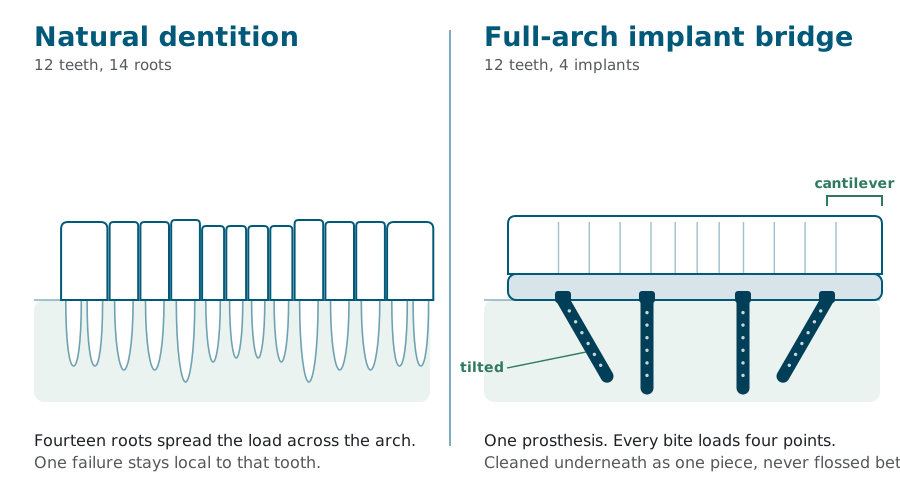
A full arch replaces twelve teeth and fourteen roots with one bridge carried on four implants. The back implants are tilted, often around thirty degrees, though the angle is chosen for each case, so the arch can rest on bone that’s already there instead of bone that has to be built. The teeth past the last implant are the cantilever, and that span decides whether a titanium framework is needed under the zirconia.
Considering a full arch of implant teeth? It’s a very good treatment for the right patient. Your first visit is where we find out if that’s you.
A card is needed to schedule online. Appointments missed, or cancelled with less than 24 hours’ notice, are charged a $75 fee.
What we do, and what we don’t
We don’t place the implants. That’s surgery, and it belongs with a surgeon who does it routinely, in a surgical setting, the same way we handle every other surgical procedure. The surgeon takes the 3D images, plans the implants, and does the surgery.
We plan the case with them from the tooth side, which means answering a different set of questions: where the teeth need to sit, what the bite has to do, how much vertical room the bridge needs, and what the finished arch should look like. Those answers have to exist before anyone drills, because where the implants go depends on where the teeth are going.
The surgeon places the foundation. We build what goes on top, and we look after it for as long as you have it. That’s the arrangement, and we’d rather you know it before your first appointment than after.
The temporary bridge: same day, or the next morning
The fixed temporary bridge is ours, and when you get it is a clinical decision, not a marketing promise.
Sometimes we deliver it the same day. Often we deliver it the next day, once you’ve fully woken up from the surgery. Same-day delivery is what gets advertised, so next-day can sound like a compromise. In our experience it’s usually the better appointment.
By the next morning, you’re alert, the anesthetic has worn off, and you’re much more comfortable. You can also tell us how the bite feels and what you think of the teeth. Fitting teeth you’ll wear for months on someone who’s still coming out of sedation isn’t the way to get that right.
The temporary has another job nobody mentions: it’s a working prototype. You wear it for months. How it looks, how you talk with it, where it catches food, how it feels when you chew, all of that is information, and all of it gets designed into the final bridge. If nobody uses the temporary that way, the permanent teeth are just a first attempt.
The final bridge: solid zirconia
The permanent bridge we deliver is monolithic, meaning solid, zirconia, and it’s screwed in.
Both of those choices are deliberate.
Zirconia, because the long-term data is now in. As recently as the 2018 ITI consensus, solid zirconia full-arch bridges were described as a possible future option that needed more evidence. That evidence has since been published. A series of 115 solid zirconia full-arch bridges in 71 patients reported a 98.6% survival rate over an average of about five years, with two fractures. The common problems were minor and fixable.
Papaspyridakos P et al. Zirconia full-arch implant prostheses: survival, complications, and prosthetic space dimensions with 115 edentulous jaws. J Prosthodont. 2025;34(3):271-280.
Screwed in, because it can come off. A systematic review comparing screwed-in and cemented full-arch bridges found real trade-offs both ways. Cemented cases had more biological problems, including implant loss and bone loss over 2 mm. Screwed-in cases had more mechanical problems, mostly screws loosening or breaking. The reviewers still preferred screws because the bridge can be removed. A loose screw on a screwed-in bridge is an appointment. The same problem under a cemented bridge can mean destroying the bridge to reach it.
Gaddale R, Mishra SK, Chowdhary R. Complications of screw- and cement-retained implant-supported full-arch restorations: a systematic review and meta-analysis. Int J Oral Implantol. 2020;13(1):11-40.
And once in a while, a titanium bar underneath. Most cases don’t need one. When the design calls for it, most often a long cantilever, we reinforce the zirconia with a titanium framework. Zirconia is very strong, but it’s still a ceramic, and long unsupported spans are exactly where ceramics are least forgiving. That’s an engineering decision made case by case, not something we do for everyone.
If you design a full arch so the predictable problems can be serviced, those problems stop being disasters. That’s most of the difference between a bridge that lasts twenty years and one that lasts five.
All-on-4, All-on-6, All-on-X: what the number means
The number is just how many implants hold up the arch. All-on-X is the general term, meaning the number is decided for each patient instead of fixed in advance.
More implants isn’t automatically better. The ITI consensus is that the research supports a range of implant numbers for a full-arch fixed bridge, and that tilting implants on purpose is appropriate when conditions call for it. How many, and at what angle, is a surgical judgment based on how much bone there is and where it is. It’s not a package you should pick off a price list.
A word on survival numbers, since people hear them constantly. Reported implant survival for this approach is very high, often cited around 99% in the short term. But reviews of the research are frank that follow-up is often short, patients drop out along the way, and problems around the implants are common enough that survival alone is a thin measure of success. An implant that’s still attached isn’t the same as a result that’s working.
When a full arch needs redoing
This is a real and growing part of what we see, and it falls into two situations worth telling apart.
Some of them are ours
We’re now redoing full arches we restored fifteen and twenty years ago. In most of those cases, nothing went wrong in the sense of a mistake. That’s just what the end of a long service life looks like.
Most of them were built the way the whole profession built them back then: a titanium bar wrapped in acrylic, with denture teeth set into it. That design works, and it wears. The acrylic wears away, teeth wear flat or break off the bar, and after twenty years of chewing there often isn’t enough left to repair. Watching that happen over two decades is a big part of why we use solid zirconia now.
Sometimes the bridge isn’t the only thing that needs replacing. If implants have been lost, new ones have to be placed before anything can be rebuilt on top, and that part goes back to a surgeon, just like the first time.
The survival numbers above can’t tell you this, because very little of that research follows anyone for twenty years. We can, because we’re still seeing the same patients. A full arch has a service life. It isn’t permanent, and it’s better to plan for that than be surprised by it.
And some of them aren’t
The rest come from somewhere else, and they usually look like one of these:
- The bridge has broken or the teeth have worn down, often on an older acrylic bridge that’s been in use a long time.
- Screws keep coming loose, which usually says something about the bite, not the screws.
- It can’t be cleaned. The arch traps food, the tissue underneath is inflamed, and nobody ever showed the patient how to clean the underside.
- The bite is wrong, and everything from soreness to breakage traces back to it.
- Nobody is taking responsibility. The surgical center blames the lab, the lab blames the dentist, the practice has closed, or the whole case was done in another country.
What we can usually do is look at the whole thing properly, and in many cases design and deliver a new bridge onto the implants you already have. What we can’t fix is implants placed where the teeth can’t work around them. That’s a surgical problem, it needs a surgeon, and we’ll tell you that on the day, not after you’ve paid for a plan that was never going to work.
One patient came to us after having crowns and bridges done abroad, unhappy with how they looked. The exam found a deeper problem: none of it fit, which had already caused gum disease and cost him several back teeth. See how we solved S.V.’s case →
The part nobody sells you
A full arch isn’t a set of teeth you stop thinking about. It’s a bridge bolted to bone, and it needs upkeep.
That means professional cleaning of surfaces you can’t reach at home, regular checks on the screws and the fit, keeping an eye on the bite as it changes, and watching the tissue around every implant for the inflammation that comes before bone loss. Problems around the implants are the most common reason a case that looked perfect on delivery day is in trouble years later, and they’re largely preventable if someone is actually looking.
Since we’re the practice that restores these, not the one that places them, this is the half of the case we’re built around.
Is this even the right option?
Sometimes the answer is no. Going to a full arch means committing to removing whatever teeth you have left, and that’s not a decision to make quickly because a seminar made it sound easy. If some of your own teeth are strong enough to build around, that’s worth knowing before anything comes out.
We’ll walk you through how this compares to individual implants, a bridge, or an implant-supported denture for your mouth, your bone and your budget, before anyone recommends anything.
Talk it through first
Whether you’re considering this, already scheduled somewhere else, or living with one that isn’t working, a conversation costs you nothing. Call 702-734-0776 or tell us what’s going on.