

Digestion does not start in your stomach. It starts in your mouth, with three jobs that have to happen before you swallow. When one of them fails, eating gets harder, and for older adults it gets riskier than most people realize.
Key points
- Teeth break food down, saliva binds it, and the tongue moves it back. All three have to work.
- Poor or missing teeth show up again and again in studies of people who choked to death on food.
- Older adults with fewer teeth are about twice as likely to develop swallowing problems.
- Food that sticks lower down, in the esophagus, is usually an esophagus problem. See your physician.
- Learn the Heimlich maneuver. Most choking deaths happen with someone nearby.
Three jobs before you swallow
1. Teeth
Break it down
Chewing is the only step that cuts and grinds. Denture wearers chew longer and still swallow bigger pieces.
2. Saliva
Hold it together
Saliva binds chewed food into one slippery mass and starts digesting starches. A dry mouth leaves food crumbly and sticky.
3. Tongue
Move it back
The tongue presses food against the palate and pushes it back in one wave. Weaker tongue pressure goes with more coughing at meals.
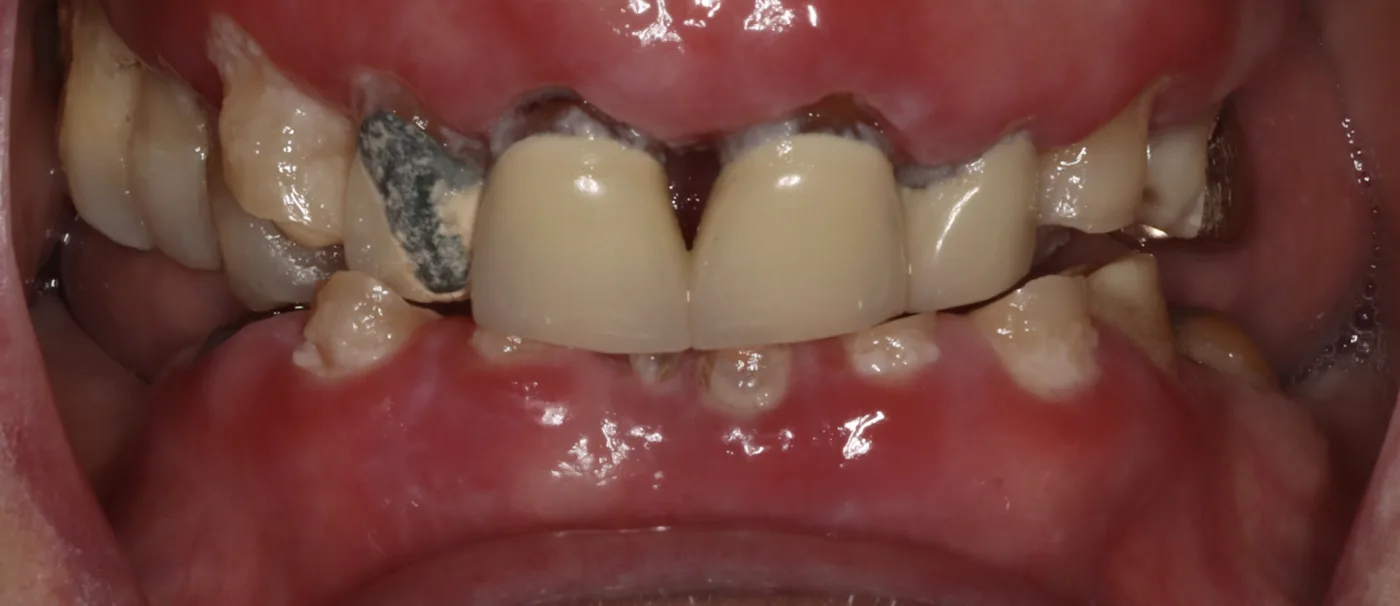
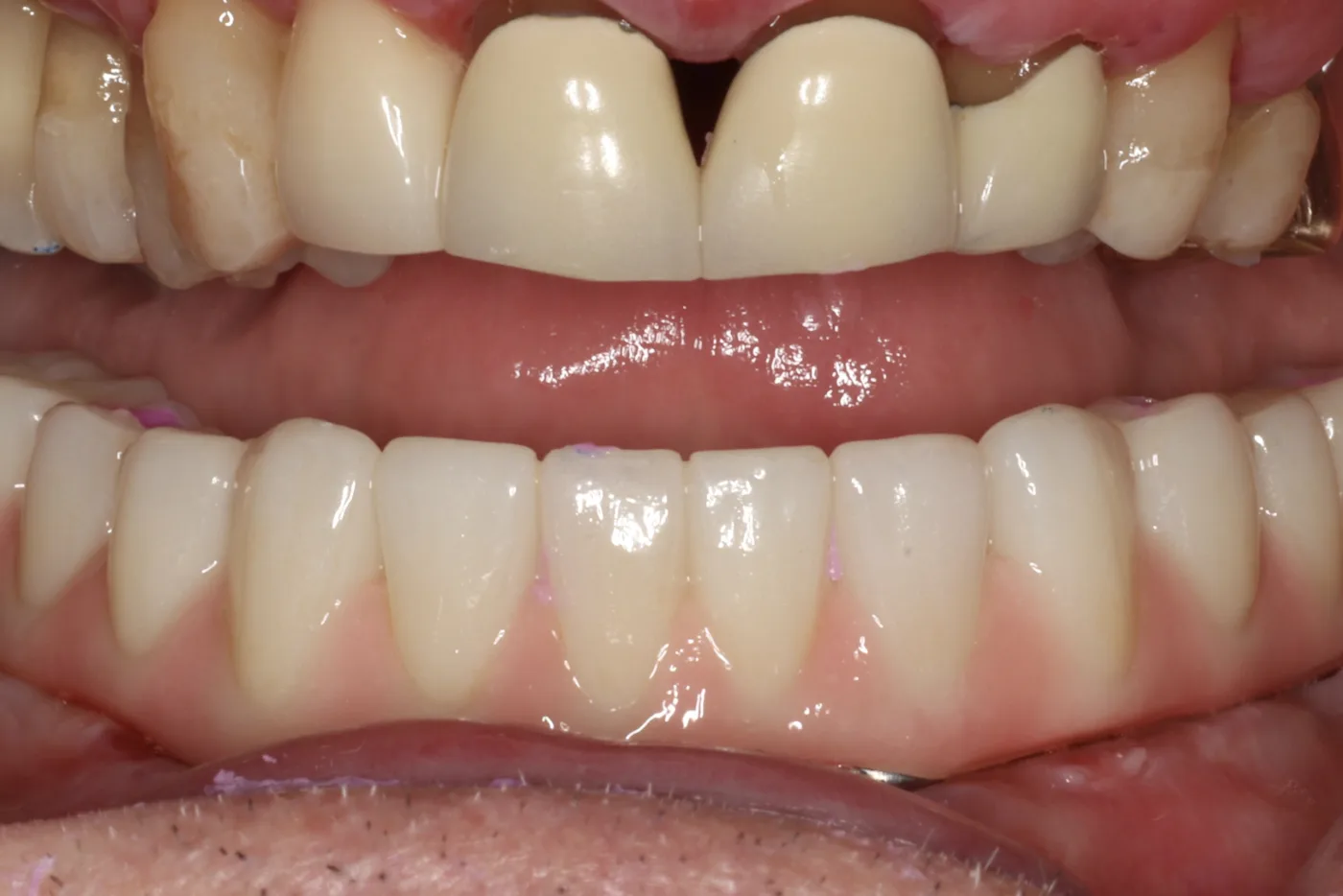
One of our patients, before and after. His lower teeth were so worn they hurt to use and could not be saved. They were removed, dental implants were placed, and we restored the lower arch on the implants so he can chew again. Full-arch implants →
What the research shows
Medical examiners have studied deaths from choking on food for more than forty years, and the same short list keeps coming up: older age, poor or missing teeth, and alcohol.
the odds of a swallowing problem in adults 65+ with 13 or fewer teeth, compared with 25 or more. Study →
the odds of developing one over five years when starting with 22 or fewer teeth. Study →
of choking deaths in one Vienna study were not recognized as choking by the people nearby. Study →
| Study | Who | What they found |
|---|---|---|
| Miami, 1982 | 141 choking deaths | Older age, poor teeth and alcohol were the expected findings. Someone was watching in 85%. |
| Vienna, 1999 | 191 choking deaths | Same three risks. Bystanders and most emergency crews did not recognize choking. |
| Vienna, 2005 | 273 choking deaths | Older victims were more likely to have no teeth and mostly choked on soft, slippery food. |
| Belgrade, 2011 | 98 choking deaths | Most had poor teeth. Poor teeth plus alcohol were the strongest risks. |
| Japan, 2012 | 3,663 independent adults 65+ | 13 or fewer teeth: about twice the odds of a swallowing problem. |
| Japan, 2015 | 1,988 adults followed 5 years | Fewer teeth at the start: about 2.5 times the odds of developing one. The tooth loss came first. |
The soft-food finding surprises people, but it fits the three jobs. Without teeth, food is not broken down or mixed with saliva. It goes back as a lump, and a soft lump can block the airway as completely as a hard one.
Choking or stuck? They are different problems
Choking: the airway
- Food blocks the windpipe.
- The person cannot talk, cough or breathe.
- Call 911 and start abdominal thrusts.
Stuck: the esophagus
- Food sticks behind the breastbone on the way to the stomach.
- Usually a sign of a problem in the esophagus itself, such as inflammation, a narrowing or a ring.
- See your physician or a gastroenterologist.
In one hospital series, more than half of the people treated for food stuck in the esophagus had an underlying esophageal problem, and half of those had never been diagnosed (study). Better teeth help you chew, but they will not fix a narrowing in your esophagus.
What we look at
- Teeth and chewing. How many teeth you actually chew on, whether they meet, and whether a denture stays put while you eat. Replacing missing teeth →
- Saliva. Whether your mouth is dry, and whether medications are the reason. Dry mouth care →
- The tongue and the swallow. Dr. Lee-Mirzayan is a certified myofunctional therapist. She looks at how the tongue rests and moves during a swallow and retrains it with exercises when the pattern is off. Swallowing trouble after a stroke or with a neurological condition belongs with a speech-language pathologist and your physician.
At the table: cut food smaller and take smaller bites. Wear your dentures to eat. Slow down and finish one bite before the next. Go easy on alcohol with meals.
Know the Heimlich maneuver before you need it, especially if you eat with an older parent or a partner who has missing teeth or wears dentures. Red Cross: how to help a choking adult → MedlinePlus illustrated guide →
If chewing has gotten harder, food seems to catch, or you cough at meals more than you used to, mention it at your next visit or call us at 702-734-0776.
Common Questions
Can missing teeth make you more likely to choke?
Can tooth loss cause trouble swallowing?
Why do older people choke on soft food?
What is the difference between choking and food getting stuck?
What can I do to eat more safely with missing teeth or dentures?
Sources
- Pedersen AM et al. Saliva and gastrointestinal functions of taste, mastication, swallowing and digestion. Oral Dis. 2002. PubMed
- Yoshida M et al. Decreased tongue pressure reflects symptom of dysphagia. Dysphagia. 2006. PubMed
- Mittleman RE, Wetli CV. The fatal cafe coronary. JAMA. 1982. PubMed
- Berzlanovich AM et al. Foreign body asphyxiation: an autopsy study. Am J Med. 1999. PubMed
- Berzlanovich AM et al. Foreign body asphyxia: a preventable cause of death in the elderly. Am J Prev Med. 2005. PubMed
- Nikolić S et al. Laryngeal choking on food and acute ethanol intoxication in adults. J Forensic Sci. 2011. PubMed
- Okamoto N et al. Relationship between swallowing problems and tooth loss in community-dwelling independent elderly adults. J Am Geriatr Soc. 2012. PubMed
- Okamoto N et al. Association of tooth loss with development of swallowing problems in community-dwelling independent elderly population. J Gerontol A. 2015. PubMed
- Ferrari D et al. Esophageal foreign bodies: observational cohort study and factors associated with recurrent impaction. Eur J Gastroenterol Hepatol. 2020. PubMed