

Dry mouth doesn’t feel like thirst. Most of the time it doesn’t feel like anything at all.
You adapt to it. A drink with dinner to get the food down. Mints in the car. A glass of water at three in the morning. None of it registers as a symptom, because it arrived slowly and you adjusted around it.
Your teeth registered it immediately.
This is the most common reason a careful brusher keeps getting cavities.
Six questions that find it faster than a mirror does
Nobody walks in and says they have reduced salivary flow. They say crackers have gotten hard to swallow. Answer these for a typical week rather than a bad day.
- You reach for a drink to get dry food down. Crackers, bread, chicken, rice. Food that used to go down fine now needs help.
- You wake at night for water, or wake with your mouth open and your throat dry. The second one also says something about how you’re breathing.
- Your mouth feels dry while you’re actually eating a meal. This is the strongest question on the list, because eating is the moment saliva should be at its highest.
- You keep mints, gum, lozenges or hard candy going most of the day. A habit that starts as comfort. If any of it contains sugar, it’s now feeding the problem as well as masking it.
- Your lips crack, or the corners of your mouth split and stay sore. Often the first thing visible from the outside.
- You take two or more prescription medications every day. Not a symptom, and the strongest predictor on the list.
If two or more of those fit, bring it up at an exam. We’ll look at your X-rays, medications and history together, and if it’s warranted, measure your saliva instead of guessing. Here’s how we look into it.
The feeling and the measurement are two different things
These two words get used interchangeably and shouldn’t be. The distinction is the reason a lot of decay goes unexplained for years.
| Term | What it means | How it is established |
|---|---|---|
| Xerostomia | The feeling of a dry mouth | Subjective. What you would report. It can be present with completely normal flow, from dehydration, anxiety, or a change in saliva’s thickness rather than its volume. |
| Hyposalivation | Measurably reduced flow | Objective. Conventionally defined as unstimulated flow at or below 0.1 mL per minute. This is the one most often blamed for the decay. |
You can have either without the other, and the combination that costs the most teeth is the quiet one.
Measurably dry, feels normal. No complaint, nothing to flag, and a set of new cavities at every checkup in someone who brushes carefully and has changed nothing. That’s where years get lost, and it’s the reason a measurement beats a conversation about how your mouth feels.
Volume isn’t the only variable
Those two words between them cover how much saliva there is and how dry it feels. Neither covers the third thing, which is what the saliva is actually like when it gets there.
- Buffering capacity. Saliva neutralizes acid largely through bicarbonate, and how much of that is present varies between people. Weak buffering means the mouth takes longer to climb back above the critical pH after every meal, and longer below the line is more dissolving.
- Resting pH. Where your mouth sits between meals decides how much headroom you have before enamel starts losing mineral. Starting lower means reaching the threshold sooner and leaving it later.
- Consistency. Thick, ropy saliva doesn’t clear food and acid the way thin, watery saliva does, even at an identical volume per minute. It’s also the version people most often describe as feeling dry while their flow test comes back normal.
Buffering usually tracks flow, but not always, so we measure both rather than assume either way. Bicarbonate is the main salivary buffer and its concentration rises as flow rises, so the two travel together rather than independently. They aren’t the same thing though, and a flow number alone won’t tell you where somebody actually sits. All three of these are testable chairside alongside the flow measurement, and we do them together. Buffering capacity in particular is a recognized caries risk factor, built into the Cariogram and the Caries Risk Semaphore, though notably not into CAMBRA, which is the risk protocol most American offices use. That’s part of why it goes unmeasured.
Saliva also has to reach the tooth
There’s a second reason good saliva doesn’t guarantee a quiet mouth, and it’s the answer to a question we get from people who clearly aren’t dry: plenty of saliva, and cavities anyway.
Plaque is a barrier. The acid attack that dissolves enamel happens inside the plaque layer sitting on the tooth, not in the saliva washing over the top of it. Mature plaque slows diffusion in both directions, so the buffering and the minerals your saliva is carrying don’t fully reach the surface underneath. That’s why pH under plaque takes twenty to sixty minutes to recover after a meal even in someone whose saliva is perfectly good.
The same applies anywhere saliva flows past rather than through:
- Between the teeth, where a brush doesn’t reach and saliva doesn’t circulate
- Deep grooves and fissures on the biting surfaces
- The margins of old fillings and crowns
- Around brackets, attachments and anything else that holds plaque against a surface
So saliva is necessary but not sufficient. Plenty of it doesn’t help at a site it can’t get to, and it can’t outrun an acid supply that never stops. That’s why frequency matters more than quantity, and why how you drink something matters more than how much of it you drink. And a mouth that seems to produce too much saliva is more often a swallowing or clearance issue than true overproduction, and drooling isn’t the same as the teeth being bathed.
Eight hours a night with the defense switched off
Salivary flow isn’t steady through the day. It rises sharply with meals, because chewing is the pump, and it falls to almost nothing during sleep. That happens in everyone. Our one-page saliva clock shows the whole day at a glance, with what to do at each point.
If your daytime baseline is already low, the night has nothing left to give. Someone with reduced flow gets a fraction of each meal peak, spends most of the day near the threshold, and then joins everyone else at zero overnight.
Two things follow from that:
- Anything acidic or sugary in the evening does disproportionate damage, because there’s no recovery window behind it.
- A remineralizing product at bedtime earns its keep in a way it doesn’t at any other hour.
It’s also why acid erosion and dry mouth compound each other. Saliva is the entire defense: it neutralizes acid, clears food, and carries minerals back into enamel. Remove it and every other risk in the mouth gets worse at once.
Quick answer: Why do I wake up with a dry mouth?
Where it comes from
Medication is the leading cause, and it’s rarely one drug
Risk climbs with the number of medications rather than the strength of any single one. Dry mouth is listed as a side effect of more than 400 prescription and over-the-counter drugs. In a review of the 200 most frequently prescribed drugs in the United States, it was the single most common oral side effect of all, appearing for roughly four in five of them.
The 400-drug figure follows the US Surgeon General’s report Oral Health in America. The four-in-five figure is Smith RG, Burtner AP. Oral side-effects of the most frequently prescribed drugs. Spec Care Dentist. 1994;14(3):96-102, which reviewed the 200 most frequently prescribed drugs in the United States for 1992 and found xerostomia the most common oral side effect at 80.5%, ahead of altered taste at 47.5%. That is old prescribing data and the mix of drugs has changed considerably since, so read it as an indication of how widespread the effect is rather than as a current count.
The classes to look for in your own routine:
- Blood pressure. Diuretics, beta blockers, ACE inhibitors, calcium channel blockers.
- Antidepressants. SSRIs, SNRIs, and especially the older tricyclics.
- Antihistamines. Allergy pills, and most nighttime cold and sleep aids.
- Anxiety and sleep. Benzodiazepines, muscle relaxants, sedatives.
- Bladder and gut. Overactive bladder drugs, antispasmodics, antidiarrheals.
- Pain. Opioids, and NSAIDs taken daily.
- Breathing. Inhalers, bronchodilators, decongestants.
- Neurologic and psychiatric. Antipsychotics, anti-Parkinson’s, anticonvulsants.
- Stimulants. ADHD medications, appetite suppressants.
Five or more medications is the threshold where the effect compounds noticeably, and two mild ones together often outweigh one strong one. Medication can change the character of saliva as well as the quantity, which is why some people on a long list report a dry, sticky mouth while their flow rate still measures acceptably.
Don’t stop or change anything on your own. The fix is almost always a conversation with the prescriber about timing, dose, or an alternative within the same class. That conversation goes considerably better with a dental finding attached to it, so bring the actual list, names and doses, to your next visit.
The other common causes
- Mouth breathing. Allergies, a blocked nose, enlarged tonsils, or simple habit. Air moving across the teeth for eight hours dries them directly no matter how well the glands are working, and it’s often the whole explanation in someone taking no medications at all. How that happens, and what it looks like in an exam.
- Sleep apnea and CPAP. Apnea drives mouth breathing, and CPAP with a mouth leak pushes dry pressurized air across the teeth all night. Treatable, usually with a chin strap, a full-face mask, or a humidifier on the unit.
- Living in the desert. Las Vegas averages roughly 30% relative humidity across the year and drops near 17% in June, with afternoon readings into single digits. Indoor comfort sits around 40 to 60%. You start every day at a deficit most of the country doesn’t.
- Caffeine, alcohol, tobacco and vaping. All reduce or thicken saliva, and thickening it is the half people notice least. Vaping deserves its own mention, because propylene glycol pulls water out of the tissues it touches, and it touches the teeth on the way through.
- Autoimmune and metabolic disease. Sjögren’s disease is an autoimmune condition in which the immune system attacks the glands that make saliva and tears, so a dry mouth together with dry eyes is its classic pairing. It can also bring fatigue, joint pain and swollen glands around the face and neck. A rheumatologist makes the diagnosis, and it often takes years, partly because each symptom on its own seems minor. Poorly controlled diabetes and thyroid disease both reduce flow too. Sudden severe dryness, or a dry mouth alongside dry eyes, deserves a medical workup, not just a dental one. If you have Sjögren’s or think you might, our one-page Sjögren’s resource sheet covers where to find help and how to protect your teeth.
- Radiation and chemotherapy. Head and neck radiation causes the most profound dryness we see, often permanently. Anyone in or past cancer treatment needs a preventive plan built before problems appear rather than after.
It isn’t just getting older. Salivary glands hold up reasonably well with age on their own. The reason dryness tracks with age is that medications and chronic disease do. That distinction matters, because “it’s just my age” is untreatable and “it’s the four things I take every morning” isn’t.
Dry-mouth decay has a recognizable signature
It doesn’t look like childhood cavities. If your recent fillings have been in these places, that’s information.
- At the gumline. A band of decay running along where tooth meets gum, often on several teeth at once. The classic presentation, and easy to mistake for staining.
- On exposed roots. Root surface has no enamel and starts dissolving around pH 6.2 rather than 5.5. Where gums have receded, this is the softest target in the mouth.
- On biting edges and cusp tips. Surfaces that are normally self-cleaning and rarely decay. When they do, it points at chemistry rather than plaque.
- Around fillings and crowns that were fine. Recurrent decay at the margins of restorations that held for a decade. The restoration didn’t fail. The environment around it changed.
- Several new lesions at once. Three or four appearing between one checkup and the next, in someone whose habits haven’t changed. When the habits are the same and the decay isn’t, something about the environment has moved.
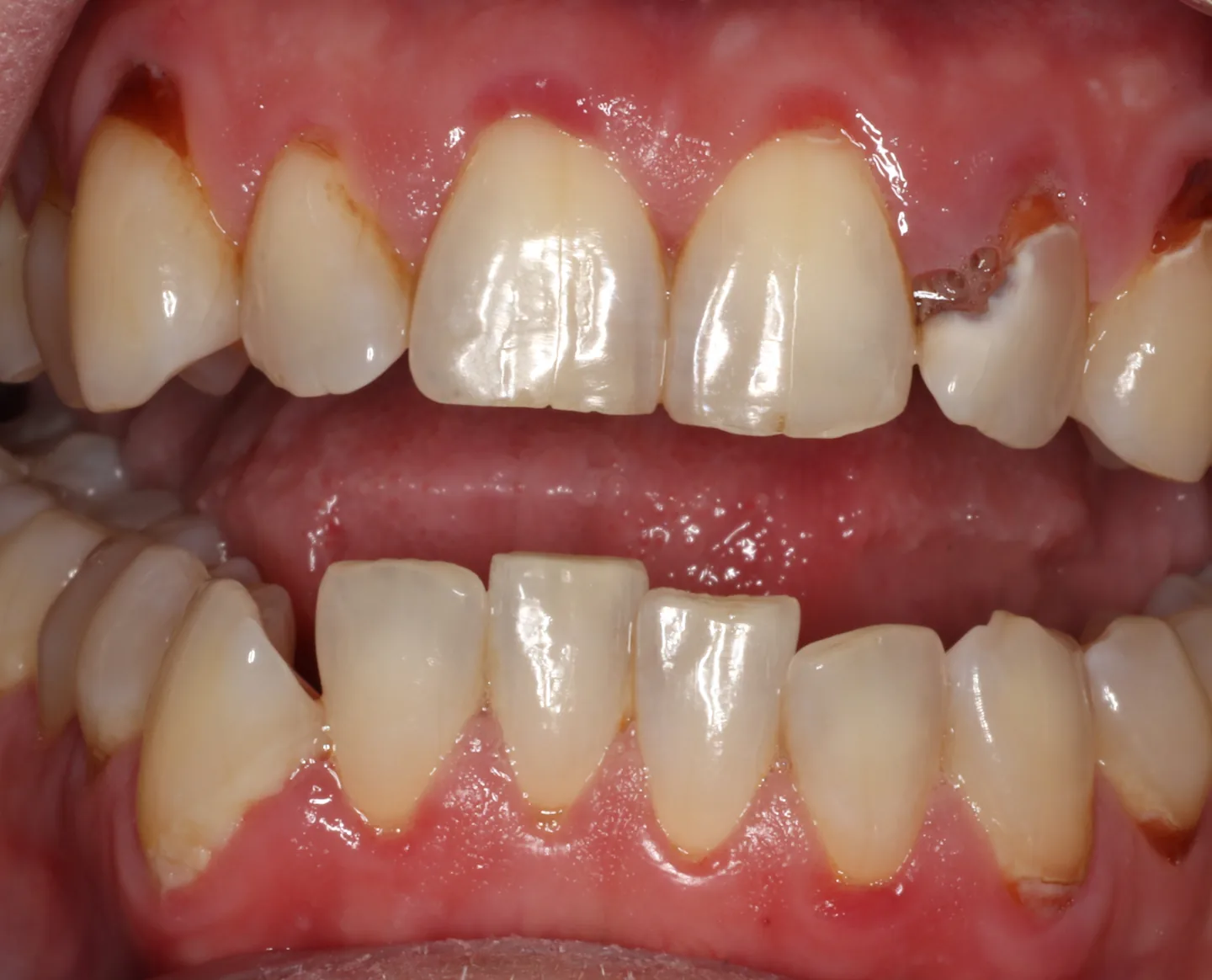
Decay following the gumline on several teeth at once, rather than in the pits and grooves where childhood cavities form. This is the pattern a dry environment produces, and it turns up even in people who use a toothbrush well. It is magnified in people who do not, which is also on show here: the plaque and the inflamed gum margins are making an already hostile environment considerably worse.
The case that changed how we look at rapid decay
One patient came to us with decay we couldn’t account for. He brushed, nothing about his habits had changed, and new lesions kept turning up anyway. The answer was diabetes, undiagnosed and well advanced.
We weren’t the ones who found it. The diagnosis came later, from his physician. Once his metabolic health was under control, the decay stopped.
We put that one in the column of things we should have connected sooner. Rapid, unexplained decay is now on our list of reasons to ask about metabolic health and to suggest somebody get their blood sugar checked, rather than restoring the teeth and scheduling the next visit.
That’s one case and it doesn’t make a rule. What it illustrates is that the mouth sits downstream of the rest of the body, and that decay nobody can explain is a question to ask, not a verdict on how well someone brushes. We can’t diagnose diabetes from a dental chair. We can notice that something doesn’t add up and say so.
Why numbers beat an impression
Three things lining up will usually identify this: what you report in those six questions, what’s on your medication list, and where the decay is actually showing up. Any one of them alone is suggestive. All three together are normally the answer.
Measuring turns that judgment into numbers, and numbers do two things an impression cannot. They tell us whether we’re treating a real deficit or a symptom with a different cause. And they give us something to compare against later, so we can tell whether anything we changed is actually working.
Flow is the headline measurement rather than the only one. Resting pH, buffering capacity and consistency fill in what flow alone leaves out. Where the decay doesn’t match the flow number, those are usually where the explanation is hiding, and where it still doesn’t add up, the answer is often that saliva isn’t reaching the surfaces that are breaking down.
Guessing at dry mouth is how people end up managing it for a decade without ever fixing it.
Ten things that actually change the outcome
- Bring the real medication list to your prescriber. Ask specifically whether anything can be moved to the morning, reduced, or swapped within the same class. Never stop anything yourself.
- Run a humidifier in the bedroom. The highest-yield change available to almost anyone living here, and the least effort. Eight hours of moist air against the eight hours your glands are offline.
- Xylitol gum or lozenges, around five times a day. Chewing is the only lever that reliably raises flow on demand, and xylitol can’t be fermented into acid by the bacteria that cause decay. After meals is the highest-value timing. It also helps the buffering side, because stimulated saliva carries more bicarbonate than resting saliva does. Headlines in 2026 tied xylitol to cardiovascular events, but that work measured xylitol in the blood, which the body also produces on its own, and the one consumption experiment used about thirty times what a piece of gum contains.
- Remineralize every night, without exception. High-fluoride paste or a nano-hydroxyapatite product, last thing, spit but don’t rinse. We run both tracks here, so if you’d rather avoid fluoride, the nano-hydroxyapatite protocol is a real option and not a consolation prize.
- Disrupt the plaque, especially between the teeth. This is the half saliva can’t do for you. Buffering and minerals don’t diffuse properly through a mature plaque layer, so the surfaces that decay are usually the ones a brush and floss aren’t reaching rather than the ones saliva isn’t reaching.
- Get the nose working. If you wake with a dry mouth and an open jaw, the drink and the toothpaste are downstream of the real problem. Dr. Lee-Mirzayan is certified in myofunctional therapy and handles that side directly, including deciding when an ENT referral is the right next step.
- Sip water steadily, but only water. Constant sipping of anything acidic or sweet is worse than the dryness it’s treating, for reasons that have more to do with time than quantity. Plain water all day, and a glass at the bedside.
- Alkaline water may help, particularly after meals. With reduced flow or weak buffering, plaque stays acidic long after eating because there isn’t enough capacity to pull it back toward neutral. Drinking something already above neutral nudges it the other way. To be clear, this is a gentle effect rather than a strong one, and the evidence behind alkaline water is thin. Its advantage is that people actually keep doing it, and a modest habit sustained for years beats a stronger one abandoned in two weeks.
- Ask about a gel or spray for overnight. Saliva substitutes coat and hold through the night in a way water can’t. For true gland hypofunction there are also prescription medications that stimulate the glands themselves. Ask your physician about them if the dryness is severe.
- Drop the alcohol-based mouthwash and the SLS toothpaste, and come in more often for a while. Both of those products dry and irritate the tissue you’re trying to protect. And three- or four-month intervals instead of six, while we get this under control, is how lesions get caught while they can still be reversed rather than drilled.
What about oral probiotics?
Some of our patients swear by them and others notice nothing, and the research explains a lot of that split. Probiotics don’t make more saliva: in a three-month trial of adults with low flow, probiotic gum did no better than plain gum. Where they have shown something is the yeast that thrives in a dry mouth. In older adults, pooled trials found they cut the odds of oral candida roughly in half. So if your dry mouth comes with burning, a coated tongue or cracked corners of the mouth, one is reasonable to try, and let us take a look too. If what you want is more saliva, it probably isn’t the answer. No brand has been shown to beat the others, so it’s trial and error. A few brands to start with, and the studies, are on our products page.
Worth bringing up
If you’re getting cavities you can’t account for, bring your medication list to your next visit and say so. It’s a short conversation, it frequently explains the whole picture, and if the exam points that way, a saliva test can settle it. Here’s how we approach dry mouth.
Call 702-734-0776 or tell us what’s going on.
Hyposalivation is conventionally defined as unstimulated whole salivary flow at or below 0.1 mL/min, or stimulated flow at or below 0.5 to 0.7 mL/min. Buffering capacity, resting pH and consistency are separate parameters measured alongside flow rather than derived from it, though buffering and flow are correlated because salivary bicarbonate concentration rises with flow rate; buffering capacity is included in the Cariogram and the Caries Risk Semaphore but not in CAMBRA. Plaque pH recovery times of twenty to sixty minutes refer to measurements taken within plaque rather than in whole saliva. Humidity figures are long-term Las Vegas climate averages. Medication sourcing is given where those figures appear above. On xylitol and cardiovascular risk: Witkowski et al., Xylitol is prothrombotic and associated with cardiovascular risk, Eur Heart J. 2024;45(27):2439, reported an association between plasma xylitol and cardiovascular events and increased platelet reactivity after 30 g of xylitol dissolved in water in ten volunteers; a larger cohort analysis was presented at ESC Congress 2026 and has not yet been peer reviewed. Both measured xylitol in plasma rather than xylitol eaten, and xylitol is produced endogenously through the pentose phosphate pathway. Chewing gum rarely exceeds 1 g per piece, and 7 g ingested produced no detectable rise in plasma xylitol in a double-blind study. We are watching that literature rather than dismissing it. On probiotics: Gueimonde L, et al. Food Funct. 2016;7(3):1601-9 (probiotic versus plain xylitol gum, 54 adults with hyposalivation, no difference in flow); Ai R, et al. Arch Oral Biol. 2017;83:187-192 (three randomized trials in older adults, 595 people, pooled odds ratio for oral candida 0.54). On Sjögren’s disease: Sjögren’s Foundation; National Institute of Dental and Craniofacial Research; National Institute of Arthritis and Musculoskeletal and Skin Diseases. General education, and not a substitute for an exam or for medical advice about your prescriptions.