

If you’ve lost a tooth, a dental implant is usually the best thing we can do for you. Not one option among several. The best one.
We’re saying that first because the rest of this article gets into detail, and detail can sound like hesitation. Once a tooth is gone, we recommend implants, we plan them and restore them regularly, and we’ve watched them change people’s lives. The fixture itself is placed by a surgeon we work with, and we plan the case together. The tooth on top of it is ours.
There’s one situation where the reasoning is different. That comes at the end.
Why an implant beats the alternatives
When a tooth is gone, you have four real choices, and three of them have problems the fourth doesn’t. We compare all four in more detail on our tooth replacement page.
A bridge works, and we still place them in the right situation. But it’s carried by the teeth on either side, and those teeth have to be cut down to hold it. If they’re already crowned, that may cost you nothing. If they’re healthy and untouched, you’re trading two sound teeth to replace one missing one.
A removable partial, or a flipper, is a placeholder. It comes out at night, it clasps onto other teeth, and most patients tolerate it rather than like it. It has a place while something else is healing. It isn’t where you want to end up. More on partials and dentures.
Leaving the space feels like the conservative choice and isn’t. A gap doesn’t stay a gap. The teeth on either side drift toward it. The tooth above or below it drops down looking for something to meet. Food packs into the spaces that open up as things shift. And the bone that used to hold the root, no longer being loaded by anything, begins to resorb. That’s the hidden cost: it makes every future option harder, including the implant you may eventually want.
An implant avoids all of that. It stands on its own, it touches none of the neighboring teeth, and because it’s anchored in bone it keeps loading the bone the way a root did. It’s the only option on the list that replaces what was actually lost. Here’s how we plan and restore implants.
What makes it work: it replaces the root
Every other restoration in dentistry sits on top of something. A crown wraps what’s left of a tooth. A bridge hangs between two teeth. A partial rests on the ridge and clasps whatever is nearby.
An implant is a different kind of thing. It’s a titanium fixture placed into the jawbone, and over the following months the bone grows into direct contact with its surface. That process is called osseointegration, and it’s the whole reason implants work. The fixture becomes part of the skeleton. The crown goes on top of it.
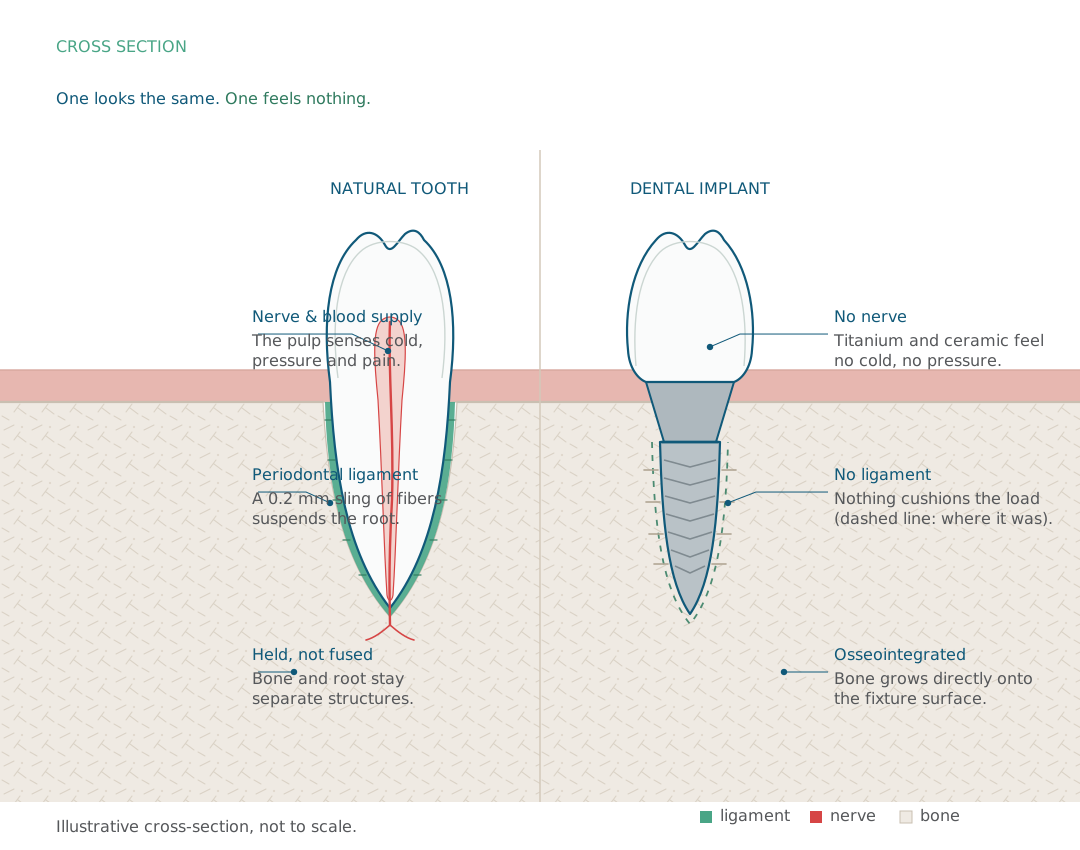
A natural tooth is suspended in bone by a ligament and carries a nerve inside it. An implant is fused straight to the bone, with neither. The dashed line marks where the ligament used to be.
That’s why an implant doesn’t move, doesn’t come out, doesn’t lean on anything else, and doesn’t need the teeth beside it to be touched. Most of our patients stop noticing which tooth it is within a few months.
How the work is divided
An implant is a team effort. Here’s who does what.
We start at the end and work backward. Before anything is placed, we work out where the tooth needs to sit: how it has to meet the teeth around it, how it has to look, and therefore where in the bone the fixture should go to make that possible. We plan that together with the surgeon, whose judgment about what the bone will support sometimes has to lead.
A periodontist or oral surgeon places the fixture. We refer that step to specialists who do it every day, and we stay involved through it.
Then the implant is ours again. We restore it, meaning the abutment, the crown and the bite, and we follow it from that point on, at every visit, for as long as you’re our patient.
How long the whole thing takes
People are least prepared for this, and it’s much better to know at the start than to find out halfway through.
If the tooth is already out, the site has healed and there’s enough bone, the road is shorter. But the common case is a tooth that still has to come out, and then it runs like this.
- The tooth comes out, and the socket is often grafted at the same appointment. Grafting the socket preserves the bone that would otherwise resorb away once the root is gone. That then heals for about four to six months.
- The fixture is placed. It’s left to integrate for another four to six months while bone grows onto the surface. The surgeons we work with prefer to run past four months rather than up to it, and we’d rather they did.
- The tooth goes on. That’s our part: the abutment, the crown and the bite.
So from a tooth coming out to a finished tooth going in, the realistic span is most of a year. That isn’t a complication and it isn’t anybody being slow. You’re waiting twice, and for two different things: first while the bone heals, then while the implant osseointegrates. Neither can be hurried, and the alternative to waiting is a fixture loaded before it was ready.
A site that’s been empty for years is its own conversation, because the bone has already gone and what has to be rebuilt is more than a socket. Ask about it early, since it changes both the time and the cost.
When a tooth can go on right away
That timeline is the usual road. There’s a shorter one, called immediate loading, where a provisional tooth goes on at or close to the time the fixture is placed rather than months later. It’s real and we do it. Whether it applies to you comes down to one thing.
Primary stability. That’s how firmly the fixture is gripped by bone the moment it goes in, before any biology has happened at all. An implant that’s solid on day one can carry something. One that isn’t has to be left alone, because the thing that prevents osseointegration is movement at the surface while bone is trying to grow onto it.
Given good stability, two situations are predictable:
- Several implants across an arch, splinted together. Joining them under one provisional spreads the load across all of them and braces each against the others. That’s why full-arch cases are the most reliable form of immediate loading rather than the most daring one.
- A single implant where the provisional can be kept out of occlusion. The temporary tooth is shaped so it doesn’t meet the opposing tooth when you bite or slide sideways. It fills the space and it looks like a tooth. It just isn’t asked to chew.
Where it gets dicey is the reverse of both. A single implant that didn’t seat firmly, or one in a position where the tooth can’t be relieved from the bite, is better left undisturbed to heal. Loading an implant that wasn’t stable enough to carry it is how you lose it, and losing one costs far more time than waiting would have.
So same-day isn’t a service level you choose. It’s a finding, and it’s often known only at the moment the fixture goes in.
What fills the space if it can’t
This matters most at the front of the mouth, which is where the bone is often thinnest and the stability hardest to get. Nobody is going to spend most of a year with a visible gap, so when an anterior implant can’t carry a provisional, we fill the space a different way.
- An acrylic partial denture. A removable tooth on a small acrylic base, the traditional answer and still a perfectly good one.
- A clear Essix tray with a tooth set inside it. Much like an Invisalign tray to look at and to wear, with the missing tooth built into it.
Both are made to stay off the healing site, so the implant is left undisturbed underneath while you go about your life with a tooth showing. Ask which one suits you before the surgery, not after.
Back teeth are a different matter. For most back teeth, the majority of patients just live with the space through the surgical phase. Nothing shows when you smile, a removable appliance back there is usually more nuisance than it’s worth, and that’s the ordinary choice, not a compromise.
Is anyone not a candidate?
Fewer people than the internet suggests, and we say so because a lot of patients rule themselves out before they ever ask.
Thin bone isn’t a disqualification. It’s something to rebuild, which is what the grafting above is for. Age on its own isn’t one either.
What really decides it is your general health, because placing an implant is surgery. If you’re not well enough to undergo the procedure safely, that answers the question before any dental planning begins. Your health also governs how well you heal, and this is a treatment that asks you to heal twice.
So it’s a medical question as much as a dental one, and it belongs at the start of the process, not partway through it. Bring your health history and your medication list to the consultation, and expect us to want your physician’s view where there’s any doubt about whether surgery is advisable at all.
What it looks like when it goes right
One of our patients, J.D., spent nearly twenty years with a collapsed bite and periodontal disease after old dental work changed the way her teeth met. By the time we rebuilt her mouth on implants, the teeth she was born with were long gone.

Before. This is the comparison that mattered to her, and it is not a healthy natural tooth. It is what twenty years of a failing bite had left her with.

After. Rebuilt on implants, working with periodontist Dr. Ryan Gifford and lab technician Justin McElroy.
She’s pain-free and back to singing with her sisters. That result wasn’t a downgrade from natural teeth. It was a huge upgrade from what she’d actually been living with, which is the comparison that counts.
We see a smaller version of this all the time. Badly worn, sensitive teeth are often easier to live with once they’ve been restored, because they stop hurting and chew comfortably again. The nervous system accepts what’s better.
Why patients adapt so well
There’s a reason implants feel normal rather than foreign, and it has been imaged.
Stimulate an implant and the sensory cortex responds. The brain reorganizes around the new arrangement, drawing on receptors in the surrounding bone, the periosteum, the jaw joint, the muscles and the mucosa to reconstruct a working sense of where your bite is. The phenomenon has a name, osseoperception, and it’s why a well-made implant stops registering as an object in your mouth within months.
You can also measure how close it gets. Studies of tactile sensitivity find that natural teeth detect a thickness of roughly 16 microns. Implant-supported restorations come in around 23. Complete dentures, around 64.
Mean active tactile sensibility thresholds: 16.1 microns for natural dentition, 23.3 for implant-supported prostheses, 64 for complete dentures. Gonzalez-Gil D, Flores-Fraile J, Lopez-Marcos J. Tactile sensibility thresholds in implant prosthesis, complete dentures and natural dentition: review about their value in literature. Medicina (Kaunas). 2022;58(4):501. That review followed PRISMA and found only ten studies reporting concrete threshold figures, so read the numbers as the best available rather than as settled.
The point of those numbers: an implant performs far closer to a natural tooth than a denture does. That’s the comparison that applies once a tooth is gone.
What to know going in
An implant isn’t a copy of a natural tooth, and there are three differences you should understand. None of them is a reason to avoid one. They’re the reasons to have one planned carefully and looked after afterward.
It has no periodontal ligament. A natural tooth isn’t fixed in your jaw. It’s suspended in it, by a thin layer of fibers holding the root in its socket. That ligament is packed with sensors. It’s what lets you feel a popcorn shell wedged between two teeth, and what tells you a new filling is a hair too tall the moment you bite down. An implant fuses straight to bone, so that particular sense organ isn’t there. In practice, your sense of exactly how hard you’re biting on that tooth is coarser than it was, and the bite on an implant is something we check rather than something that self-corrects.
A natural tooth keeps adjusting for life; an implant doesn’t. Teeth shift microscopically as your bite changes over decades. An implant stays where it was placed, in a mouth that goes on changing around it. Over many years, that needs watching.
Pain arrives late. An implant has no pulp, so it doesn’t give you the early ache that a decaying tooth gives you. Implants can and do become painful, and peri-implantitis, which is inflammation and bone loss around the fixture, can absolutely hurt. But by the time an implant is painful, it has usually been progressing without symptoms for a while, and at that stage it frequently has to come out.
Found early on a radiograph, peri-implantitis is often manageable. Found because it hurts, it usually isn’t. That’s the best argument for keeping implants on a regular checkup and X-ray schedule.
One more thing, because it’s often glossed over: permanent describes the fixture, not the restoration. The titanium can last decades. The crown on top of it wears, chips, and occasionally needs replacing, and screws can loosen. An implant is maintained, like everything else in your mouth.
The one question to settle first
Everything above assumes the tooth is already gone. If it is, the comparison is implant versus absence, and the implant wins that comfortably.
If the tooth is still in your head and someone is proposing to remove it, that’s a different question, and it deserves a real answer before anything is extracted.
The reason is that an implant is excellent but not identical. If it were identical, a borderline tooth would be an easy call: take it out, put one in. Because it isn’t, a borderline tooth deserves a serious attempt first. Keep the tooth and you keep the ligament and the feedback that comes with it, and that’s the one thing in this article that can’t be manufactured.
The timeline is the other half of that argument. Keeping a tooth that has several years left in it also keeps you out of most of a year of healing, and buys time for the decision.
We’re not absolutist about it. We’ve had patients fight to keep a broken-down tooth and get several more good years out of it, and they were glad they did. We’ve had others where the effort bought very little, and in hindsight the extraction should have come first. Nobody can reliably tell in advance which one a given tooth will be, and any prediction confident enough to skip the attempt is more confident than the evidence supports.
Knowing that, some patients would rather go straight to the implant and be finished. That’s a legitimate choice and we don’t argue with it. What matters is that the choice is made by someone who understands what they’re trading.
So the first question we ask about a questionable tooth isn’t which implant system to use. It’s whether the tooth can be kept, and if it can’t, why not, and whether whatever caused it to fail is going to affect the next one.
If you’ve lost a tooth, or you’ve been told you’re about to, call us at 702-734-0776. We’ll give you a straight answer about what your options are and which one we’d choose in your position.