

If you’ve been putting off the dentist for a long time, it’s usually not your teeth that are stopping you. It’s the appointment.
And the advice people give you doesn’t help. Relax. It’s not that bad. You’ll be fine. Being told not to be scared has never made anyone less scared.
So here’s what we can actually tell you, starting with what a lot of offices leave out.

This is the room you would be sitting in. If seeing the place first makes it easier, that is a normal thing to want.
Been putting it off? Calling first and just asking questions is a perfectly good place to start.
A card is needed to schedule online. Appointments missed, or cancelled with less than 24 hours’ notice, are charged a $75 fee.
What we do and don’t offer
Plenty of offices handle dental fear with sedation, so you should know where we stand before you call.
- You’ll be numb. Whenever treatment calls for it, we numb the area with local anesthetic, and we make sure you’re numb before we start.
- No nitrous oxide. We don’t use laughing gas at all.
- Nobody gets put to sleep. No general anesthesia and no IV sedation.
- Sometimes, a pill. For some patients we’ll prescribe triazolam or Xanax to take the edge off. That comes after a proper exam and a real conversation, not as the first thing we offer, and it’s the exception, not how we usually work.
A pill before an appointment can be the right call, and when it is, we use it. But it depends on your health history and your other medications, and it comes with practical things to sort out, like how you’re getting home. That’s a conversation to have in person, not something to set up over the phone before we’ve met.
If nitrous or being put to sleep is what you’re looking for, it’s better to find an office that offers it now than to find out after you’ve finally worked up the nerve to schedule. That’s a completely reasonable thing to want, and there are good offices in Las Vegas that do it.
Why we’d rather you were awake
First, being awake doesn’t mean feeling the work. When treatment needs it, you’ll be numb with local anesthetic, and we check that before we start. Being awake just means you’re still with us.
And that matters because of how the work gets done.
When you’re awake, you can tell us things. Whether a filling feels high. Whether the cold is hitting one spot. Whether a new tooth feels right, whether it catches, whether you can still say a word clearly. Whether something hurts now, not after you’ve gone home.
We use that feedback while we work, and someone who’s sedated can’t give it. It’s hard to get a bite right on someone who can’t tell you how their teeth are meeting, and we can’t adjust for sensitivity nobody’s mentioned yet.
It isn’t perfect. When you’re numb, it can still be hard to tell exactly how your bite feels, so we can’t promise it’s spot on every time. But it’s far better than trying to get a bite right on someone who’s asleep.
We do the same thing on much bigger cases. When we rebuild a full arch, we fit the temporary teeth at a separate appointment the next day, once the anesthetic has worn off and you’re alert, so you can tell us how they feel. It makes no sense to fit something you’ll wear for months to someone who’s still groggy.
There’s a longer-term reason too. A pill gets you through one appointment. It does nothing for the next one. If every visit means being medicated first, the fear is still there a year later.
So what we lean on instead is slower and less dramatic. We get to know you, we explain everything before we do it, and we do what we can to keep you comfortable. Over time, that trust is what makes the next visit easier.
What people are actually afraid of
People say they’re afraid of the dentist. But when you ask what exactly, it’s usually one or two specific things, not all of it.
That helps, because a specific fear is something we can do something about. Here are the ones we hear most:
- Not being able to stop. Lying back with someone working in your mouth and no way to say “wait.” This is the most common one, and the easiest to fix.
- Not knowing what’s going on. The sounds, the instruments, a conversation happening over your head that you’re not part of.
- Pain, or the memory of it, often from one appointment years ago that went badly. We make sure you’re numb before we start.
- The needle. For some people that’s the whole fear.
- Gagging. It rarely gets taken seriously, and it’s miserable. There’s more on it below.
- Being judged for how long it’s been, what your teeth look like, or what you have or haven’t been doing.
- What it’s going to cost, and being talked into something you can’t afford.
- What they’re going to find. That’s a fear of its own, and a reasonable one.
Tell us which ones are yours. It really does change how we run the appointment.
What you can ask for
Nobody tells patients this, so most people never ask. Every one of these is a normal request.
- A signal that stops everything. Raise your hand and we stop, right away, not when it’s convenient. Just knowing you can stop is often enough that you never need to, and it only works because you’re awake to do it.
- A running commentary, or none at all. Some people want to know exactly what’s coming next. Others would rather hear nothing. Either is fine; just tell us which you are.
- No treatment at the first visit. You can get examined, have it all explained, and go home to think about it. Nothing has to be decided in the chair.
- To see it first. We photograph and scan everything, so you can look at your own teeth on a screen before anyone touches them. Seeing it is different from being told about it.
- A morning appointment. Dread builds over the day. Most nervous patients do better first thing than at four in the afternoon.
- Shorter visits, more of them. We can almost always break the work up. It’s a little less convenient, and often worth it.
- To bring someone with you. That’s completely fine, and more common than you’d think.
- Your own headphones. The sound is a big part of it for a lot of people, and it’s the easiest thing on this list to fix.
- To know the cost before anything starts, and to say no to any part of it.
- To ask about medication, once we’ve examined you and talked it through. The section above explains what that does and doesn’t mean here.
Almost everything on that list gives you back some control. That’s the thing most people are missing at the dentist, and it helps a lot more than being told to relax.
If it’s been years
Then this page is for you, and there are two things we want you to know.
First, we’re not going to make the gap the problem. People stop going for ordinary reasons: a bad experience, a stretch without money, a move, a year when everything else took over. And the longer it’s been, the harder it is to walk back in, partly because of what you picture someone saying about it. That cycle is real, and researchers have measured it.
A study that followed a group of people in southern Brazil from birth found that 22.1% had dental fear by age 31. Fear was more likely in people who’d had dental pain and more cavities at fifteen, whose decay got worse over the next sixteen years, who rated their own teeth poorly, and who hadn’t seen a dentist in the past year. Fear leads to staying away, staying away lets problems grow, and bigger problems make the next visit scarier.
Silveira ER, Cademartori MG, Schuch HS, et al. The vicious cycle of dental fear at age 31 in a birth cohort in Southern Brazil. Community Dent Oral Epidemiol. 2021;49(4):354-361. One group of 535 adults, observed over time, so it shows a pattern rather than proving cause for any one person. It matches what we see in the office.
Second, and more useful: what you’re imagining is usually worse than what’s actually there. Not always, and we won’t promise that. But after a long gap, the list is very often shorter than people expect. The most common thing we find in a mouth nobody’s looked at for ten years is a set of teeth that are mostly holding up. Here’s what the first visit looks like after years away.
And if there is real work to do, you’ll know what it is and what order it goes in, instead of carrying around a vague dread. A thorough exam gives you a map, not a sales pitch, and most of what’s on it is usually fine.
Nobody’s going to lecture you
This is the fear people are least likely to admit, and the one that keeps them away the longest.
No one here is going to scold you. Not about how long it’s been, not about how your teeth look, and not about flossing. When we ask questions, it’s because the answers change what we’re looking at, not to find out whether you’ve been good.
That goes for the things people are most embarrassed about, too. If you smoke, we ask because it changes how we read your gums and how often we want to see you. That’s all. If you’ve been throwing up a lot, whether from illness, pregnancy or an eating disorder, it changes what we’re looking for and how we protect your teeth. And if your last dental visit was in the nineties, that’s just part of your history. It says nothing about you as a person.
When patients feel judged, they stop telling us things, and we can’t treat what we don’t know about. Making it easy to talk to us isn’t just being nice. It’s how we get the diagnosis right.
If you gag
This gets brushed off all the time, and it’s a real reason people avoid the dentist.
The worst part used to be the impression tray: a mouthful of goop you had to hold still while it set. For most things, we use a digital scanner instead. It’s a small wand, with no tray and no goop, and you can stop and start as often as you need. It’s the biggest comfort improvement there is for anyone with a strong gag reflex, and it’s the same scan we take at every exam anyway.
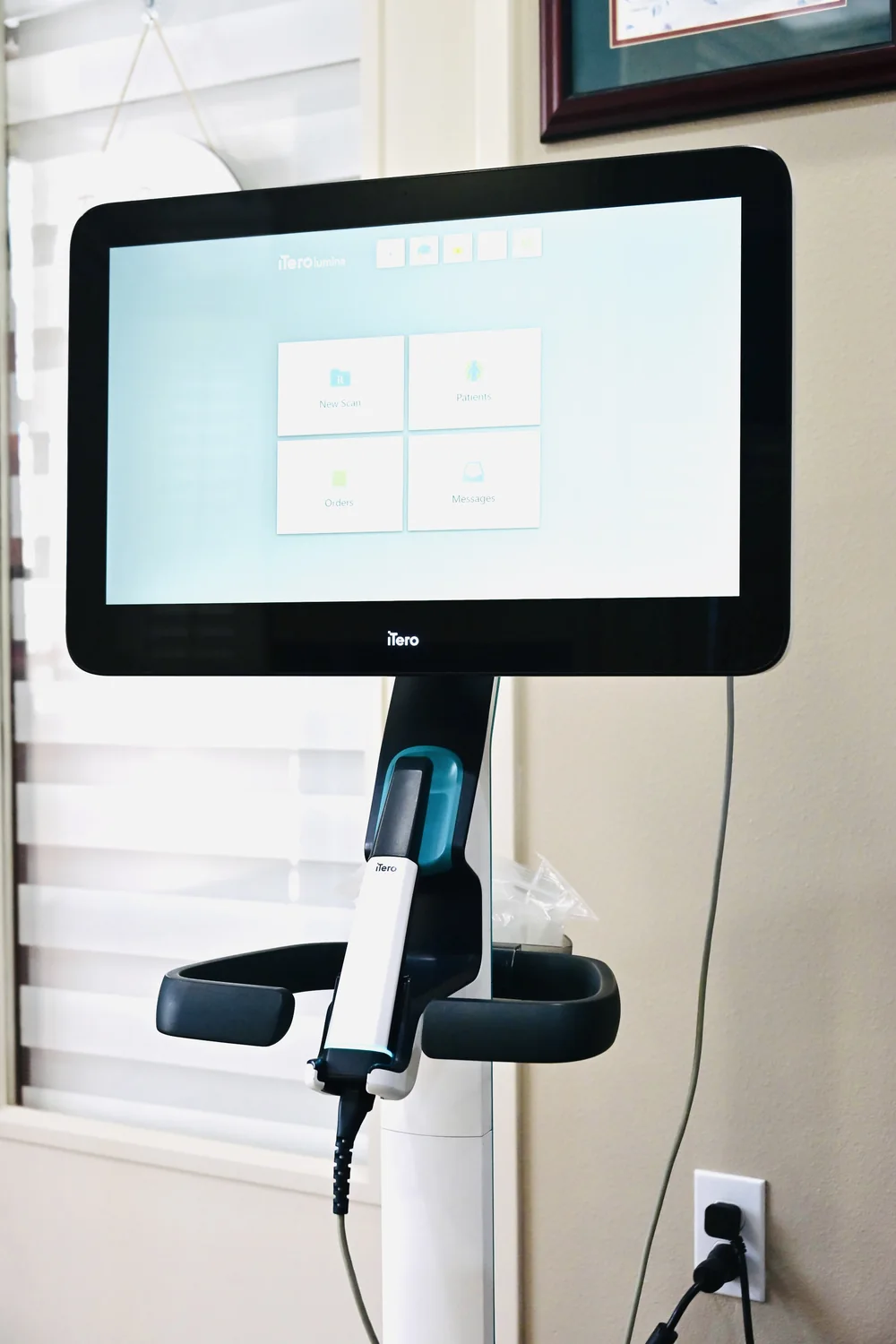
This is the scanner. The wand at the front is what goes around your teeth, and you can stop it at any point.
We still use traditional impressions for the few cases where a scan doesn’t work well. But for most people, most of the time, the thing you’re dreading isn’t part of the visit anymore. Here’s more on what we use.
A few other things help, too: sitting up more, breathing through your nose, working in shorter stretches, and being warned before anything goes near the back of your mouth. If you can’t breathe through your nose, that’s worth looking into on its own, because it affects a lot more than gagging.
Money is part of this too
For a lot of people, what looks like dental anxiety is really a fear of being sold something. Walking in with one problem and walking out with a huge treatment plan and a financing form.
Here’s how it works here:
- You’ll know the cost before anything starts, and you can turn down any part of it.
- Deciding to wait is a real decision, and we note it in your chart as one. Sometimes the timing just isn’t right, and if you understand what’s going on and choose to wait, that’s your call.
- Big cases can be done in stages over years. Several of the cases in our gallery were done exactly that way, taking care of what was urgent first and doing the rest as the budget allowed. If you’re on Medicare or a fixed income, here’s what’s realistic.
We’re also not in any insurance network, which is better to know before you schedule than after. If your plan has out-of-network benefits, you can still use them here, and we’ll file the claim for you. Here’s how it all works, including the one phone call that tells you what kind of plan you have.
You’re not the only one
A review that pooled nineteen studies covering 9,267 adults around the world found that about 18% have high dental anxiety. That’s roughly one in five people, and it’s the severe end, not just ordinary nerves.
Lesna M, Gorna K, Kwiatek J. High dental anxiety among adults worldwide: a systematic review and meta-analysis using the MDAS. Br J Clin Psychol. 2026. The estimate has a wide range, from 10% to 30%, and the studies varied a lot, so treat 18% as the middle of that range rather than an exact number.
Whatever the exact figure, there are probably several people in any waiting room dealing with the same thing you are, and most of them haven’t said so either.
Where to start
Pick the smallest step that feels doable:
- Call and talk it through without scheduling anything. 702-734-0776. Tell our team what worries you and ask whatever you want. They’ll help you figure out the right first step, and nobody will push you onto the schedule.
- Schedule a full exam when you’re ready, and tell us at the start which fears are yours.
If you’re in pain right now, skip ahead and call today. Here’s what to do in the first few minutes.
Our hours:
And if you’d rather read about what a first appointment involves before talking to anyone, it’s all written out here.