

The short answer
Those dark triangles are spaces where the gum between two teeth doesn’t reach all the way up to where the teeth touch. They often show up when significantly crooked adult teeth are straightened. For many people they’re no bother. If they bother you, small ones can usually be closed with bonding, with no tooth structure removed.
Why they show up
The little point of gum between two teeth is called the papilla. It only grows so tall. In most people its tip ends somewhere around 3 to 5 mm above the bone, and exactly where depends on your own gum and bone type, the way some people naturally have thicker gums or squarer teeth than others. That height can’t be stretched. So if the point where two teeth touch sits farther above the bone than your papilla reaches, a dark triangle shows below it.
The research lines up with that. In a well-known study, the gum filled the space almost every time when the distance from the contact point down to the bone was 5 mm or less. At 6 mm it filled it about half the time, and at 7 mm or more, about a quarter of the time. A later study found fuller papillae with thicker gums, squarer teeth and longer contacts between the teeth, and found the papilla gets slightly shorter with age.
Tarnow DP, Magner AW, Fletcher P. The effect of the distance from the contact point to the crest of bone on the presence or absence of the interproximal dental papilla. J Periodontol. 1992;63(12):995-996. Kois JC. Altering gingival levels: the restorative connection. Part I: biologic variables. J Esthet Dent. 1994;6(1):3-9. Chow YC, Eber RM, Tsao YP, Shotwell JL, Wang HL. Factors associated with the appearance of gingival papillae. J Clin Periodontol. 2010;37(8):719-727.
So anything that raises the point where teeth touch, or lowers the gum and bone below it, can open a triangle:
- Significantly crooked adult teeth that get straightened. Overlapped teeth often hid the space. Once they’re unraveled, it shows. This is the most common way we see them.
- Teeth that are triangular in shape, wide at the edge and narrow at the gum, touch only near the top.
- Gum and bone that have pulled back over the years, from gum disease or simply with age. Why gums recede →
What can be done
Nothing has to be done. Black triangles aren’t a health problem, and for many people they aren’t an issue at all. Some people just don’t like how they look, and then there are options.
- Bonding. Tooth-colored composite is added to the sides of the teeth so they meet lower and fill the dark space. Nothing is cut away, and it can be repaired or redone later. This is what we did for E.C., below.
- Invisalign with IPR, in the right situation. IPR, short for interproximal reduction, smooths a very small amount of enamel off the sides of the teeth where they touch. That changes the shape of the contact, and Invisalign then moves the teeth together so they meet lower, closer to the gum, and the space closes.
- Veneers or crowns. They can close the triangles too. But when the spaces are significant, the restorations have to wrap around to the tongue side of the teeth to fill them, so they end up being more like crowns than veneers.
- Rebuilding the gum itself. In our conversations with periodontists, regrowing a papilla is not very predictable, so it isn’t something we count on.
A case from our office: E.C.
Braces had straightened E.C.’s teeth but left dark triangular gaps near the gumline that showed every time she smiled big. Since the orthodontic work was already done, bonding filled those spaces without removing any tooth.
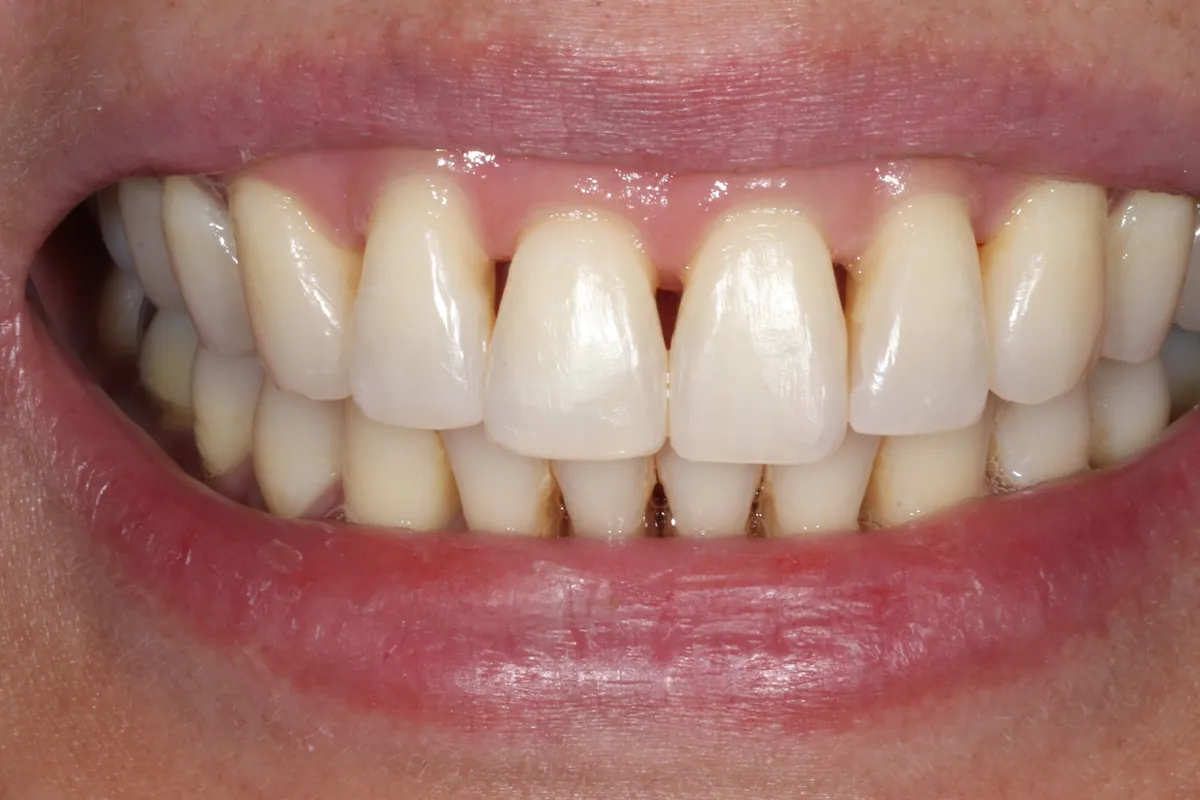
Before. Straight teeth, but dark triangles between them near the gums.
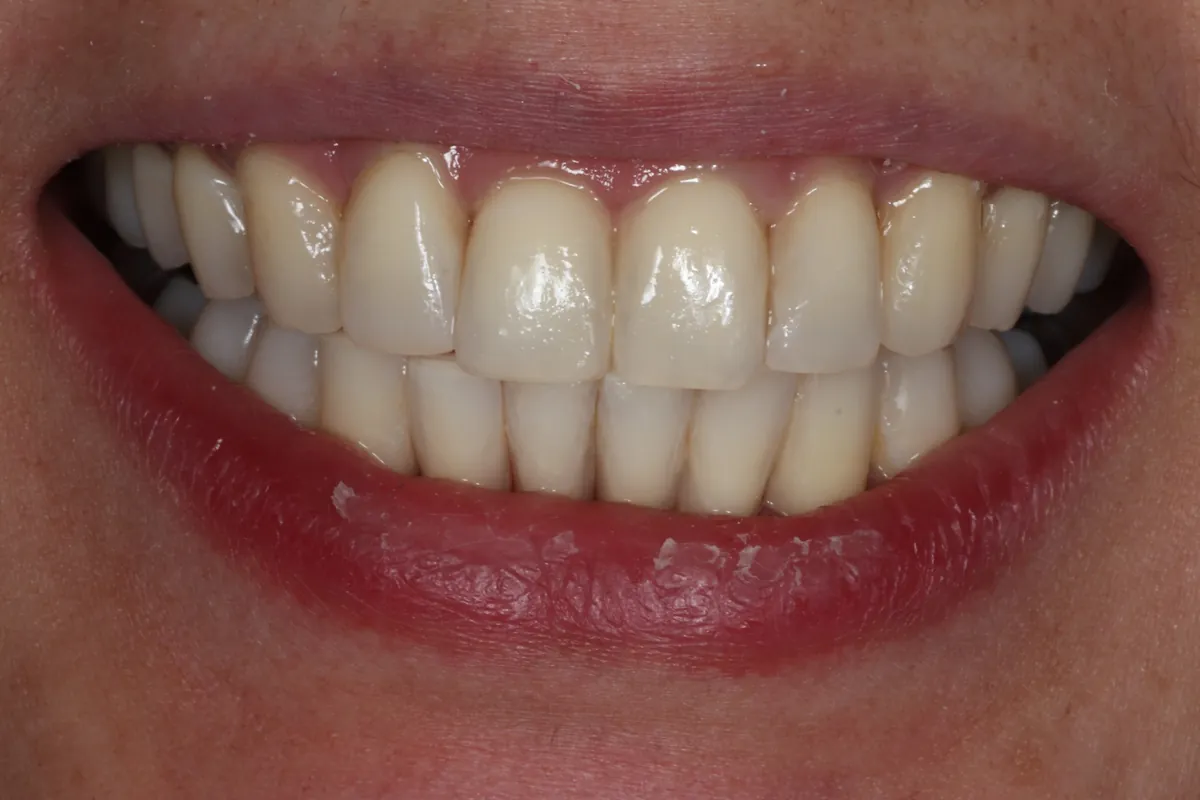
After. The spaces filled with composite bonding, with no tooth structure removed.
The full story: Dental bonding: chips, gaps and dark triangles and E.C.’s case in our gallery.
Chairside Q&A from Douglas Sandquist, DDS and Jeannie Lee-Mirzayan, DDS, Sandquist Dentistry, Las Vegas. More quick answers.