

Could myofunctional therapy help you? Our ten-question self-assessment takes under a minute, and nothing you check is sent anywhere.
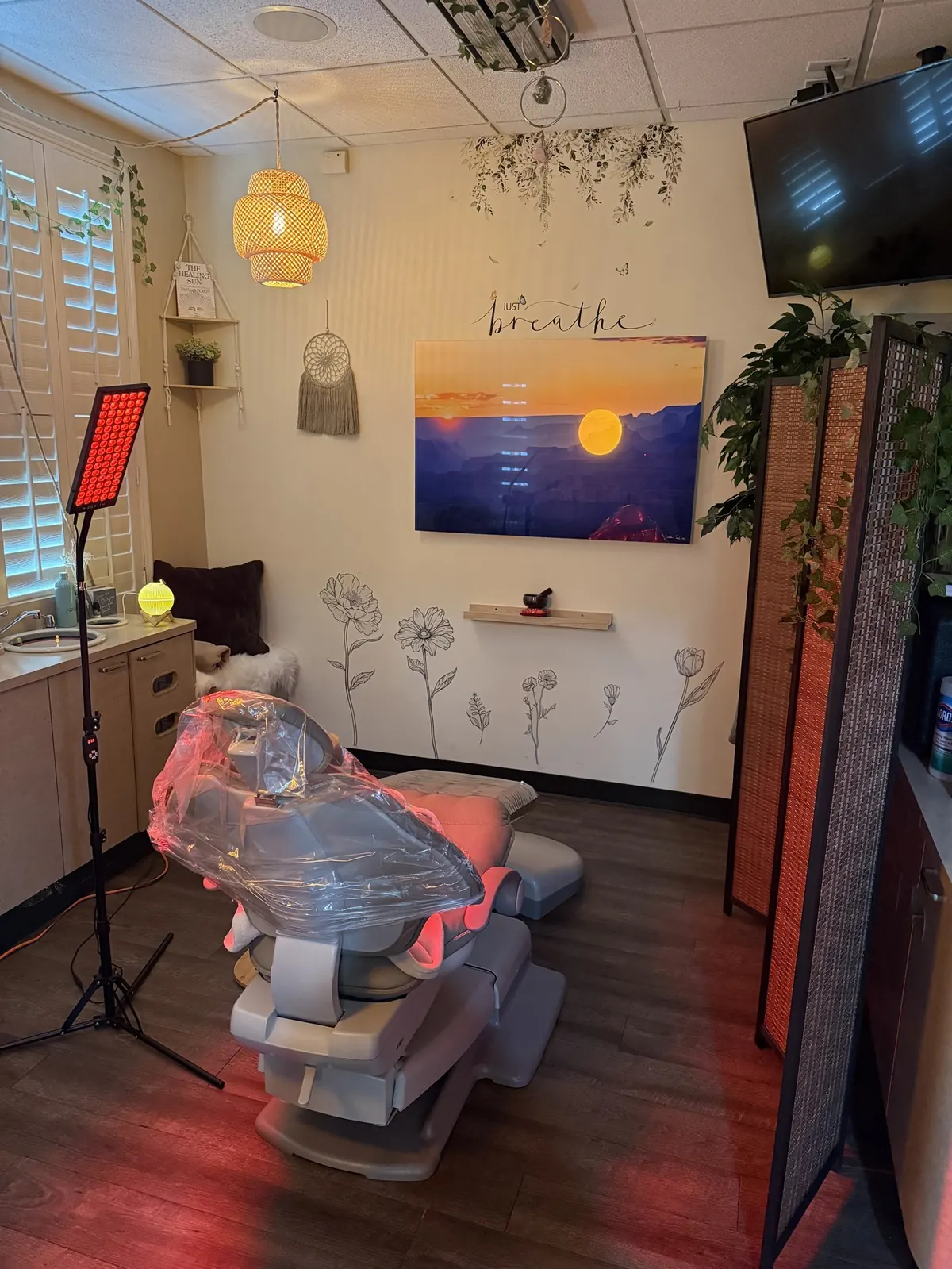
The sunset on the wall is one of Dr. Sandquist’s own landscape photographs. See more of his work →
Wondering if this could help you? Schedule a visit and we’ll start with what’s actually going on.
A card is needed to schedule online. Appointments missed, or cancelled with less than 24 hours’ notice, are charged a $75 fee.
What it is
Buccal massage is hands-on work on the jaw and face muscles, done with a gloved hand from inside the mouth as well as outside. The muscles we work on are the ones that close your jaw: the masseter along the angle of your jaw, the temporalis at your temple, and the muscles of your cheek. They fire every time you chew, swallow, clench, or tense up under stress, and you can’t reach them properly from the outside alone.
Why you need a diagnosis before an appointment
Jaw pain comes from one of two places, and buccal massage only reaches one of them.
Muscle pain comes from those closing muscles being overworked. Joint pain comes from the jaw joint itself: a displaced disc, arthritis, or some other structural problem. The symptoms overlap enough that you can’t reliably tell them apart on your own, and neither can we without examining you.
For a joint problem, this does very little. Not less than you’d hope. Very little. Every trial below was done in people with muscle pain, and there’s no evidence for using it on anything else. So the exam isn’t a formality before scheduling. It’s the step that decides whether the treatment has any chance of working.
We hold Botox to the same standard, for the same reason. Anything aimed at a muscle is only worth doing once we know the muscle is the source. Without that, a good session is a pleasant hour that changes nothing, and you’re no closer to knowing what’s wrong.
So in our office, we want a diagnosis of what the massage is for before anyone schedules one. It can look like a spa treatment, and it’s often sold as one. But it’s a therapy for specific conditions, and as clinicians we want a firm diagnosis before we deliver a therapy. Here’s how we figure out which kind of pain you have.
What the research supports
The published research studies a specific technique called intraoral myofascial therapy, which closely matches what buccal massage does: the same muscles, reached the same way. Three randomized trials have tested it in jaw pain coming from the muscles, not from the joint.
| Study | Patients | Design | Result |
|---|---|---|---|
| J Man Manip Ther 2010 | 30 | Pilot, 6 months | Both treatment groups did better than no treatment on pain at rest, opening and clenching, and on how wide people could open |
| JMPT 2012 | 93 | Randomized, 1 year | Both treatment groups did better than no treatment at 6 months and at 1 year. Therapy plus self-care beat therapy alone at 1 year |
| Chiropr Man Therap 2013 | 46 | Compared with education and self-care | Statistically better at 6 weeks, but not by a clinically meaningful amount. Better odds of a meaningful change |
Kalamir A et al., 2010, 2012 and 2013. All three trials come from the same research group in Sydney, all used a five-week course of two sessions a week, and all were in muscle-related jaw pain. That’s a real limitation, and we’d rather tell you than leave you to find it.
So here’s a fair summary. Hands-on work on the jaw muscles from inside the mouth does reduce muscle-related jaw pain, and the effect was still there a year later. It isn’t a miracle, the trials are modest, and one found that the advantage over simply teaching people to care for their own jaw was smaller than you’d hope.
What we’ve seen here
That’s the published evidence. What we see in our own patients covers a wider range than any trial average shows.
At one end, we’ve had patients whose muscle-related TMJ symptoms went away. Not reduced. Gone. At the other end, we’ve had patients who felt better for a while before the tension came back.
Both are real outcomes, and we can’t tell you ahead of time which one you’ll get. Both also assume the diagnosis was right in the first place.
Even temporary relief is worth more than it sounds, because it tells us something. If releasing the muscle helps even for a few days, the muscle was part of the problem. That points to the next step, which is usually figuring out why those muscles are overloaded, not scheduling more massage. Most often the answer is clenching, and it matters a lot whether you do it awake or asleep.
That’s why we think it’s worth trying early, before anyone suggests anything permanent.
The finding we pay the most attention to
In the largest and longest of those trials, the group that got hands-on therapy plus education and self-care exercises did better at one year than the group that got the therapy alone.
The massage helped. The massage plus the homework helped more, and the difference only showed up over the long run. That’s the most useful thing the research tells us, and it’s why we don’t offer buccal massage as a standalone treatment you schedule and forget.
It’s the same principle we use for breathing: the hands-on part opens things up, and retraining how things work is what makes it last. Myofunctional therapy is the homework we use here, and for a lot of patients the two go together. It’s also the most direct answer if your relief keeps wearing off.
If you saw it on social media
There, it’s almost always sold as a face-sculpting treatment, so here’s a straight answer to the question that brought you here.
None of the research above measured anyone’s face shape. Those trials measured pain and how wide people could open their mouths. There’s no good evidence that buccal massage contours or slims a face, and we’re not going to claim it does.
What is true: any deep massage causes a short-lived change from fluid shifting and muscles relaxing, and people do notice it in the mirror afterward. It’s real, and it’s temporary.
What’s also true, and more interesting: a masseter overworked by years of clenching really does get bigger, and you can see it. That’s a diagnosis, not a cosmetic complaint, and what’s worth treating is the clenching. If that muscle is working that hard, your teeth are taking the force too. It usually shows up on the teeth long before anyone connects it to the shape of the face.
If we brought it up with you
Then it came up while we were talking about your jaw or about myofunctional therapy, and it’s usually for one of these reasons:
- Sore jaw muscles, especially the kind that’s worst when you wake up.
- A jaw that feels tight or restricted, when the tightness is in the muscles and not the joint.
- Face and temple tension that comes with clenching.
- You’re already doing myofunctional therapy, where relaxing the muscles makes the retraining easier.
In every one of those, we’d already confirmed the muscle was the source before anyone mentioned massage. That order is on purpose, and we don’t reverse it.
How we use it here
Dr. Jeannie Lee-Mirzayan does buccal massage in our Zen Room, the same room where she does myofunctional therapy. She’s a dentist and a certified myofunctional therapist, which is why the two fit together here instead of being sold separately.
We treat this as part of a plan, not a service you schedule on its own. What the plan looks like depends on whether your pain is in the muscles, whether you’re clenching, whether your bite is playing a part, and whether there’s a habit underneath it. The exam answers those questions, which is why we’d rather find out first than start a series of appointments and learn it later.
Is this part of your plan?
Call us at 702-734-0776 or tell us what’s going on, and we’ll tell you honestly whether this is the right tool for what you’re dealing with. Sometimes the answer is no, and that’s a useful answer too.