

The short answer
Your implant hasn’t failed, and this is very common. Over time, a small gap can open between your implant crown and the tooth next to it, and that’s where food starts catching. It’s usually a straightforward fix, and it’s worth fixing sooner rather than later.
Why it happens: your teeth move, your implant doesn’t
A dental implant is fused directly to your jawbone. That’s what makes it so strong and stable, and it’s why an implant is still the best way to replace a missing tooth.
Your natural teeth are different. They sit in a cushioning ligament, and throughout life they slowly drift forward and shift with chewing. The movement is tiny, but it adds up over the years. The implant stays exactly where it was placed, so the tight contact it once had with the neighboring tooth can gradually loosen into a small gap.
Other reasons a gap can open
- Tongue habits. Your tongue is a strong muscle. If it rests low in the mouth or pushes against your teeth when you swallow, that gentle, constant pressure can move natural teeth over time. The implant stays put, so the space between them opens. This often goes along with mouth breathing.
- Gum or bone changes. The gum around an implant can shrink slightly over time, leaving a small triangle-shaped space near the gumline.
- Changes to the neighboring tooth. Wear, a new filling, or a new crown next door can change how the two teeth meet.
- Bite changes. As other teeth wear or shift, the forces on that area change too.
Why you shouldn’t just floss harder
Food that packs into that gap every day causes two problems.
- Decay on the natural tooth next door. Trapped food sits against the side of that tooth, right at the gumline, where cavities start easily. These cavities form between the teeth, where you can’t see them, and are often found only on X-rays. Left alone, a healthy tooth can end up needing a filling or a crown.
- Inflammation around the implant. Trapped food irritates the gum around the implant. Unlike a natural tooth, an implant usually gives no pain warning until a problem is advanced, and by then it can be much harder to save.
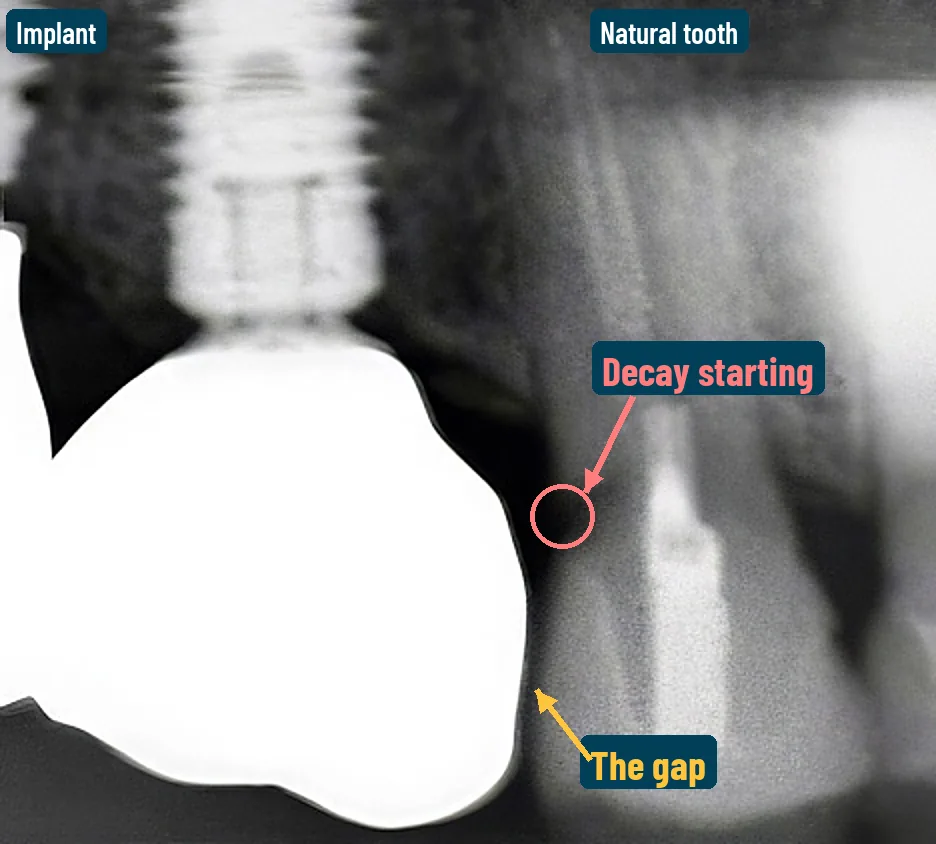
This is one reason we take regular X-rays of teeth next to implants, even when nothing hurts.
How we fix it
The fix depends on what’s causing the gap, and we’ll check with an exam and X-rays first.
- Adjusting the implant crown. Because we restore our patients’ implants, we can often remove the crown, add material to rebuild the contact, and put it back.
- Treating the neighboring tooth. Sometimes the better fix is a filling or crown on the tooth next door, especially if it already needs work.
- Replacing the implant crown. If the crown is older or worn, a new one can be made to fit the way your teeth sit today.
In most cases, none of this involves the implant itself, only the crown on top of it.
If tongue habits are part of the cause, closing the gap alone may not last, because the teeth can keep moving. In that case we may recommend our Airway & Function Assessment to look at how your tongue rests and how you swallow and breathe.
What to do in the meantime
- Clean the gap after meals. A water flosser or a small interdental brush reaches it better than floss alone.
- Don’t pick at it with toothpicks or sharp objects, which can injure the gum around the implant.
- Notice any bleeding, swelling, or a bad taste around the implant, and mention it to us.
If food has started catching around your implant, it’s worth having us take a look. It’s usually a simple fix, and catching it early protects both your implant and the tooth beside it.
The full story: Dental Implants and Dental Implants: The Best Way to Replace a Missing Tooth
Chairside Q&A from Douglas Sandquist, DDS, Sandquist Dentistry, Las Vegas. More quick answers.