

Receding gums are about too little gum. This is the opposite: too much gum showing when you smile, or front teeth that look short and square because part of each tooth is hidden. People call it a gummy smile. It isn’t one problem, and the fix depends entirely on what’s causing it.
The short answer: a gummy smile can come from the gums, the bone under them, the lip, the upper jaw, or the teeth themselves, and often from more than one at once. Before anyone trims gum, we need to know where the bone is. If only extra gum covers the tooth, a small gum-only trim can fix it. If the bone sits too close as well, trimming gum alone grows back, and the bone needs reshaping by a periodontist.
How much gum is too much?
Most people show a little gum when they really smile. A millimeter or two is considered normal. There’s no single cutoff for too much, but in studies of how people rate smiles, people who aren’t dentists started calling a gummy smile unattractive at around 3 to 4 mm. If it bothers you, that’s what matters.
Brizuela M, Ines D. Excessive Gingival Display. StatPearls. 2023. Kokich VO Jr, et al. Comparing the perception of dentists and lay people to altered dental esthetics. J Esthet Dent. 1999;11(6):311-324. Kokich VO, et al. Perceptions of dental professionals and laypersons to altered dental esthetics. Am J Orthod Dentofacial Orthop. 2006;130(2):141-151.
The different causes
- The gum never moved up. As adult teeth come in, the gum normally settles to just past where the enamel ends. Sometimes it stops short and covers part of the crown, so the teeth look short and square even though they’re a normal size. This is called altered passive eruption.
- The lip lifts high. Some upper lips rise more than most when you smile. In one study of people seeking treatment for a gummy smile, about 8 in 10 had a lip like that, on its own or along with extra gum.
- The upper jaw is long. When the jaw itself is taller than average, the gum shows evenly across the whole smile, and the lips may not close easily at rest.
- The front teeth have drifted down. In a deep bite, or as worn teeth slowly erupt to keep in contact, the teeth can bring the gum down with them. Why teeth get shorter.
- Swollen gums. Inflammation, and some medicines for seizures, blood pressure and organ transplants, can make the gums overgrow.
Often it’s more than one. In one study of women with a gummy smile, more than 4 in 10 had two or more causes at once. That’s why diagnosis comes before treatment.
Andijani RI, Tatakis DN. Hypermobile upper lip is highly prevalent among patients seeking treatment for gummy smile. J Periodontol. 2019;90(3):256-262. Amro LA, et al. Prevalence of different etiologies of excessive gingival display. ScientificWorldJournal. 2026:8869911. Seymour RA, et al. Drug-induced gingival overgrowth and its management. J R Coll Surg Edinb. 1993;38(6):328-332.
Extra gum, or extra gum and bone?
When the gum covers too much tooth, the next question is where the bone is. The gum needs a little room between its edge and the bone, a bit over 2 mm on average, and it grows back toward that distance after it’s trimmed. So before anyone trims gum, I numb the area and gently measure down to the bone. That one measurement decides who should do the treatment.
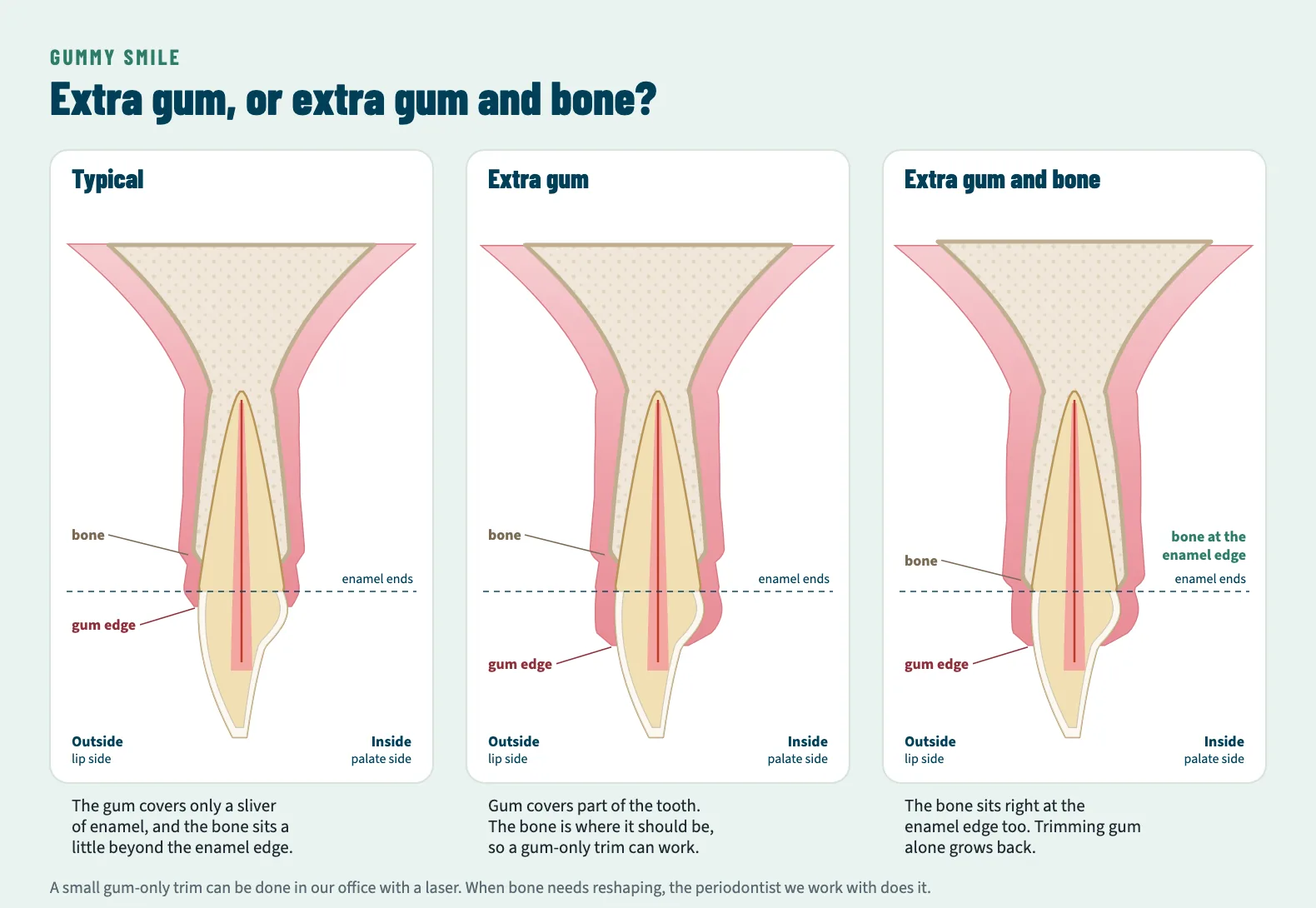
- If the bone is where it should be, a small gum-only reshaping can work. For small cases like that, I can do it here with our LightWalker laser.
- If the bone sits right at the edge of the enamel, trimming gum alone usually doesn’t last. After crown lengthening surgery, the gum has been measured creeping back about 3 mm over a year, and it creeps back more when it ends up close to the bone. Those cases need the bone reshaped, and I send them to the periodontist we work with. I don’t remove bone.
In studies, laser and scalpel gum reshaping give similar results. The laser usually means less bleeding. How long the result lasts depends more on the diagnosis than on the tool.
Schmidt JC, et al. Biologic width dimensions: a systematic review. J Clin Periodontol. 2013;40(5):493-504. Pontoriero R, Carnevale G. Surgical crown lengthening: a 12-month clinical wound healing study. J Periodontol. 2001;72(7):841-848. Deas DE, et al. Osseous surgery for crown lengthening: a 6-month clinical study. J Periodontol. 2004;75(9):1288-1294. Abdelhafez RS, et al. The use of diode laser in esthetic crown lengthening: a randomized controlled clinical trial. Lasers Med Sci. 2022;37(5):2449-2455.
When the lip is the cause
If your lip rises higher than most when you smile, the gum isn’t the main problem, and trimming gum won’t change how high your lip goes. Two options exist. Botox can relax the muscle that lifts the lip. In studies it softens a gummy smile within about two weeks and wears off over roughly six months, so it has to be repeated. Surgery can reposition the lip, but some of the effect tends to return, about a quarter of it within a year in pooled studies.
Zengiski ACS, et al. Effect and longevity of botulinum toxin in the treatment of gummy smile: a meta-analysis and meta-regression. Clin Oral Investig. 2022;26(1):109-117. Dos Santos-Pereira SA, et al. Effectiveness of lip repositioning surgeries in the treatment of excessive gingival display. J Esthet Restor Dent. 2021;33(3):446-457.
When the jaw is the cause
When the upper jaw itself is long, the answer is orthodontics, and for moderate to severe cases jaw surgery with an orthodontist and oral surgeon. No amount of gum trimming fixes a jaw.
Khojasteh A, et al. Orthognathic surgery for management of gummy smile. Dent Clin North Am. 2022;66(3):385-398.
Veneers and crowns come last
Veneers or crowns alone are the wrong answer when the gum or bone is the problem. Making the teeth longer at the biting edge to hide extra gum just makes them look too long. When teeth do need veneers or crowns, I wait for the new gum line to settle first, at least three months and often longer in the front of the mouth, so the edges of the new work land in the right place. How veneers are planned here.
Hempton TJ, Dominici JT. Contemporary crown-lengthening therapy: a review. J Am Dent Assoc. 2010;141(6):647-655.
How it works here
We start by finding out which causes are in play: photos of your smile at rest and in a full smile, the length and shape of the teeth, how high the lip moves, and where the bone sits. Small gum-only cases I can do with the laser. Anything that needs bone reshaping goes to the periodontist we work with, and jaw and bite problems to the orthodontist. Because many people have more than one cause, treatment often happens in steps, with any veneers or crowns last.
Where to start
If your smile shows more gum than you’d like, or your front teeth look short, call 702-734-0776. We’ll tell you what’s causing it and who’s best placed to fix it.
General education, and not a substitute for an exam.