

Some people have tried everything. Whitening strips, a tray from another office, the charcoal toothpaste a friend swore by. The teeth stay gray, or brown, sometimes with darker bands running across them, and nothing seems to move the color at all.
If that sounds familiar, and especially if it has been that way since you were a child, the cause is very often an antibiotic called tetracycline. It isn’t a stain on your teeth. It’s built into them, and that is why whitening barely touches it.
How an antibiotic ends up inside a tooth
Tetracycline and the drugs in its family bind to calcium. When they’re taken while teeth are still forming, they get built into the tooth along with the calcium, and they stay there for good. The color can be yellow, gray or brown, depending on the dose and the particular drug.
That window is the key. The drug label warns that tetracycline-class drugs taken during tooth development, which it defines as the last half of pregnancy, infancy and childhood up to age 8, can permanently discolor the teeth. So the person with the stained teeth usually didn’t do anything to cause it. The antibiotic was given to them as a young child, or to their mother while she was pregnant.
Because the drug went into the tooth as it formed, the color runs through the tooth itself, not just the surface.
“Isn’t that an old problem?”
Mostly, yes. Tetracycline came into use in 1948, and most people with this kind of staining were young children in the decades after that.
Two things still matter today, though.
- Short courses of doxycycline in young children don’t appear to stain. Doxycycline is in the same family. A CDC study looked at 58 children who had been given short courses before age 8, and found no tetracycline-type staining in any of them. That’s a question for your child’s pediatrician, but it’s reassuring if you’ve been worried.
- Adults aren’t completely safe from it. Minocycline, another member of the family often used long term for acne, has been reported to darken adult teeth that were already fully formed, sometimes toward blue-gray. If your teeth have changed color since you started a long course, tell us what you’ve been taking.
Why whitening disappoints
Whitening works best on everyday color: coffee, tea, wine and the slow yellowing of age. Our whitening article covers what it can and can’t reach. Tetracycline color is deeper than that, and it was put there as the tooth was built.
That doesn’t mean bleaching does nothing. In a small, long-running study at the University of North Carolina, people with tetracycline staining wore a whitening tray every night for six months. Their teeth did get lighter, and most still said the color had held when they were checked four and a half years later, and again seven and a half years later. But it took months of nightly wear rather than a couple of weeks, some people re-treated along the way, and the studies were small, with 12 to 15 people followed up.
Lighter isn’t the same as white. Bleaching can improve tetracycline teeth. It usually won’t make them look like teeth that were never stained, and the darker the gray and the more obvious the bands, the further there is to go.
Where we start
I don’t usually start tetracycline cases with bleaching. For someone who would like to try it first, KöR® whitening, which has a longer protocol built for tetracycline staining, is a reasonable attempt. The important part is going in with a clear idea of its limits: some improvement is realistic, the result varies from person to person, and it won’t always get as light as you’re picturing.
If the color still bothers you after that, or you’d rather go straight to a result you can count on, the answer is to cover it.
Covering the color: veneers and crowns
When whitening can’t reach the color, the other option is to put new, ceramic surfaces over the front teeth, either as veneers or as crowns. Which one fits depends on the teeth themselves, and that’s something we work out at the exam.
Composite bonding is an option too. Newer composites come in more opaque shades that can block much more of the gray than they used to. It’s very much a case-by-case decision, and my own bias is not to use bonding for tetracycline teeth. That doesn’t mean it can’t be done, and it’s a fair question to ask about.
T.C.: crowns, twenty years later
T.C. had tetracycline staining, and years of trying to whiten had only left his teeth duller and grayer. The color was inside the teeth, where bleaching couldn’t reach it, so we restored the upper and lower front teeth with ceramic crowns.
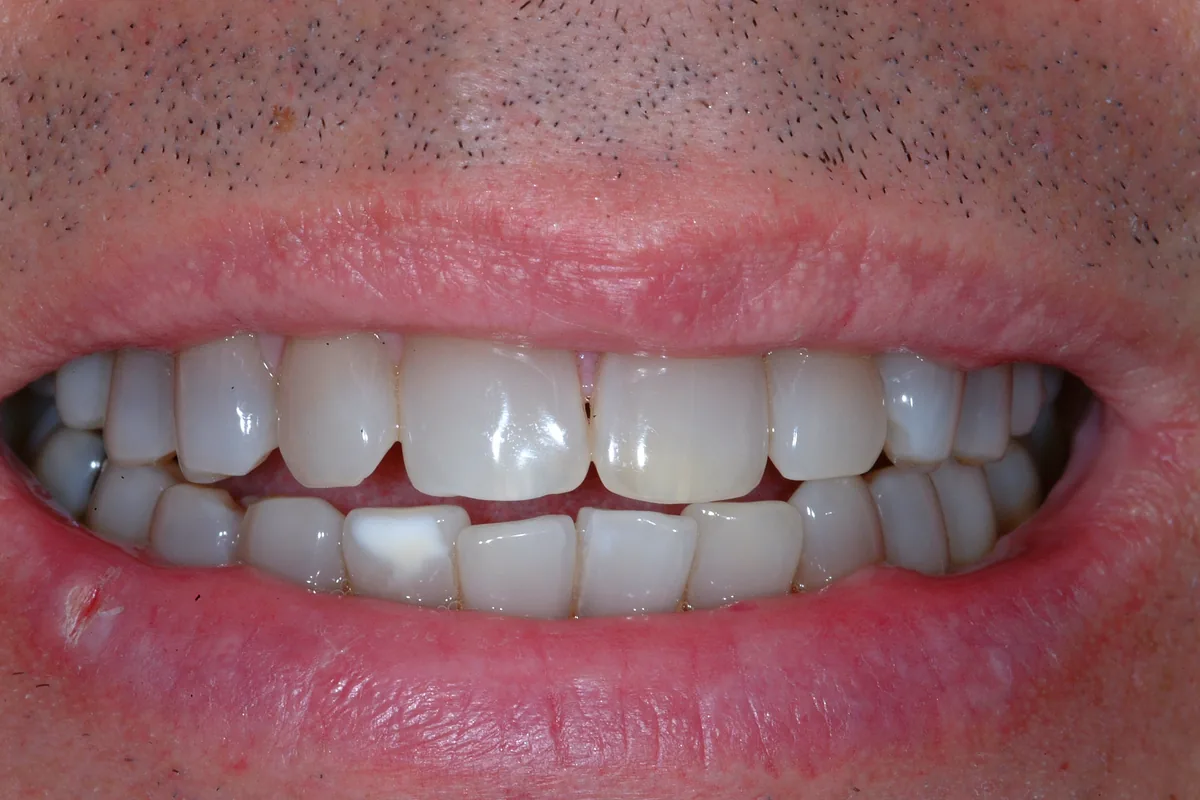
Before, in 2003.
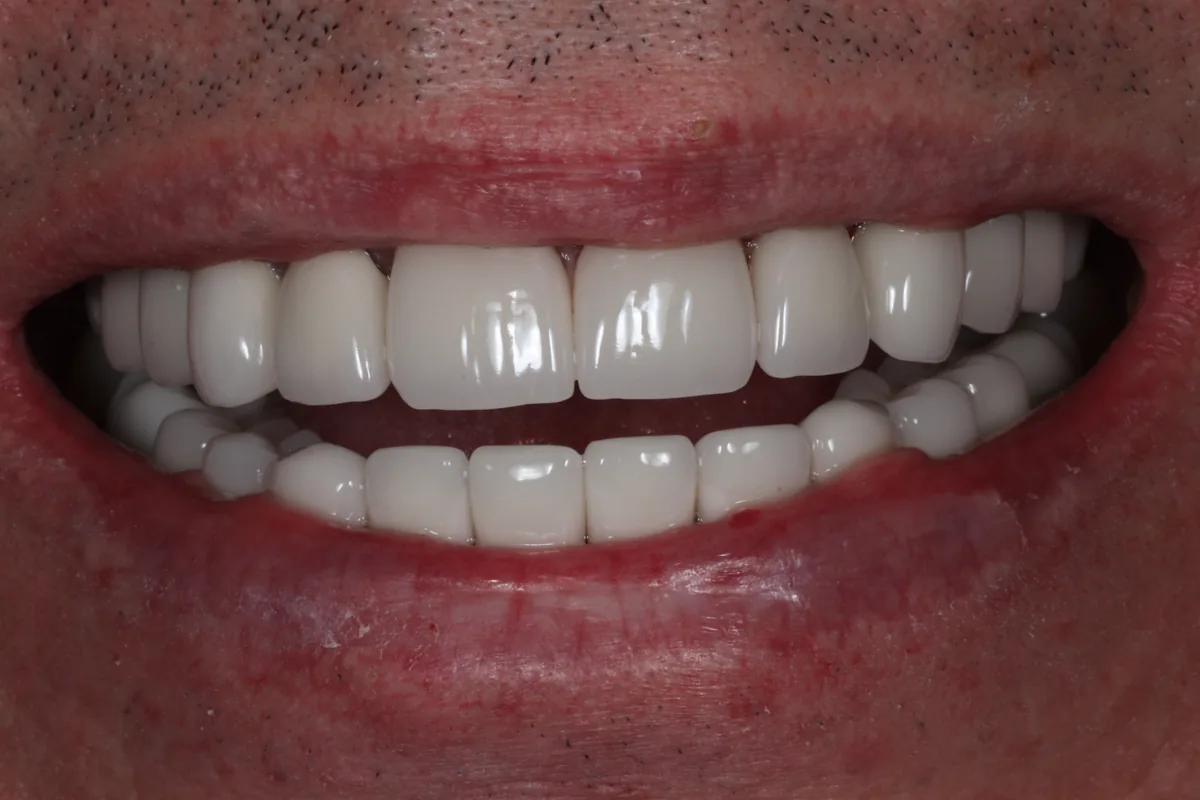
The same smile in 2023, twenty years after the crowns were placed, and the work is still doing its job. See T.C.’s case in the gallery.
C.S.: finishing what the top teeth started
C.S. had childhood tetracycline staining too, and his teeth were so dark that crowns were the right answer. I crowned his upper teeth first, but the lower teeth were still dark, and he’d spent years hiding them behind his lip. Crowning the lower teeth as well finished the smile, and he could finally stop hiding them.
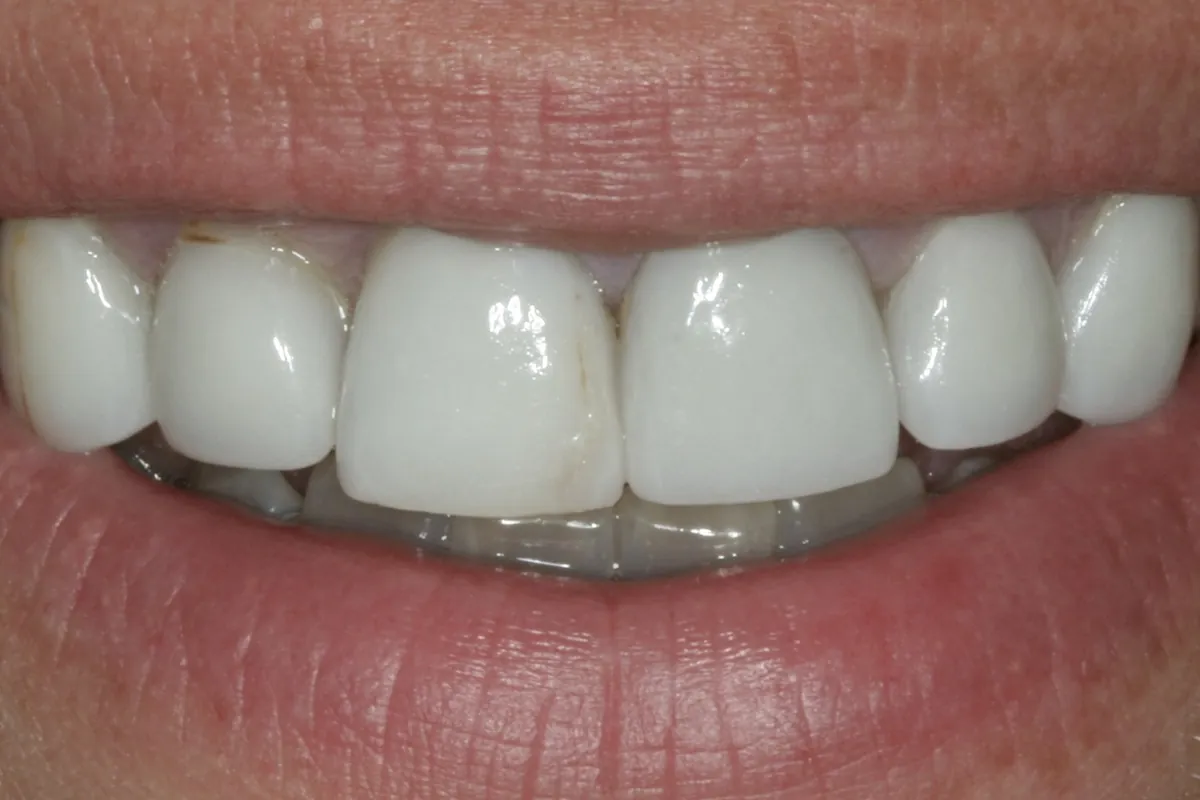
Before. The upper crowns were already in place. His lower teeth, still stained, stay tucked behind his lip.
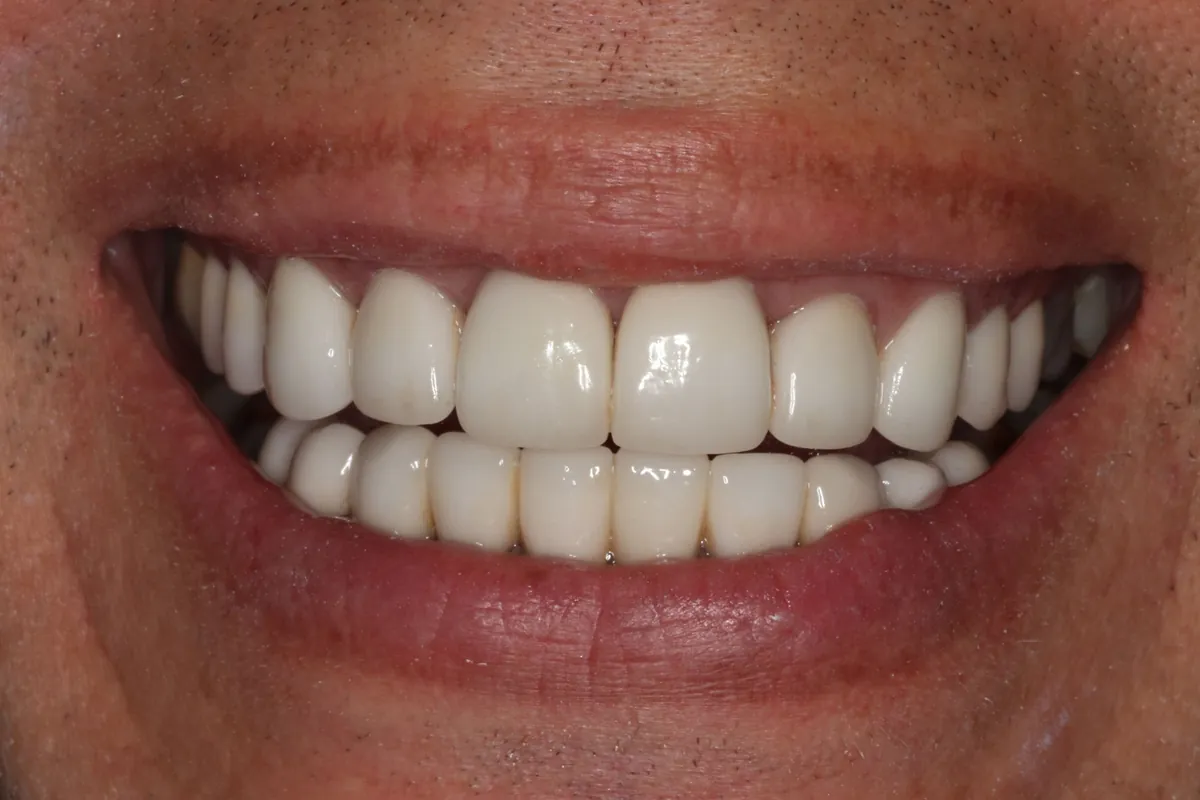
After. The lower teeth now match, and he shows them when he smiles. See C.S.’s case in the gallery.
His case makes a point that’s easy to miss when planning. The lower teeth show every time you talk. Fixing only the top teeth can make the ones below look darker by comparison, so it’s best to decide at the start how far the treatment should go.
What we would actually do
- Confirm what the color is. Tetracycline staining has a look of its own, but so do fluorosis, old injuries and teeth darkened after a root canal, and each is handled differently. When it’s just one tooth turning gray.
- Talk about what you want to see. Somewhat lighter, or a smile nobody would guess was ever stained. The answer decides the plan.
- Decide how far to go. Which teeth show when you smile and talk, top and bottom, so nothing stands out afterward.
- Choose the approach. A whitening attempt with clear expectations, bonding in the right case, veneers or crowns, or whitening first and then restorations on the teeth that need them.
Worth bringing up
If your teeth have been gray or banded for as long as you can remember, and whitening hasn’t moved them, you’re not doing it wrong. Bring it up at your next visit. Call 702-734-0776 or tell us what’s going on.
Tooth development window from the FDA-approved tetracycline hydrochloride label (Warnings: Tooth Development). Sánchez AR, Rogers RS, Sheridan PJ. Tetracycline and other tetracycline-derivative staining of the teeth and oral cavity. Int J Dermatol. 2004;43(10):709-715. Todd SR et al. No visible dental staining in children treated with doxycycline for suspected Rocky Mountain spotted fever. J Pediatr. 2015;166(5):1246-1251 (58 exposed children, 0 with staining). Leonard RH Jr et al. Nightguard vital bleaching of tetracycline-stained teeth: 54 months post treatment. J Esthet Dent. 1999;11(5):265-277; and 90 months post treatment. J Esthet Restor Dent. 2003;15(3):142-152 (six months of nightly 10% carbamide peroxide; 12 and 15 participants followed up). General education, and not a substitute for an exam.