

A dark line at the top of a crown, right where it meets the gum, is one of the most common things people point to when they smile in the mirror. On an older crown it’s almost always the same thing: the metal the crown was built on. Whether it’s worth doing anything about depends on which of two things you’re seeing, and on what the crown is made of.
Crowns used to be built like the old bathtubs
Think of the old footed bathtubs: cast iron underneath, with porcelain fused over the top. For decades most crowns were made the same way. A thin metal shell fits over the tooth, and porcelain is baked onto it. Dentists call it porcelain fused to metal. It’s strong, and plenty of these crowns have done their job for many years.
The catch is that the metal is always there. As long as it stays hidden, nobody notices. The dark line is what it looks like when it stops being hidden.
Two ways the metal shows
The collar itself. Many of these crowns have a thin band of metal right at the edge, where the crown meets the tooth. When the crown was new, that edge sat under the gum. It usually starts showing after some gum recession: the gum pulls back a little over the years, and the band that was tucked out of sight is now at the surface, as a gray or black line.
A shadow. Sometimes no metal is visible at all, and the gum edge still looks dark. That’s a shadow. A natural tooth lets light pass through it, and that light also illuminates the root just under the gum. Metal blocks it. With no light coming through the crown, the root behind it stays dark, and so does the gum line in front of it.
Either way, the cause is the same. It’s the metal.
What it looked like for one of our patients
C.J. had two old crowns on his upper front teeth. You can see the metal collars at the gum line in his before photo.
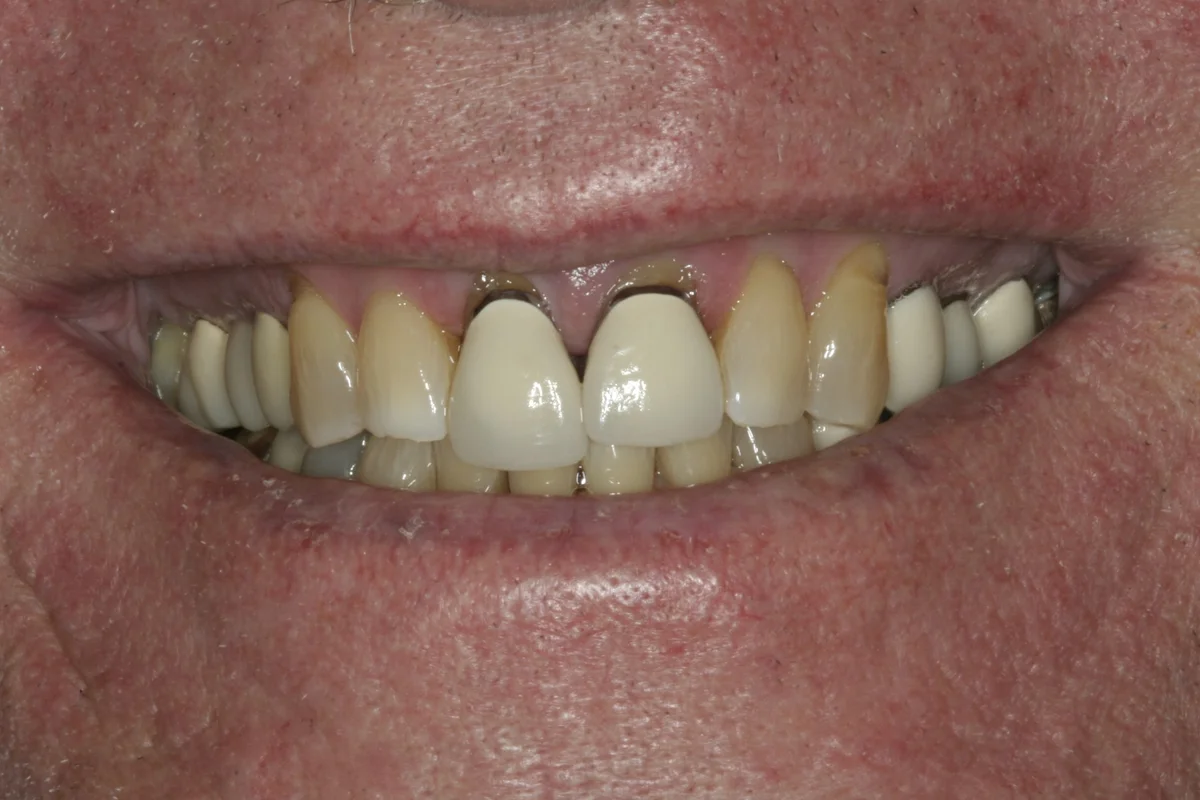
We replaced them with all-ceramic crowns, which have no metal at all, so light passes through them the way it passes through a tooth. While we were at it, he decided to have six upper teeth and seven lower teeth done.
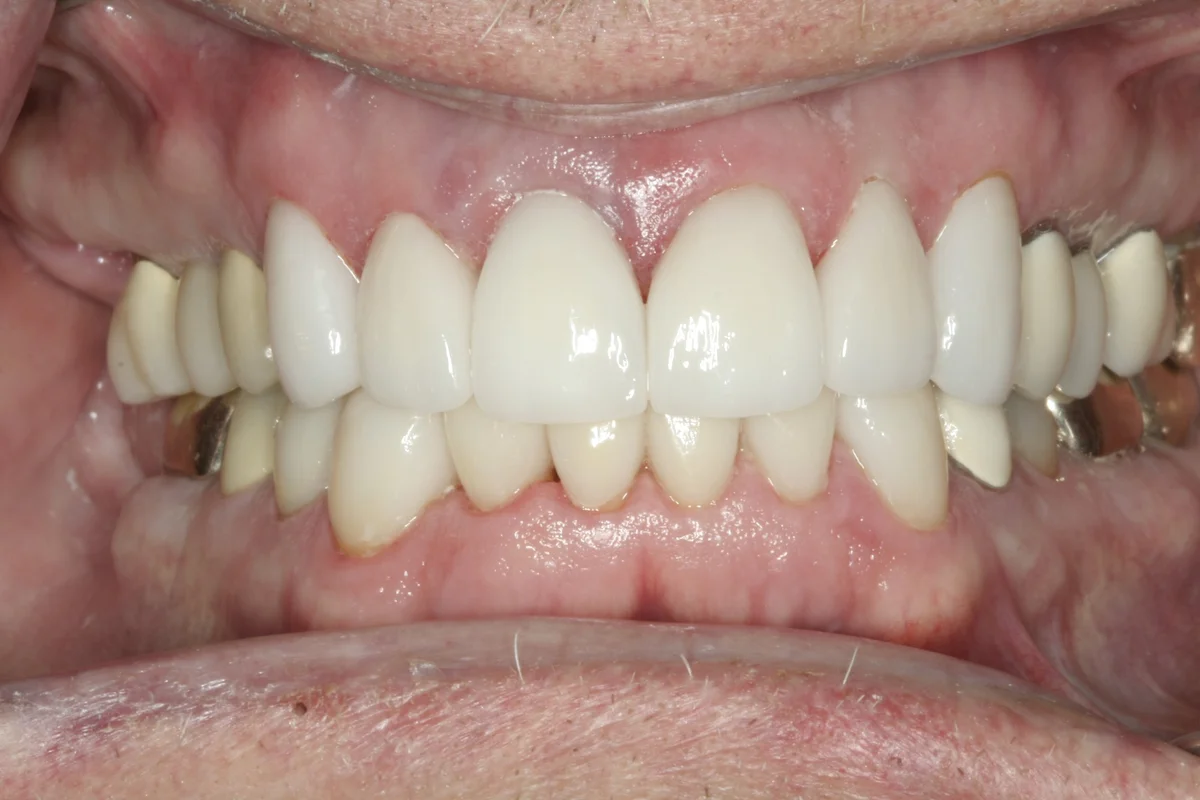
See C.J.’s before and after in our gallery.
When a crown with no metal gets a dark line
All-ceramic crowns can show a black line too, but it means something different. There’s no metal to show through, so a dark line usually means there’s a problem with the seam, the margin where the crown and the tooth meet.
That’s worth having looked at, and it isn’t the same conversation as a metal collar. A metal collar showing is mostly about how it looks. A problem at the seam of a crown is about the crown and the tooth underneath it.
Not always a new crown
If it’s caught early and the area is small, sometimes a small composite repair can be done right at the edge of the crown instead. That’s case by case, and we’ll tell you at an exam whether yours is a candidate. For C.J., replacing the crowns with all-ceramic ones was the answer.
How to tell which one you have
Most people don’t know what their crowns are made of, especially if someone else placed them years ago. That’s fine. We can tell at an exam, and we’ll tell you which of these you’re looking at: a collar, a shadow, or a seam that needs attention.
A dark line on an old metal-based crown isn’t an emergency. Nobody has to replace a crown because of how the edge looks. But if it bothers you, it’s a perfectly good reason to ask, and if the crown has no metal in it, it’s a reason to get it checked.
Call 702-734-0776 or tell us what’s going on. More on how we make crowns, and on what wears out porcelain over time.