

Patients arrive in our office having been told that a dental implant will be just like their own tooth. It’s a comforting sentence, and it isn’t true.
Here’s the honest version, and it has two halves that both matter. An implant is not a tooth and never will be. And for the right patient it is a genuinely excellent answer, often far better than what they were living with.
Both of those need saying, because a patient who only hears the first one turns down care they need, and a patient who only hears the second agrees to an extraction they might not have needed.
Nothing we make is a tooth
This is worth sitting with, because it reframes the entire field.
Dentistry does two things: it helps you keep the teeth you have, and it restores what’s already been lost. Everything in the second category is a replacement for absence, not a replacement for a tooth.
A crown doesn’t replace your tooth. It replaces the tooth structure that broke away, wrapping what’s left. A filling replaces the volume decay removed. And a denture, which is the clearest case, does not replace teeth at all. It replaces the condition of having none. That’s a prosthesis for a state of loss, in the same way a prosthetic limb is. Nobody calls that a replacement leg.
Implants sit in the same category. An implant is a titanium fixture placed into bone, with a crown attached on top. It occupies the space where a tooth used to be and does much of what a tooth did. It is not a tooth growing back.
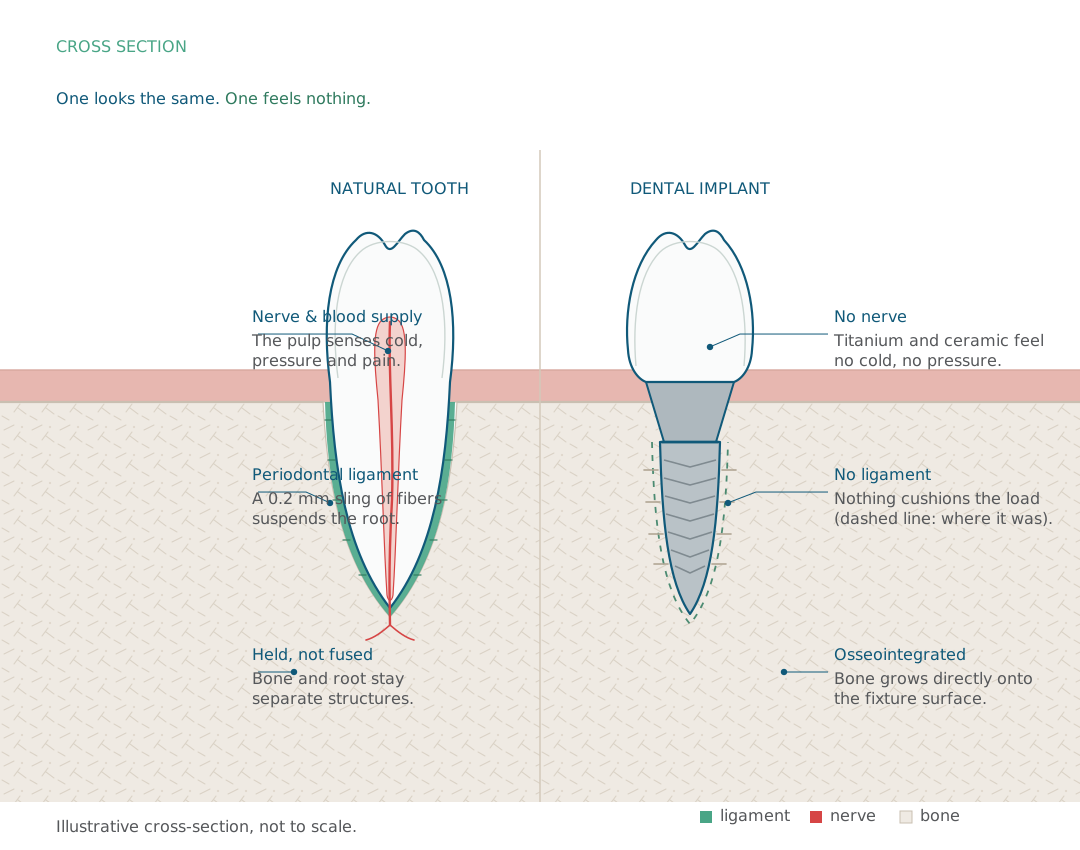
A natural tooth is held in bone by a ligament and carries a nerve inside it. An implant is fused straight to the bone, with neither. The dashed line marks where the ligament used to be.
What’s actually missing: the ligament
The difference isn’t cosmetic, and it isn’t really about the materials. It’s about two structures most people have never thought about. The first is one most patients have never heard of.
A natural tooth is not fixed to your jaw. It’s suspended in it, by a periodontal ligament — a thin layer of fibers holding the root in its socket, letting the tooth move microscopically under load. That ligament is packed with mechanoreceptors. It’s a sense organ.
That’s what lets you feel a popcorn shell wedged between two teeth: something almost too small to see, and impossible to think about anything else until it’s out. It’s why you can tell that a filling is a hair too tall the moment you bite down. And it’s continuously feeding your nervous system information about how hard you’re biting and in what direction, so your jaw muscles can adjust before you damage something.
An implant has none of this. It fuses directly to bone. That’s osseointegration, and it’s what makes implants work at all. But bone has no ligament, and the sense organ doesn’t come back.
You can measure the difference. Studies of tactile sensitivity find natural teeth detect a thickness of roughly 16 microns between the teeth; implant-supported restorations, around 23; complete dentures, around 64. On the force side, the gap is wider: natural teeth register loads at roughly 0.1 to 1 newton, implants at 1 to 10.
Read that carefully, because it tells you two things at once. Implants perform much closer to natural teeth than dentures do. And your ability to sense how hard you’re biting is roughly ten times coarser than it was.
What’s actually missing: the nerve
There’s a second sensory system inside the tooth itself.
The pulp, what most people call the nerve, sits in the chamber at the center of a tooth. It’s the reason a tooth aches when decay gets deep, twinges on something cold, or throbs when it’s cracked. That’s not a design flaw. It’s an alarm, and it’s the reason most dental problems get caught while they’re still fixable.
An implant has no pulp. It cannot hurt, because there’s nothing in it capable of hurting.
That sounds like an advantage, and patients are sometimes sold it as one. It’s better understood as the loss of a warning system. When an implant develops a problem, whether the bone around it is receding or the fixture is starting to fail, there is usually no pain to announce it. It’s found on a radiograph at a checkup, or when something loosens, and by then it has been progressing quietly for a while.
This is also why a root canal is not the same thing as losing a tooth. A root-canal-treated tooth has lost its pulp, so the alarm is gone. But the ligament is still there, still holding the root, still feeding your brain information about your bite. That tooth is diminished. It is nowhere near as diminished as an empty socket.
So the full accounting: a natural tooth has a ligament and a nerve. A root-treated tooth has the ligament. An implant has neither.
Why patients adapt anyway, and often love the result
Here’s what makes dentistry possible at all: people adapt. If they didn’t, none of this would work.
The adaptation is real and it’s been imaged. Stimulate an implant and the sensory cortex responds; the brain reorganizes around the new arrangement, drawing on receptors in the surrounding bone, the periosteum, the jaw joint, the muscles and the mucosa to reconstruct a usable sense of where your bite is. The phenomenon has a name, osseoperception, and it’s why a well-made implant stops feeling like a foreign object within months.
But adaptation isn’t only tolerance. Very often it’s relief.
We’ve had denture patients elated. Not because a denture is equivalent to teeth, but because years of pain ended. One of our patients, J.D., lived nearly twenty years with a collapsed bite and periodontal disease after old dental work changed her bite. When we finally rebuilt her mouth on implants, the result wasn’t a downgrade from her natural teeth. Those were long gone. It was an enormous upgrade from what she’d actually been living with. She’s pain-free and back to singing with her sisters.
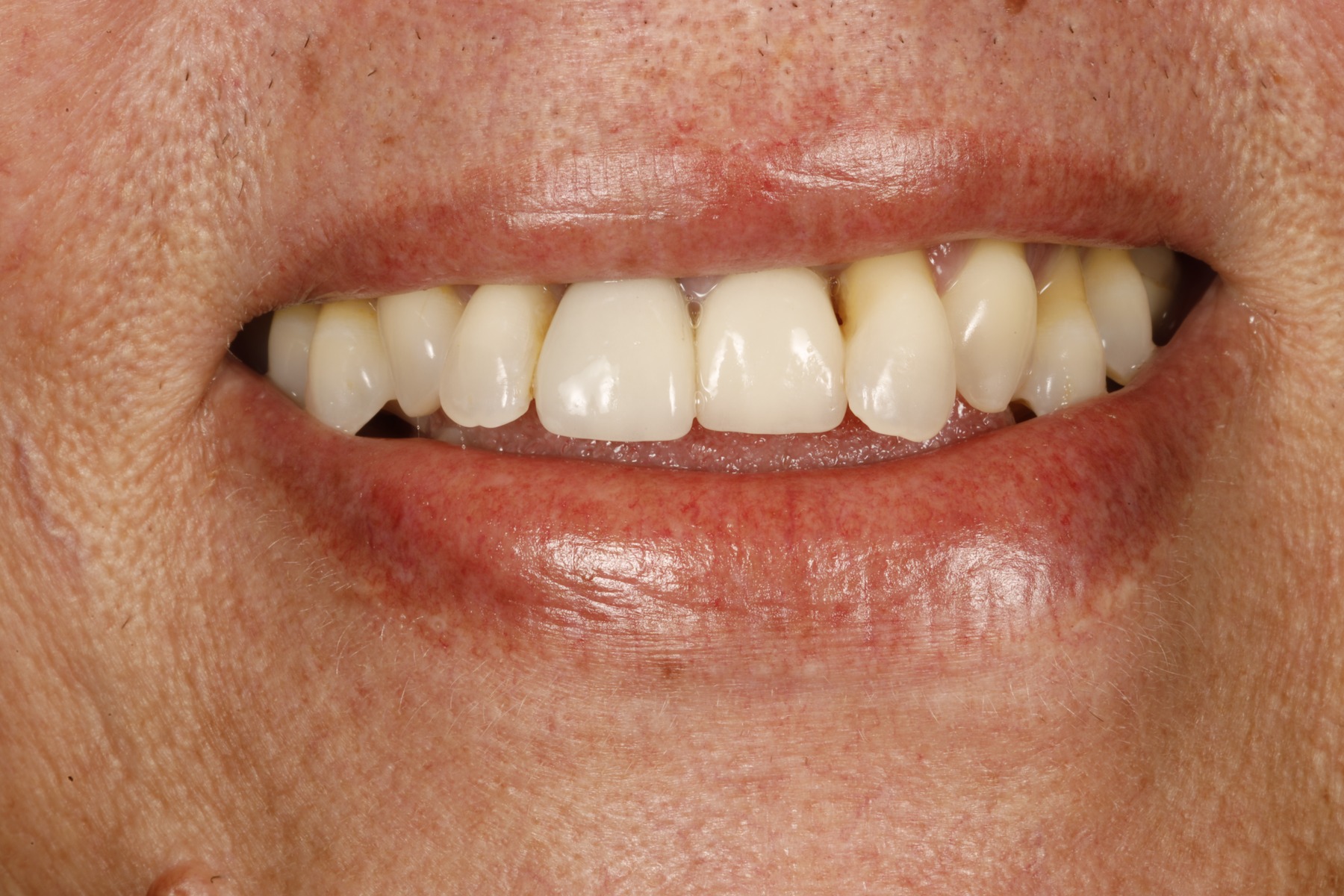
Before. This is the comparison that mattered to her, and it isn’t a healthy natural tooth. It’s what twenty years of a failing bite had left her with.
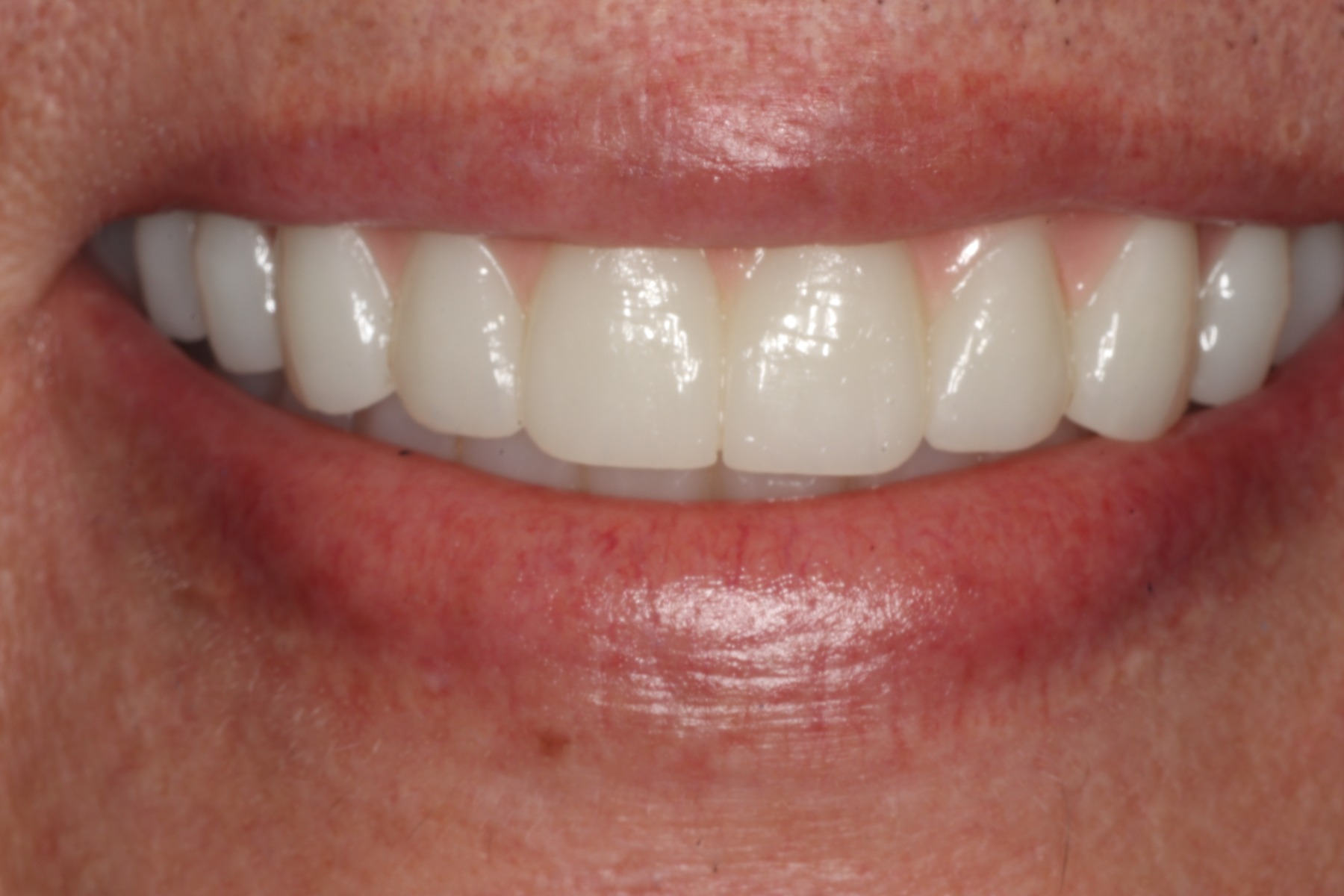
After. Rebuilt on implants, working with periodontist Dr. Ryan Gifford and lab technician Justin McElroy. Not the teeth she was born with, and far better than what she had been living with.
Badly worn, sensitive teeth are frequently easier to adapt to once they’ve been restored, simply because they no longer hurt and they chew comfortably again. The nervous system accepts what’s better.
So the sentence “nothing we make is as good as a tooth” is true and also, by itself, misleading. It’s only the right comparison when the tooth is still there.
The comparison that actually matters
Which brings us to the decision in front of you.
If the tooth is already gone, the comparison is implant versus absence, and an implant usually wins that outright. Better than a gap, better than a removable partial, better for the bone, better for the teeth on either side. If you’re in that situation, this article isn’t a warning. It’s an explanation of what you’re getting.
But if the tooth is still in your head and someone is proposing to remove it, the comparison is completely different. And that’s the conversation the “just like your own tooth” line quietly closes off. If an implant were equivalent, a borderline tooth would be an easy call: take it out, put one in. Because it isn’t equivalent, that borderline tooth deserves a serious attempt first.
There are a few other things that go unmentioned when an implant is sold as a permanent solution:
- Implants don’t get cavities, which is true and often used to close the deal. What follows it usually isn’t said: they get peri-implantitis, which is inflammation and bone loss around the fixture. And with no pulp to complain about it, that usually turns up on an X-ray rather than as pain.
- A natural tooth keeps adjusting for life. It shifts microscopically as your bite changes over decades. An implant is fixed at the position where it was placed, in a mouth that goes on changing around it.
- “Permanent” describes the fixture, not the restoration. Screws loosen, porcelain chips, crowns wear. Implants need maintenance like anything else.
None of this makes an implant a bad choice. It makes it a choice with terms, and you’re entitled to know them before a tooth is removed rather than after.
Where we stand
None of this makes saving the tooth automatically the right call. We’ve had patients fight to keep a broken-down tooth and get several more good years out of it before an implant was finally needed, and they were glad to have them. We’ve had others where the effort bought far less time, and in hindsight the extraction should have come first. We can’t always tell in advance which one a given tooth will be, and anyone who tells you they can is more confident than the evidence supports.
Knowing that, some patients would rather go straight to the implant and be done with it. That’s a legitimate choice and we don’t argue with it. What matters is that it’s made by someone who understands what they’re trading, not someone who was told an implant is the same as a tooth.
The first question we ask about any questionable tooth isn’t which implant system to use. It’s whether this tooth can be kept, and if it can’t, why not, and whether the reason it failed is going to affect the next one.
Because the one comparison you never get back is the healthy tooth against the prosthetic. Keep the tooth and you keep the ligament, the feedback, the thing that can’t be manufactured. Lose it and the comparison becomes prosthetic versus absence for the rest of your life — a comparison you can absolutely win, but a different game entirely.
If you’ve been told you need an implant and nobody has explained what you’d be trading, call us at 702-734-0776. We’ll give you a straight answer about whether that tooth can be saved.